

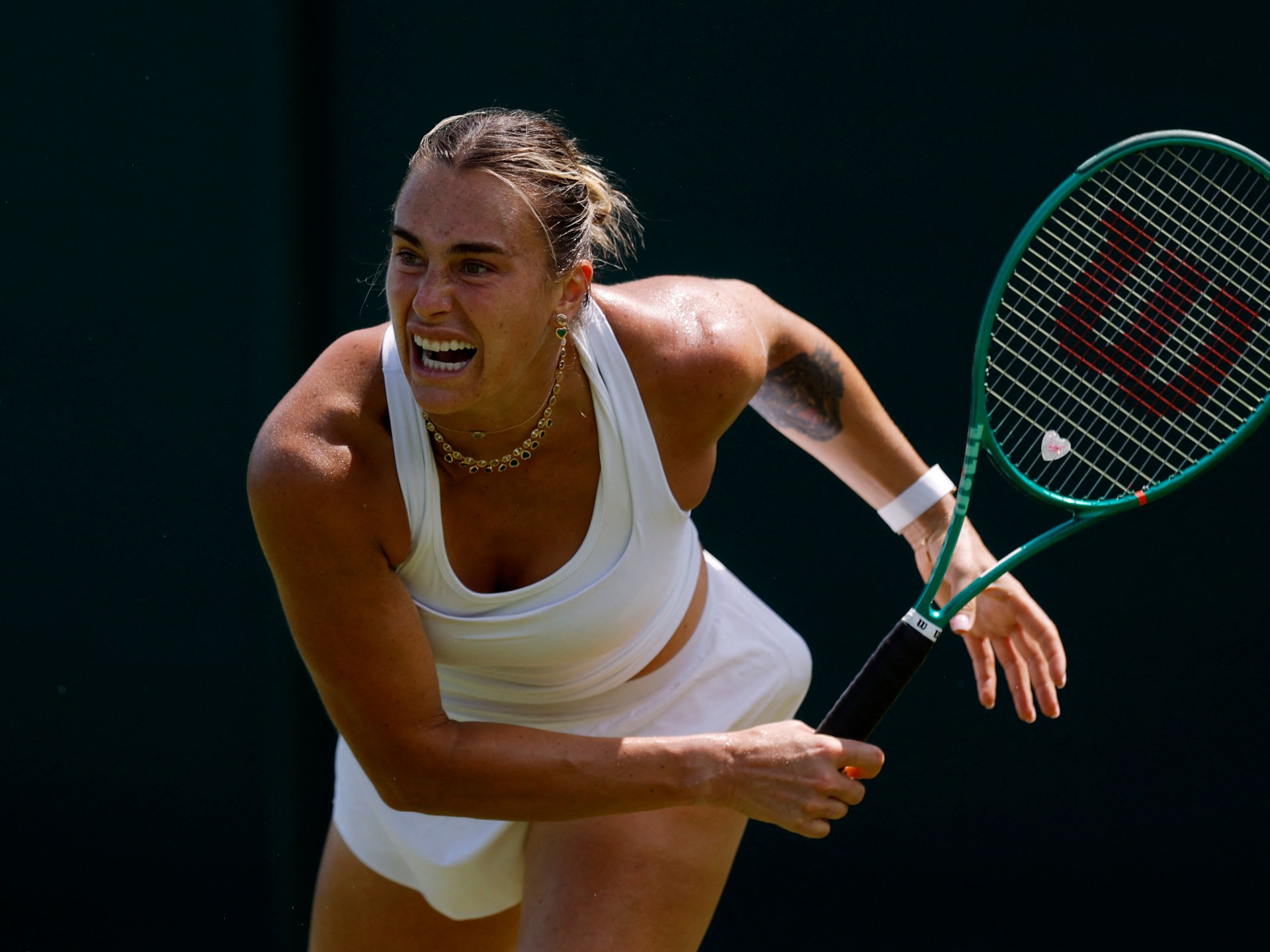
The world number one belongs to a group of players seeking bigger prizes at the Grand Slams.
Published June 27, 2026
Wimbledon top seed Aryna Sabalenka has defended the prize money protests by leading players, even though the grass-court Grand Slam has increased its pot by a record 20 per cent this year.
The world number one is part of a group headed by former WTA chief executive Larry Scott, who is calling for an expanded Grand Slam pie and improved player welfare.
Recommended stories
list of 4 itemsend of list
Wimbledon’s 64.2 million pounds ($84.7 million) in prize money this year represents about 15% of the tournament’s revenue, falling short of the 16% of the 70 million pounds ($92.4 million) the players were seeking.
The Belarusian held a shortened press conference, similar to the French Open at Roland Garros, where Sabalenka and others protested and restricted pre-tournament press operations.
“It’s a great start. They raised the prize money. It’s a great start. If you look at the last 10 years, if you compare the prize money to 2016, it’s kind of the same (percentage-wise) because the prize money went down,” she told reporters.
“I really hope that we can finally come to the table and really get it done and come to a conclusion that everyone is happy with. Hopefully, we never have to go through something like this again.”
Sabalenka’s first Wimbledon win would earn her £3.6 million, more than the £3 million paid to 2025 champions Iga Swiatek and Jannik Sinner.
The first-round loser will be paid between £66,000 ($87.1 million) and £80,000 ($106,000).
Asked if he thought complaints from top players facing rising ticket and food prices would be unacceptable given that many of them are millionaires, the four-time Grand Slam singles champion said: “We’re doing it for the tour, we’re not doing it for ourselves.”
“We do it for the rest of the players who are facing difficulties even in hiring a coach. For players in the lower ranks, it’s not an easy life.”
“I’m sure the crowd understands. I mean, we’re playing the game, we’re there, we’re competing, we’re bringing the show. Right now, we’re just limiting the media. We’re just trying to get to something that everyone is happy with.”
The All England Club said this week that it was “surprised and disappointed” by the protests and that its players’ council proposals to resolve the issue had been rejected. “This year’s prize pool is the largest increase in the history of the event.
This comes alongside investing hundreds of millions of pounds in upgrading player facilities as part of a three-year transformation to create a world-class player performance environment. ”
Sabalenka, 28, arrived at Wimbledon lacking confidence after a crushing defeat at Roland Garros, where she faced Russia’s Diana Schneider in the quarterfinals, and lost her last 10 matches.
She said she has now recovered from the situation with the help of a psychologist.
“Overall, it feels like things are getting back on track.”
