

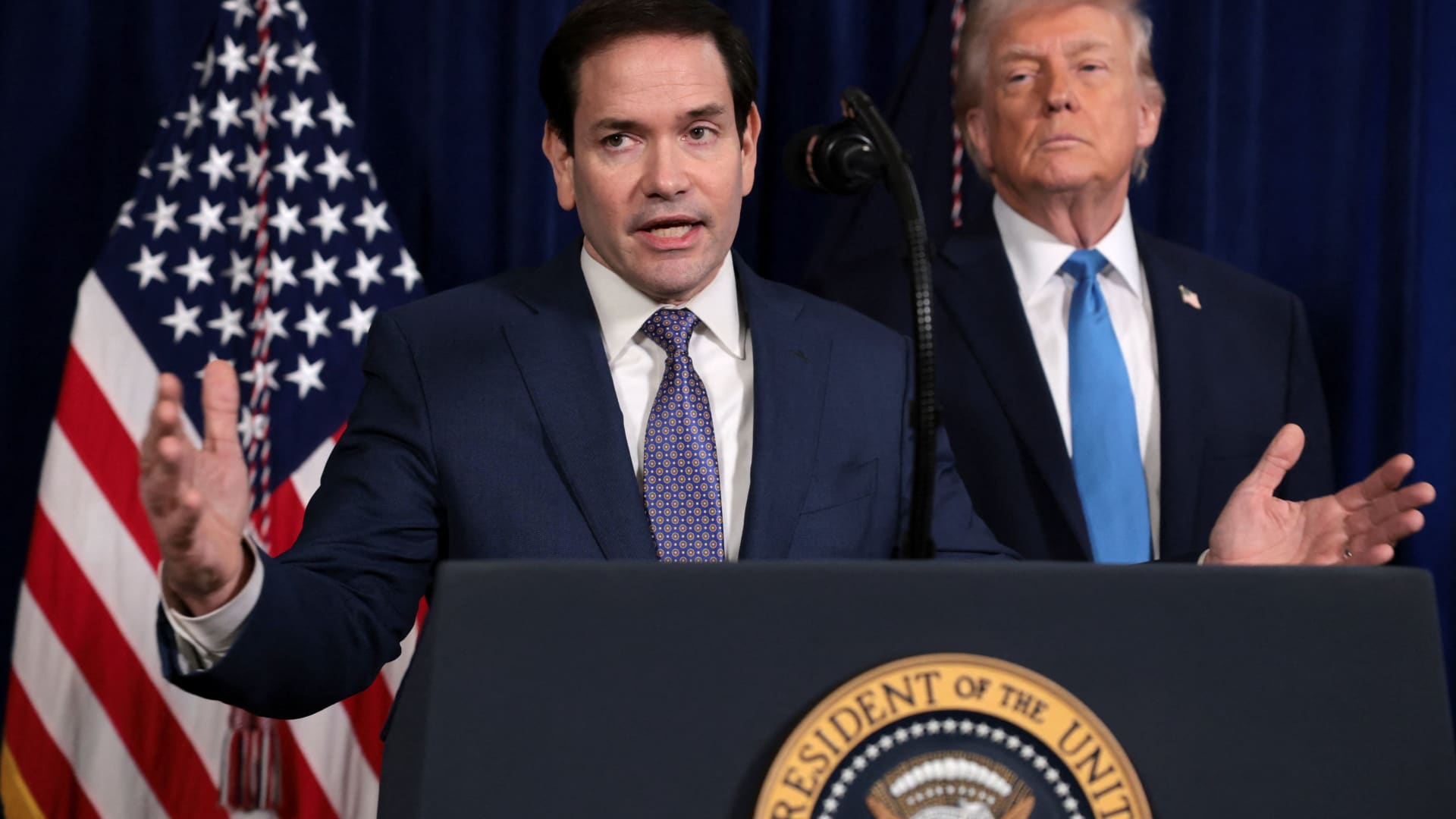
U.S. Secretary of State Marco Rubio stands behind President Donald Trump and speaks during a press conference following the attack on Venezuela that captured President Nicolas Maduro and his wife, Cilia Flores, from Trump’s Mar-a-Lago club in Palm Beach, Florida, on January 3, 2026.
Jonathan Ernst | Reuters
US Secretary of State Marco Rubio appeared on Sunday to backtrack on President Donald Trump’s claims that the US would “run” Venezuela after US forces captured Venezuelan President Nicolas Maduro on Saturday and extradited him to the US.
Asked for details about how the United States plans to run Venezuela, Rubio said the United States would use the leverage it gained from the oil blockade against the country and the region’s military buildup to achieve its policy goals. He did not say that the United States would directly rule Venezuela.
In recent months, the United States has seized tankers associated with the country and moved warships and military aircraft to the Caribbean.
“What’s going to happen here is we’re going to quarantine their oil, which means their economy can’t move forward until conditions are met that are in the interests of the United States and the interests of the Venezuelan people. That’s what we intend to do,” Rubio said on ABC’s “This Week with George Stephanopoulos.”
“That influence is still there, that influence continues, and I hope that that translates into results here,” Rubio said.
President Trump said Saturday that the United States “will run the country until such time as there is a safe, appropriate and prudent transition of power.”
The remarks sparked a storm of criticism from Trump’s opponents and some allies, who warned against nation-building exercises in Venezuela.
“We’ve learned over the years that when America attempts regime change and nation-building like this, the American people pay the price in both blood and dollars,” Senate Democratic Leader Chuck Schumer of New York told ABC on Sunday.
Delcy Rodríguez, Vice President of Venezuela, took office following Maduro’s arrest. President Maduro and his wife, Cilia Flores, arrived in New York on Saturday night to face charges related to drug trafficking.
Mr. Rubio’s comments suggest that the United States will take a softer approach to Venezuela than President Trump’s original proposal to govern the country “collectively.” Rubio said President Trump could still take further military action to achieve U.S. goals.
Asked about further military action in Venezuela on NBC’s “Meet the Press,” Rubio said Trump “reserves all options.”
Rubio also estimated the US’ intentions regarding Venezuela’s oil reserves. President Trump said Saturday that the United States is “going to get the largest American oil company in the world to come in and spend billions of dollars to fix our badly broken infrastructure, our oil infrastructure.”
Venezuela has the world’s largest proven oil reserves.
“At the end of the day, this is not about making the oil fields safe. It’s about making sure sanctioned oil can’t come in or out until we make changes to the governance of the entire industry,” Rubio said on ABC. “The way to deal with this problem in the interests of the Venezuelan people is to have private companies that are not from Iran or other countries come in and invest in equipment.”
Rubio said he has not spoken to any specific U.S. oil companies about the prospect of starting operations in Venezuela. Currently, only chevron We are active in Japan.
“I’m sure there will be dramatic interest from Western companies,” Rubio said.
Rubio said Interior Secretary Doug Burgum and Energy Secretary Chris Wright will “take the evaluation and talk to some of these companies.”
