

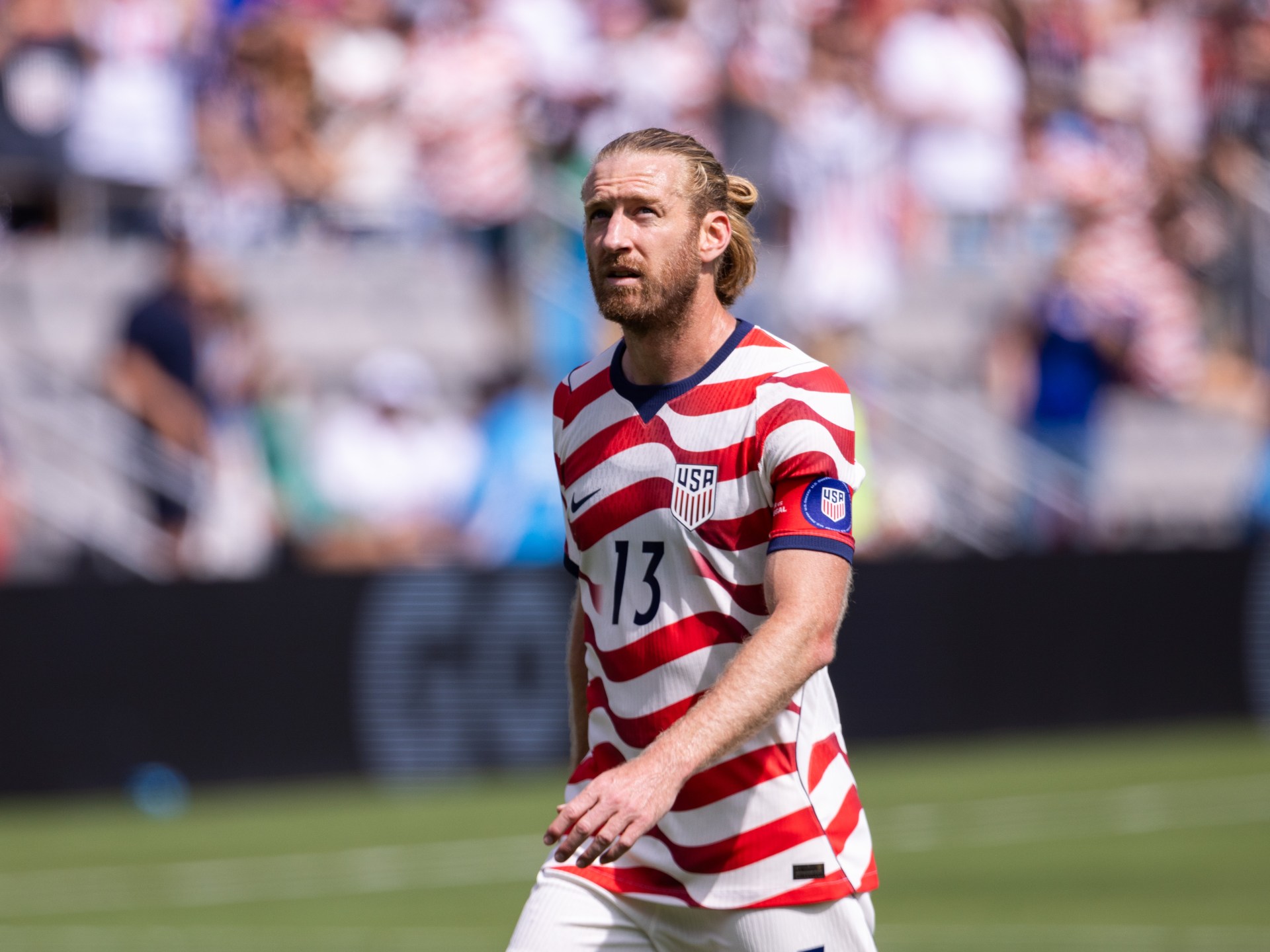
After playing in Qatar in 2022 at the age of 35, U.S. defender Tim Ream thought it was “pretty unlikely” he would play in another World Cup. But he was determined to stay in the game at least as long as possible.
“Because for me it’s about pushing the limits, pushing myself, pushing the limits of what I can handle physically and emotionally,” he told Al Jazeera.
Recommended stories
list of 4 itemsend of list
Last week, Ream was named captain of the U.S. team for the soccer tournament in North America, making him, at 38, the oldest outfielder on the U.S. World Cup team.
“It’s incredible to be given the honor and opportunity to wear the captain’s armband at my home World Cup,” he said.
Ream, who played for Bolton Wanderers and Fulham in the Premier League and is currently with Charlotte FC in Major League Soccer (MLS), is one of several outfield players in their late 30s and older who will play in the 2026 World Cup. Among them are Portuguese superstar Cristiano Ronaldo, 41, Luka Modric and Edin Dzeko, 40, Yuto Nagatomo, 39, and Argentina legend Lionel Messi, who turns 39 later this month.
Evolving sports science plays an important role in extending career longevity. Long gone are the days when “recovery” meant having a few beers after a game, with many athletes now praising all sorts of advances from lymphatic drainage to cryotherapy.
Vast amounts of data measuring biomarkers, from heart rate variability and muscle oxygenation to hormonal fluctuations and inflammation, are also now available, including through wearable technology.
But experts say sports science is just one part of a complex system of factors that contribute to football’s longevity: culture, relationships, learning mindsets, luck, resources and motivation to keep going 50 years from now.
“It’s not just about science, machines and AI,” Vlatko Vucetich, a Croatian professor of kinesiology at the University of Zagreb who has worked as a personal trainer for Real Madrid star midfielder Modric for more than a decade, told Al Jazeera.
“This question is always about people.”

“I lead by example.”
Soccer players tend to reach their peak before the age of 30, and research shows that speed, power and explosiveness decline overall in the early 30s, while endurance declines more slowly.
As athletes get older, they take longer to recover and are more prone to injury. Soccer has also become much faster and more physical in recent decades, and the number of matches played at the elite level has increased dramatically.
Goalies tend to play the longest. The oldest World Cup player in history is Egyptian keeper Essam El Hadary, who played in Russia 2018 at the age of 45.
According to Transfermarkt.com, only 15 of the more than 500 players who appeared in the Premier League this season were over the age of 35.
However, there is evidence that the average age of football players may be rising, with a notable number of outfield players playing into their late 30s to early 40s at the upcoming World Cup. Prior to this tournament, Cameroon’s Roger Mila, who scored at the age of 42 in the 1994 USA tournament, was the only outfield player in his 40s to play in a World Cup.
Ben Rosenblatt was the performance coach for the England men’s team for seven years and is also the founder and director of 292 Performance, a sports consultancy that trains and advises elite individuals and organizations.
He told Al Jazeera that advances in sports science and data collection, as well as an increased focus on health and wellness culture both on and off the game, are helping to advance his career in football.
“Within the game, over the past 20 years, more detailed attention has been paid to the understanding and knowledge of training science, particularly how to schedule organized training sessions to optimize athlete performance and reduce the risk of injury. This is clearly going to be a huge factor in survival for athletes,” he said.
Rosenblatt says longevity will depend on “the amalgamation of all the different tools, resources, culture and behavioral changes that are happening in the game,” but the fundamentals remain important. Training, recovery, sleep, lifestyle, nutrition and hydration.
“It’s about doing something very boring and basic 99 percent of the time,” he said.
Vucetich is an evangelist for elastic resistance bands, which help keep the body strong and agile by increasing muscle plasticity, and says microdosing exercises throughout the day can help prevent injury in preparation for explosive demands like sprints, jumps, and sudden changes of direction.
But he also says that athletes need to excel across eight “parameters”: healthy lifestyle, morphology (body shape and structure), athletic skills, athletic knowledge (ability to learn movements), energy capacity (particularly aerobic and anaerobic fitness), spirituality, intelligence, and socio-economic status.
And Vucetic says senior players have to work harder due to diminishing returns, so maintaining motivation and love for the game is important for longevity. Many older players have families, less pay and opportunities, their bodies are creaking, they may be protesting, but they find it too hard to continue playing football.
“It’s difficult and many athletes past the age of 30 to 35 can’t keep doing this,” he said.
Vucetich said the motivation for players to continue playing at an elite level as they age is usually intrinsic, rather than money or other external factors. For Modric, it’s a desire to be the best version of himself and an eternal love for the game.
“As we say in Croatia, he likes to play like a child in the sand,” he said.
Ream, who debuted with the U.S. men’s national team in 2010, said recovery has become harder as he gets older, but says Pilates, red light therapy and prioritizing sleep have helped in recent years.
He says the hardest part about continuing to play at age 38 is being away from his family for long periods of time. But he says he’s partly playing for his three children.
“(I’m) setting an example for them to set goals and follow through and push themselves and show grit and determination and leadership,” he said.
“It’s all about connections”
Paddy Hogben, rehabilitation strength and conditioning coach at Brentford FC in the Premier League, recently co-authored an academic paper on longevity in professional sport, highlighting the importance of “psychosocial and organizational” variables such as a supportive environment and leadership qualities in developing a football career.
“I was definitely surprised that a lot of players didn’t focus on lifestyle and physical things, and they talked more about opportunities and relationships,” he told Al Jazeera.
Hogben said that while most clubs want to extend a player’s career, financial pressures can undermine player longevity as the resale value of a 20-year-old player is significantly higher than that of a player 10 years older, so successful senior players usually provide additional cultural or social value to the club.
“I think if you have older players with good mental intelligence and good communication skills who can lead you on the pitch, then you’ll find a way to play with them, even if you have a replacement who can do more,” he said.
Hogben pointed out that this requires a willingness to learn early in one’s career and the ability to balance supreme confidence with humility.
“You can think you’re the best, but part of that is due to your growth mindset, your ability to keep evolving and getting better, and I think that’s a very underrated form of talent.”
Veterans playing into middle age often adapt their games to compensate for their slowness with assets such as enhanced vision.
“I think my biggest improvement has been being able to see things develop and see them as they happen, but also being able to understand and adapt to different coaches,” Ream said.
“I think that’s where you have to understand the interpersonal side of this game, because this game is all about connection, communication, relationships on and off the field.”
Tactics and positioning are also important for veteran players. Middle-aged Ronaldo probably wouldn’t be happy to be asked to do any more work for the channel.
“(Older players) will probably be at a club where they have some influence, they can train in a way that works for them and they can have the coach’s tactical ear to help them play the role that suits them,” Hogben said.
Looking ahead, Rosenblatt says integrating the vast amount of data available to create a more holistic picture of players could be “transformative” in their longevity.
“That’s kind of the holy grail because it gives the manager and the owner a clear picture of what that player can offer and obviously what kind of development you’re looking for on a match-by-game basis and throughout the season,” he said.
And extending your lifespan means establishing routine, discipline, and what works early on.
“I know a lot of players who tried to find a routine late in their careers and couldn’t stick to it because they didn’t practice it early,” Ream said.
“Find these things and work on them early. It will help you in the long run.”
