

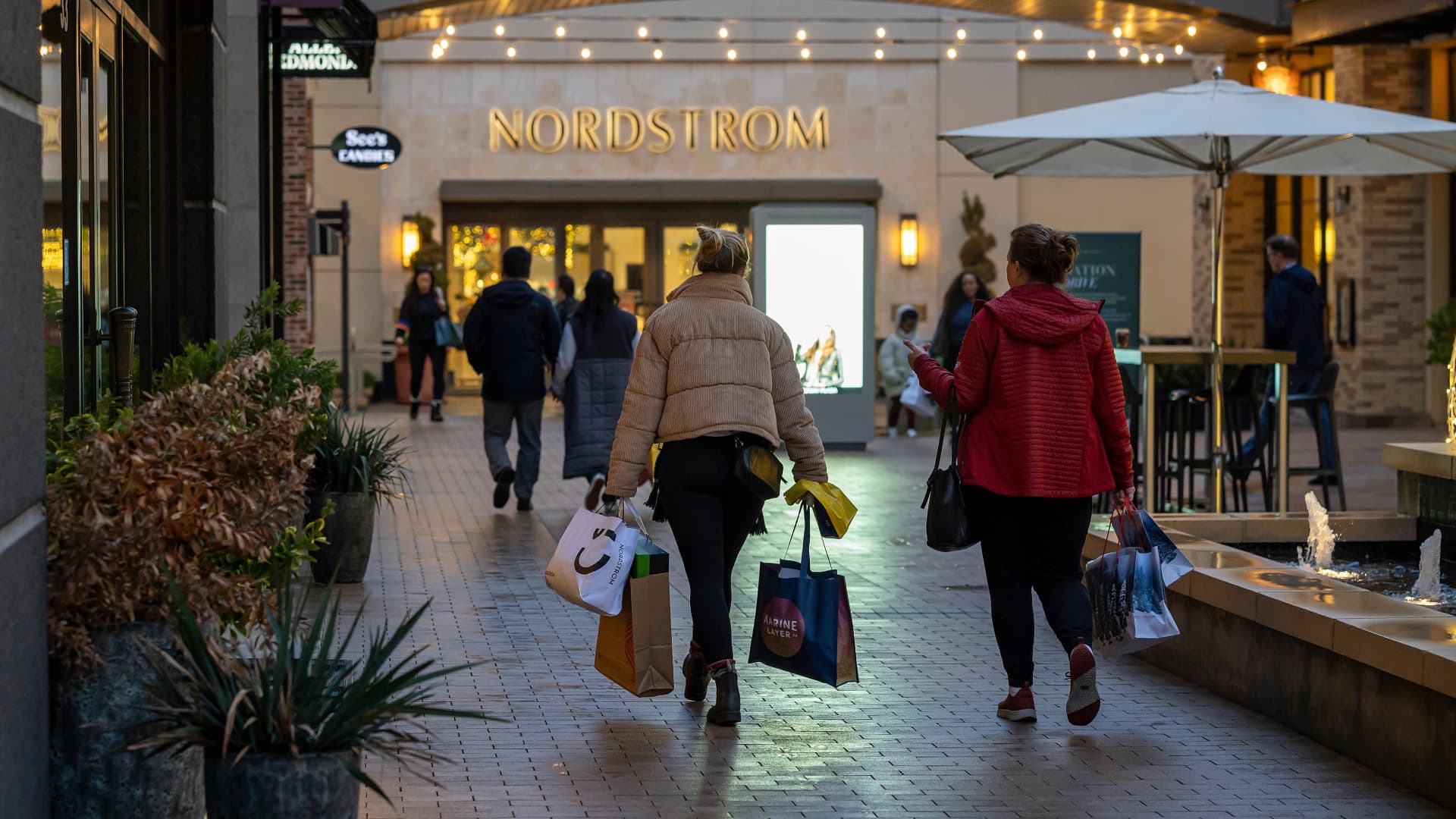
Shoppers carry bags at Broadway Plaza on Monday, December 16, 2024 in Walnut Creek, California, USA. The Bureau of Economic Analysis is scheduled to release personal spending statistics on December 20th.
David Paul Morris | Bloomberg | Getty Images
The National Retail Federation said Thursday that holiday hiring by retailers this year is expected to total between 265,000 and 365,000 positions, the lowest number of seasonal workers in at least the past 15 years.
NRF CEO Matthew Shea said on the retail industry group’s conference call that employment expectations “reflect the softening and slowing of the labor market.” That’s a significant decrease from a year ago, when retailers hired 442,000 seasonal workers, the retail industry group said.
NRF chief economist Mark Matthews said some companies may have hired seasonal workers early to support the October sales event, but retailers were looking to limit spending to manage higher costs from tariffs.
Forecasts from major industry groups offer an updated glimpse into the job market as a record government shutdown drags on and government reporting on economic indicators such as unemployment and inflation declines. As a result, companies and economists have instead come to rely on data from private companies and organizations.
Early Thursday morning, outplacement firm Challenger, Gray & Christmas announced that layoffs announced in October jumped to 153,074, an increase of 183% from September and 175% from the same month last year. This is the highest October level since 2003 and makes 2025 the worst year for announced layoffs since 2009.
Meanwhile, payroll company ADP reported a net gain of 42,000 jobs in October, reversing two consecutive months of losses in the private sector.
Increased spending and decreased employment
Despite low seasonal staffing levels, NRF is optimistic that holiday spending will remain strong. Holiday spending from Nov. 1 to Dec. 31 is expected to reach a record $1.1 trillion to $1.2 trillion, the first time the total will exceed $1 trillion.
This corresponds to a year-on-year growth rate of 3.7% to 4.2% from the previous holiday season, and a slight decrease from last year’s holiday sales growth rate of 4.3%. NRF’s projections do not include car dealerships, gas stations or restaurants.
Mr. Hsieh said that despite weak consumer confidence, an extended government shutdown, “multiple tariffs,” and price sensitivity due to inflation, consumers continued to spend against expectations.
“To be fair, this was a bit of a surprise considering back in April we expected it to go back quite a bit,” he said.
He said the industry group expects this momentum to continue through the key holiday shopping period. He said families typically save other parts of their budgets for other parts of the year and for celebrations.
Even as consumers continue to spend, the retail industry is taking a cautious stance on hiring, a fact reflected in NRF’s seasonal worker forecast. This year marks the fourth slowest year-to-date year for retail employment since at least 2000, behind only 2009, 2010 and 2012 in the years following the Great Recession.
In an interview with CNBC, Matthews said the slow hiring environment can all be summed up in one word: “uncertainty.”
“One of the things companies do when you’re in an uncertain environment is put things on hold,” he said in an interview with CNBC.
Matthews said on Thursday’s NRF conference call that the U.S. economy doesn’t need the same level of job creation as before due to demographic and policy changes such as baby boomers retiring and President Donald Trump’s crackdown on immigration.
Still, he said the level of employment and investment by businesses will be important indicators to watch next year.
He said the current flood of investment in artificial intelligence is delivering “huge benefits to the economy”. But, he added, “that may be hiding some cracks.”
“We need to keep a close eye on how businesses feel and what the environment looks like, which remains uncertain,” he said.
