

moscow —
For years, Russia’s Victory Day parades have symbolized the country’s military might and power, with dazzling displays of heavy equipment and a flurry of visiting dignitaries.
Things will be very different this year. Russian President Vladimir Putin will host a scaled-down parade on Red Square, with no display of military equipment due to the “current operational situation,” the Russian Defense Ministry said. There will also be fewer foreign leaders in attendance than in previous years, and most international news organizations will now have to rely on footage from Russian state media to cover the event.
In a sign of growing concerns about the Kremlin’s security, many international journalists have reportedly been barred from attending a parade commemorating the Soviet Union’s victory over Nazi Germany in World War II.
“Putin likes to look like he’s in control and he wants the Russian state to look strong, but that’s not the message this sends. It sends a message that you don’t normally want to send,” said Sam Green, a professor of Russian politics at King’s College in London, calling this “uncharacteristic” of a Russian leader.
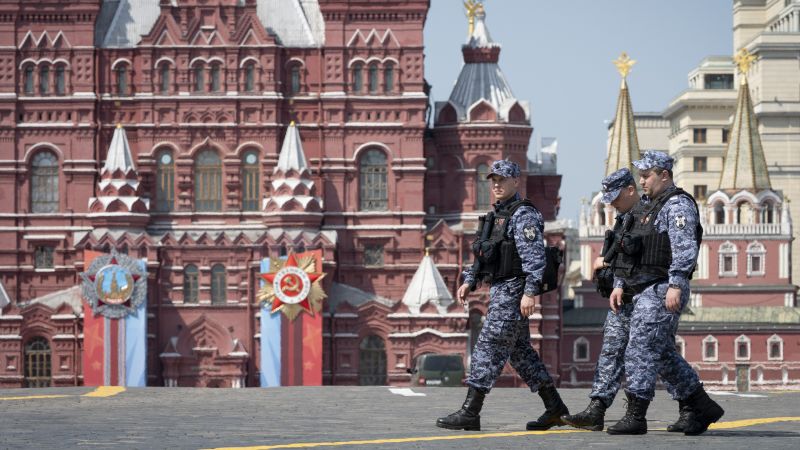
This year, the Kremlin appears to be prioritizing security over traditional displays of force. The parade comes amid an escalation of Ukrainian attacks deep inside Russian territory, particularly on oil refineries. In a rather symbolic blow that caused no casualties, a drone struck a high-rise apartment building in an upscale residential area in west-central Moscow on Monday. This contributed to strengthening security measures.
Anti-aircraft systems can be seen all over Moscow, amid the traditional red, white and blue decorations of the Russian flag that decorate the city’s streets and the black and orange St. George’s ribbons, the symbol of the Russian military, widely seen in store windows.

Russian government spokesman Dmitry Peskov denied on Friday that international journalists’ accreditation had been revoked, saying instead that the format of this year’s parade had been scaled back, limiting the number of journalists who could take part.
“This year, the entire ceremony is to some extent restricted, so the number of journalists allowed is also limited,” Peskov said, adding that “there was not a single case of decertification.”
However, several international journalists, including those from CNN, who had been allowed to take part in the parade, were told by the Kremlin on Thursday that they could no longer participate. CNN was only informed that the “host broadcaster” would be attending this year’s celebration.
Unlike the 2025 commemoration, which included China’s Xi Jinping as the guest of honor and dozens of other leaders, this year’s guest list is also more conservative, with key allies of Putin’s Belarusian President Alexander Lukashenko, Malaysia’s King Sultan Ibrahim Iskandar and Laos’ President Thongloun Sisri attending. Prime Minister Roberto Fico of Slovakia, a NATO and EU member, is scheduled to visit Moscow for bilateral talks with President Putin, but said he would not attend the parade.
The truncated parade comes amid growing concerns in Russia about a slowing economy and tougher internet restrictions that are disrupting daily life, but Putin said it was necessary for public safety.

One of Russia’s largest telecom operators warned Moscow residents on Friday that there may be restrictions on mobile internet and text messaging around the capital “to ensure safety during festive events,” according to a message seen by CNN.
The mood among Moscow residents appears to be calmer, with Mikhail, who gave only his first name, telling CNN, “It’s time for the war to end.”
“It’s about time,” he said, adding: “People are dying, finances are disappearing, all kinds of restrictions are being introduced. It’s clear that this is unpleasant. War has never been good.”
Nina Khrushcheva, a professor of international studies at the New School who was recently identified by Russian authorities as a foreign agent, told CNN President Putin that security services were likely frightened by recent international developments and the large number of drones flying towards Russian territory from Ukrainians.


“There’s paranoia in every situation,” she says. “President Putin was completely horrified after seeing what happened to the leadership of Iran, Venezuela, and even the shooting that targeted US President Donald Trump. On top of that, hundreds of drones are launched from Ukraine every day.”
Ukraine and Russia on Friday accused each other of violating a cease-fire agreement announced by both sides ahead of Victory Day celebrations in Moscow.
The Russian Ministry of Defense announced a ceasefire in the war with Ukraine from May 8 to 9, marking Moscow’s annual celebration.
Ukrainian President Volodymyr Zelenskiy said Kiev had not received a “formal appeal” of Russia’s ceasefire, and then announced its own unilateral ceasefire from May 6.
A Russian Foreign Ministry spokesperson has issued a stern warning to diplomatic missions abroad to evacuate their staff from Kiev in the event of a large-scale attack by Moscow and the Ukrainian government targeting Victory Day on May 9.
Galina, a native of Novoazovsk in the Russian-occupied Donbas region, was visiting Moscow with her husband on a sightseeing trip. She told CNN that she has been feeling the effects of war since 2014, following Russia’s annexation of Crimea and the subsequent war between Russian-backed separatists and the Ukrainian military. Despite wearing a St George’s ribbon, she said she hoped the war would end quickly, saying: “It’s the people who suffer,” adding: “War is bad for everyone.”
