

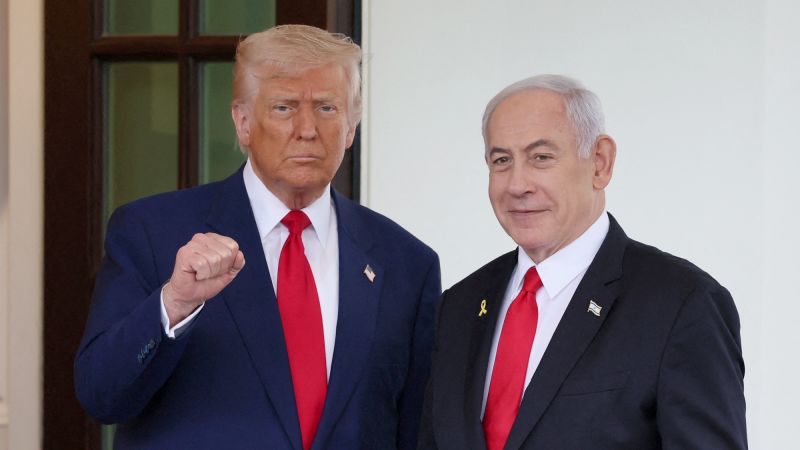
US President Donald Trump has written a letter to the Israeli president asking him to grant a full pardon to Prime Minister Benjamin Netanyahu in his ongoing corruption trial.
In a letter distributed by the Israeli presidential press secretary, President Trump wrote: “I hereby ask you to fully pardon Benjamin Netanyahu, a formidable and decisive wartime prime minister who is now leading Israel into an era of peace.”
For any other president, the letter would be an unprecedented intervention in a foreign country’s internal affairs. But this is just the latest effort by President Trump to intervene on behalf of one of his most vocal international supporters.
Prime Minister Netanyahu faces charges of fraud, bribery and breach of trust in three separate cases that began during Trump’s first term. He has pleaded not guilty and maintains his innocence.
“While I fully respect the independence of the Israeli judicial system and its requirements, I believe that the ‘litigation’ against Mr. Bibi, who has fought alongside me for many years, including against Israel’s most powerful adversary, Iran, is a political and unwarranted prosecution,” Trump said in the letter.
Despite the ceremonial nature of the role, Herzog has the power to grant pardons. However, the request must be made by the person accused of wrongdoing, his or her legal representative, or a family member. Neither Prime Minister Netanyahu nor his aides have filed such a petition.
Herzog’s office said in a statement that it has “high regard” for Trump and appreciates his “unwavering support for Israel, his significant contributions to the return of hostages, the transformation of the Middle East and Gaza, and ensuring Israel’s security.”
But Herzog’s office also said that “those seeking clemency must submit their applications according to established procedures.”
President Trump has expressed his opinion on Prime Minister Netanyahu’s trial several times. In June, after the 12-day war between Israel and Iran, he wrote a lengthy post on Truth Social, calling Netanyahu’s trial a “ridiculous witch hunt” and repeating language he had used to describe his own legal threats.
And last month, during a brief visit to Israel, President Trump raised the issue of pardons in a speech to Israel’s Congress.
He turned to Herzog, who was sitting nearby, and said, “Mr. President, why won’t you pardon him?”
President Trump’s new letter prompted mixed reactions across the Israeli political spectrum.
Far-right National Security Minister Itamar Ben Gvir wrote in X: “President Herzog, listen to President Trump!” and claimed that the “disgraceful” indictment against Prime Minister Netanyahu “long ago became an indictment against the prosecutor itself.”
Opposition leader Yair Lapid responded to the letter in a statement: “A reminder: Israeli law clearly provides that the first condition of a presidential pardon is an admission of guilt and an expression of remorse.”
Prime Minister Netanyahu is the first sitting prime minister in Israel’s history to face criminal prosecution while in office.
The trial on charges of bribery, fraud and breach of trust began in May 2020.
Netanyahu’s own testimony began in December 2024, but has been repeatedly postponed and canceled, most at his request. Given the remaining stages of testimony, sentencing, and possible appeals, the litigation is expected to continue for several more years.
This is not the first time Trump has attempted to intervene in ongoing judicial proceedings overseas.
In July, President Trump urged Brazilian authorities in a social media post to stop prosecuting former President Jair Bolsonaro, another international ally convicted of plotting a coup, saying Bolsonaro was “guilty of nothing except fighting for the people.”
In April, it supported French far-right leader Marine Le Pen when she was found guilty of embezzling European Union funds and banned from running for political office for five years.
“The witch hunt against Marine Le Pen is another example of the European left using the legal system to silence free speech and censor political opponents, this time going so far as to imprison their opponents,” he wrote. “It’s the same ‘strategy’ that was used against me.”
