

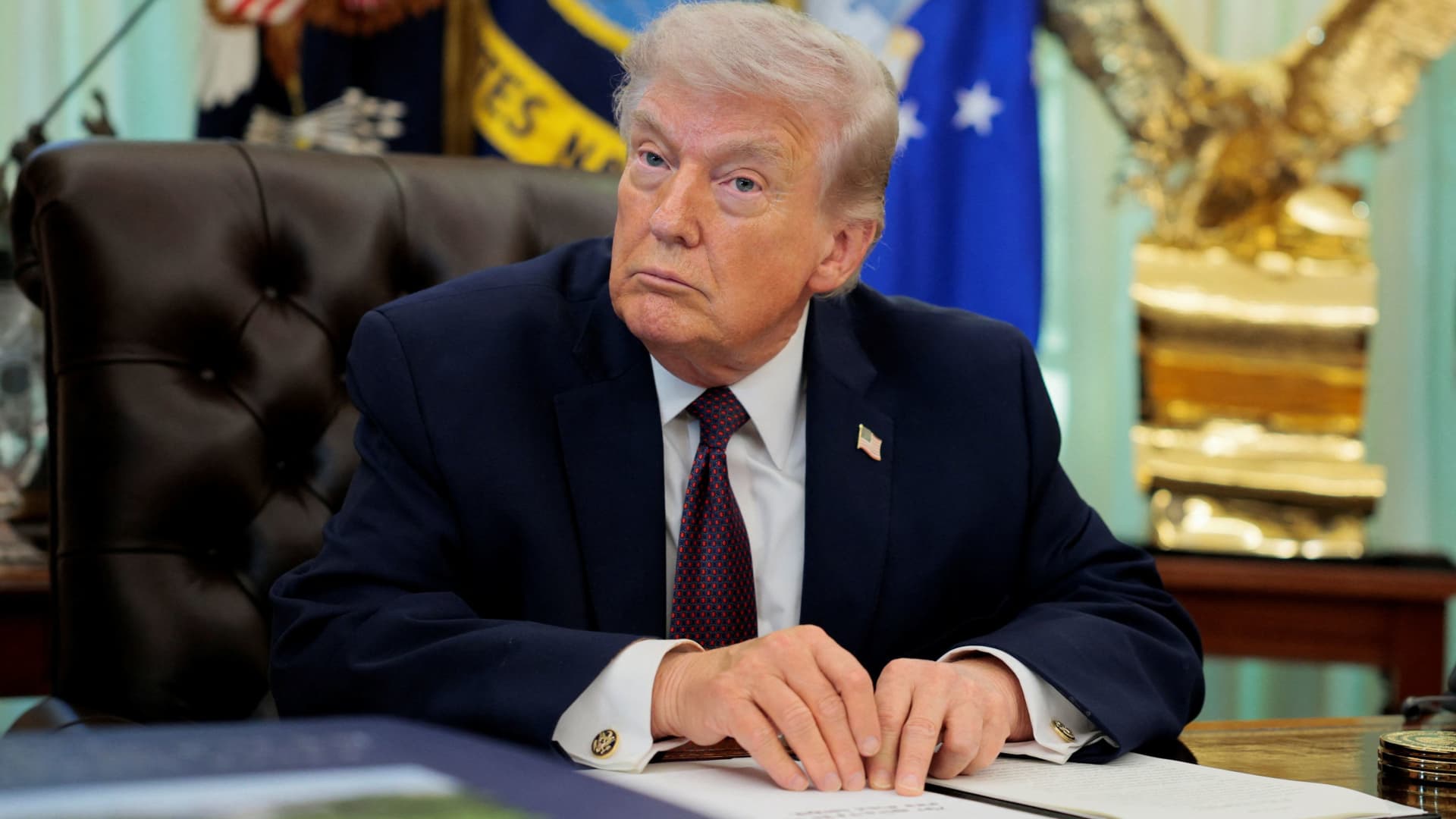
U.S. President Donald Trump speaks to reporters before departing from the South Lawn of the White House on April 16, 2026 in Washington, DC.
Brendan Smialowski AFP | Getty Images
President Donald Trump on Monday once again threatened Iran with overwhelming military force, saying “a bunch of bombs are going to start going off” if a deal isn’t reached by the time an uneasy ceasefire with Tehran expires Tuesday night.
This latest threat, made in a phone call with a PBS News reporter, comes as the status of additional U.S.-Iran peace negotiations and other important details about the current relationship between the belligerent powers become increasingly uncertain.
At the same time, President Trump resumed the sword-wielding rhetoric that had escalated two weeks before a fragile cease-fire agreement was due to expire. President Trump has wavered in calls with reporters over the past two days between warmongering and providing opaque details about future negotiations.
Details about the potential deal also remain vague. The Trump administration has repeatedly said it must never allow Iran to acquire nuclear weapons, and the president said Friday that the United States would also receive what he called “dust” left after last year’s bombing of Iran’s nuclear facilities.
He also called on Iran to fully resume shipping traffic in the Strait of Hormuz, which has slowed to a trickle since the war began on February 28. The virtual closure of major shipping routes has caused global disruption. crude oil price The situation spiraled, giving Iran significant leverage and prompting the United States to impose a retaliatory naval blockade of Iranian ports during the ceasefire.
In a post on Truth social Monday afternoon, President Trump boasted that the blockade would “totally destroy Iran” and declared that it would not be lifted until a deal was reached.
In another post, the president claimed that the deal with Iran “will be much better” than the Obama-era agreement known as the Iran nuclear deal, which Trump abandoned during his first term.
Trump has slammed his critics, but also said he doesn’t feel obligated to strike a deal within the six weeks he originally predicted the war would last. “We will not allow them to rush the United States into a deal that is not as good as it could be,” Trump wrote.
Monday’s further bomb threat followed a declaration to a Fox News reporter on Sunday morning that “the whole country will be blown up” and that Iranian bridges and power plants would be targeted in those attacks if Tehran did not sign the deal.
The threat has heightened tensions with Iran even as the US delegation prepares to return to Pakistan for a possible second round of peace talks.
The delegation is “planning a trip to Islamabad in the near future,” a source told CNBC on Monday morning, speaking on condition of anonymity to discuss the visit.
The information, which suggests the delegation has not yet departed, comes after President Trump told a New York Post reporter Monday morning that U.S. officials are “on their way.”
The first round of talks in Islamabad earlier this month, led by Vice President J.D. Vance and U.S. Special Envoys Steve Witkoff and Jared Kushner, ended without an agreement after 21 hours of negotiations.
President Trump confirmed to the New York Post that the same three officials will be part of the second round of delegations.
It was not immediately clear whether Iran had agreed to participate in further peace talks.
According to multiple media outlets, Iran’s Foreign Ministry spokesperson said at a press conference on Monday that Iran has no plans to attend negotiations with the United States.
However, the New York Times reported late Monday morning, citing two senior Iranian officials, that a delegation from Tehran was planning to head to Islamabad on Tuesday for talks with the United States.
In a statement Monday morning, Iranian President Masoud Pezeshkian illustrated how the long-standing hostility between the two countries makes further negotiations inevitable.
“Iran’s deep-seated historical distrust of the actions of the U.S. government remains,” Pezeshkian wrote in the X post. “Meanwhile, unconstructive and contradictory signals from U.S. officials send a stark message that they want Iran to surrender. Iranians will not submit to force.”
The United States and Iran agreed to a two-week ceasefire on the night of April 7, just before the deadline, with President Trump warning that “the entire civilization will perish” if the deal is not reached.
Tensions have been high throughout the short-lived ceasefire, with both sides accusing the other of violating its terms.
President Trump said Sunday that the U.S. Navy, which is blockading an Iranian port near the Strait of Hormuz, fired on and captured an Iranian-flagged cargo ship as it tried to evade the blockade.
The escalation came after President Trump complained that Iran had failed to reopen the strait, through which 20% of the world’s oil shipments pass during peacetime.
This is developing news. Please check back for the latest information.
