

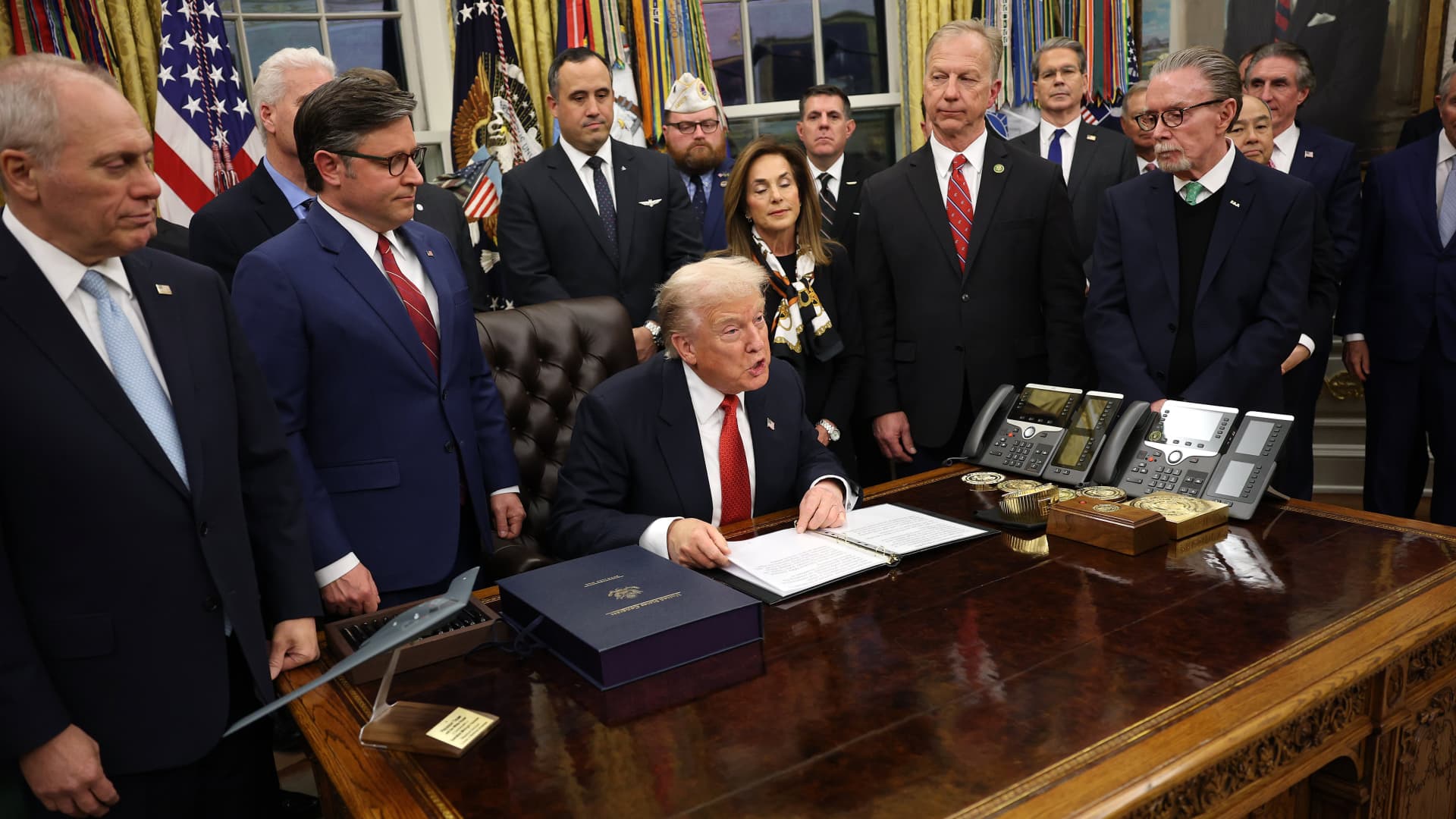
U.S. President Donald Trump signs the funding bill to restart the federal government with House Speaker Mike Johnson (R-LA), House Minority Leader Steve Scalise (R-LA), Republican lawmakers, and business leaders during a ceremony in the Oval Office of the White House on November 12, 2025, in Washington, DC. Photographed on November 12, 2025.
Win McNamee | Getty Images
President Donald Trump signed a funding bill late Wednesday to end the longest federal government shutdown in U.S. history.
The bill, which funds government operations through the end of January, passed the House on a 222-209 vote Wednesday night.
“Democrats tried to rob our country,” Trump said before signing the bill in the Oval Office of the White House on the 43rd day of the shutdown.
Democrats had blocked passage of the funding bill until Sunday, but a bloc in the party’s Senate caucus agreed to support the new funding measure in the chamber, even though it does not include an extension of the Affordable Care Act tax credits.
“Republicans did not want a government shutdown,” the president said, surrounded by Republican Congressional leaders.
“People have been hurt terribly,” Trump said, noting that more than 1 million federal workers have been furloughed, impacting government services to Americans. “We can’t let something like this happen again.”
He reiterated his call for the Senate to abolish the filibuster rule, which effectively requires 60 votes to pass legislation, including short-term funding resolutions.
Trump did not take questions from reporters after the signing, even though several reporters attempted to ask him about House Democrats’ release of documents from the estate of his former friend and notorious sex offender Jeffrey Epstein earlier in the day. He was asked about the emails in which Epstein mentioned him, but was ignored.
President Trump has denied knowing about Epstein’s sexual abuse of underage girls and young women when they were friends.
“Folks, let’s get this done,” House Speaker Mike Johnson (R-Louisiana) said in comments supporting the bill on the floor before Wednesday’s vote.
The only two Republicans in the House to vote against it were Thomas Massie of Kentucky and Greg Steube of Florida.
All but six Democrats voted against the bill.
The Office of Management and Budget directed federal employees to return to work on Thursday.
Early Wednesday night, the U.S. Department of Transportation froze the level of flight reductions it had imposed in light of the shortage of air traffic controllers during the shutdown.
As of Tuesday, 6% of scheduled flights at U.S. airports were canceled, and that level is expected to rise to 10% by Friday.
The government shutdown began on October 1, and government operations have remained suspended since then. That’s because Senate Democrats overwhelmingly refused to vote on a funding measure that would not extend the ACA credit increase that lowers the cost of Obamacare health insurance plans for 20 million Americans.
The Senate passed the funding bill Monday night, a day after the Republican majority narrowly reached the minimum 60 votes with support from seven Democrats and one independent senator.
Under the agreement, Senate Republicans agreed to allow Democrats to vote in December on a bill to extend the subsidy increases that are set to expire at the end of the month.
Without these tax credits, millions of Americans would face steep increases in the cost of their Obamacare insurance plans.
In addition to providing short-term funding, the agreement also reverses all shutdown-related layoffs of federal employees and ensures that all federal employees are paid the regular salaries they would have received had the shutdown not occurred.
It’s still unclear when all federal employees will be paid, but agencies are expected to roughly follow the payment schedule for House employees, who are expected to receive checks on Tuesday.
The package also funds the SNAP program, which helps feed 42 million Americans through food stamps.
The Trump administration tried to end food stamp benefits in November, citing the government shutdown, but Congress refused to put anything other than $4.6 billion into the appropriate emergency fund to fully pay SNAP benefits that month.
The Supreme Court put on hold until Thursday a federal judge’s order ordering full benefit payments and passed a shutdown bill, effectively giving Congress time to consider the case.
The agreement also includes provisions for a bipartisan budget process and prevents the White House from using continuing resolutions to fund the government.
CR has been used repeatedly to avoid government shutdowns.
In remarks on the House floor before the House vote, Rep. Rosa DeLauro, D-Conn., said the lack of protection for the added ACA subsidies could cause some people to “double or even triple” their monthly premiums.
In 2026, he said, “more than 2 million Americans are expected to lose health insurance next year because it’s too expensive.”
DeLauro said House Speaker Johnson “has shown no interest” in voting on ACA subsidies, despite Senate Republicans insisting that is the plan.
“We shouldn’t be here,” said House Minority Leader Steve Scalise (R-Louisiana).
“As Republicans, we worked to prevent a government shutdown more than a month ago,” Scalise said.
“We waited 42 days, and Democrats voted again and again to keep the government shut down to appease their most extreme base.”
Scalise said “millions of Americans” had to endure “pain and suffering” because Democrats refused to vote yes on the funding bill.
He denounced the hypocrisy of Democrats in calling for $200 billion in health spending that benefits “illegals” while advocating dismantling $50 billion in local health funds.
“It’s crazy,” Scalise said.
