

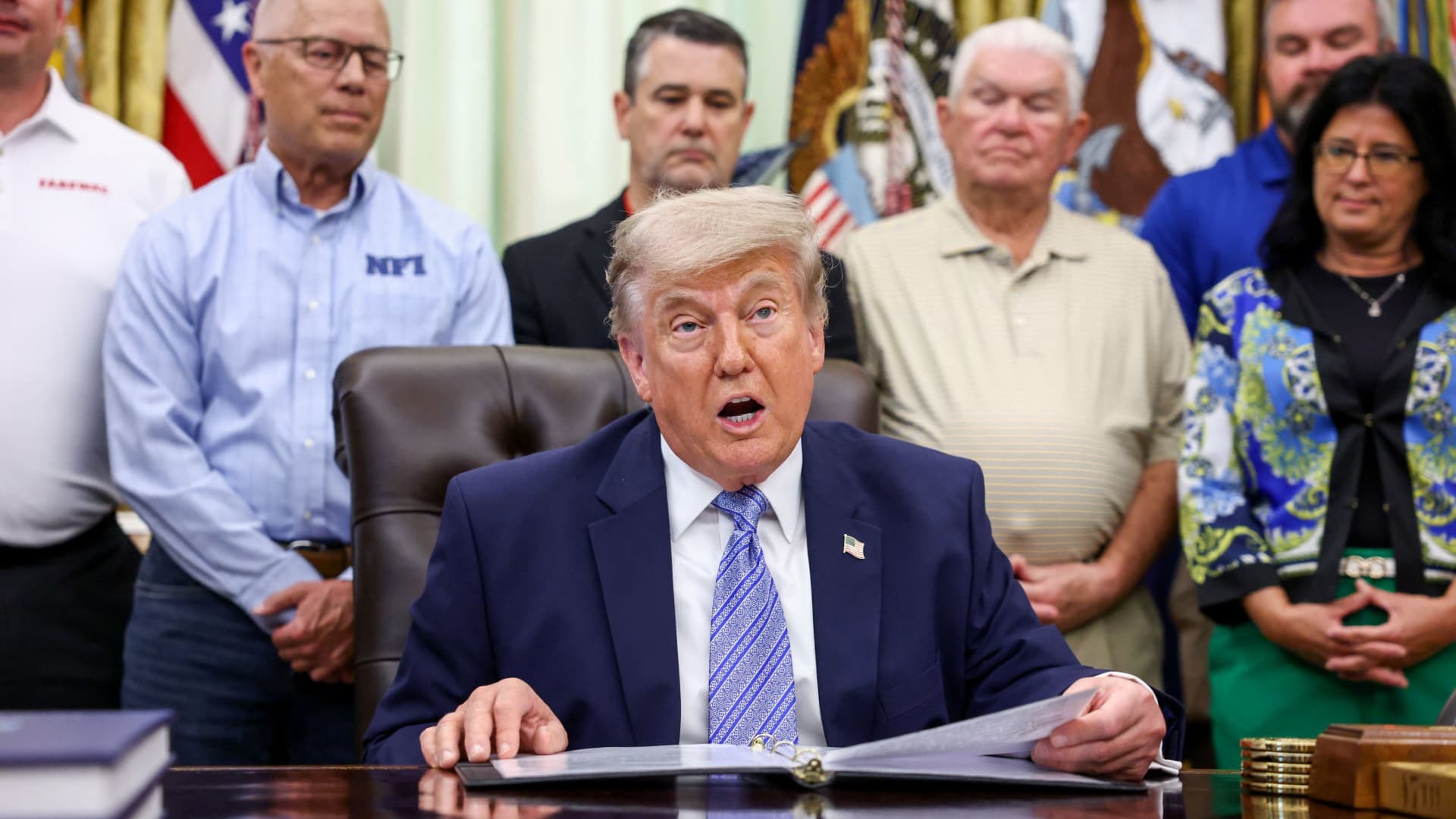
U.S. President Donald Trump speaks during a presentation with U.S. Environmental Protection Agency (EPA) Administrator Lee Zeldin (not pictured) in the Oval Office of the White House on May 21, 2026, in Washington, DC, USA.
Kevin Lamarque | Reuters
President Donald Trump on Thursday announced a postponement of two Biden-era EPA refrigerant rules, arguing the measure would reduce costs for businesses and save consumers money at the grocery store.
The administration estimates that American households and businesses will save more than $2.4 billion under the new rules.
“Our actions will help companies choose the refrigeration system that works best for them, saving them billions of dollars,” EPA Administrator Lee Zeldin said in a statement.
He added that “American households will feel this firsthand as food prices decline.”
But as of Thursday, it was unclear whether or how businesses such as grocery stores would use those savings to help shoppers fill their carts at more affordable prices. The change will free grocers from having to lower prices at a time when many households are finding their budgets stretched to the limit due to high gas prices and years of high inflation.
The rule targets hydrofluorocarbons (HFCs), powerful greenhouse gases commonly used in refrigeration and air conditioning systems that are widely accepted as contributing to global warming. Under the Biden administration, the EPA finalized regulations in 2023 aimed at reducing leaks and emissions from these systems, impacting industries from grocery stores and food distribution to semiconductor manufacturing.
Currently, EPA is delaying compliance by revising the 2023 rule and another rule starting in 2024.
The administration’s message appears aimed squarely at consumers fed up with inflation, especially as food prices remain politically sensitive ahead of this fall’s midterm elections. Grocery retailers rely heavily on their refrigeration infrastructure, which in some cases required upgrades, leak detection systems, and new refrigerants to comply with EPA regulations.
At the time the rule was enacted, the EPA claimed that energy efficiency and lower-cost refrigerants would ultimately save businesses and consumers $4.5 billion over the long term. Grocery and food industry groups have warned that the transition could cost the industry billions of dollars in initial equipment and compliance costs.
Major chains, etc. walmart, krogerand costco The largest operators were generally in a better position to absorb the transition, as companies had already invested in “natural refrigerant” systems for years. Small local grocers and mom-and-pop stores may feel the cost burden more acutely.
“This orderly transition of equipment reduces both capital and operating costs, which ultimately translates into lower prices, which is good for consumers,” Kroger CEO Greg Foran said at a White House event.
Still, it remains unclear how grocers will pass on the cost savings to consumers. Asked at the time of the deal, Foran said the company was “in the thick of it” passing savings on to consumers and making sure they were “paying the right price.”
On Thursday, before Trump’s policy announcement, Bloomberg News reported that Foran was planning to cut prices at Kroger, making the grocer more competitive with Walmart and Costco.
Food inflation is driven by a wide range of factors, including labor, transportation, feed and commodity prices, some of which have risen in recent months as a result of the Iran war. Refrigeration compliance costs are only a small portion of a grocery store’s overall operating expenses.
