

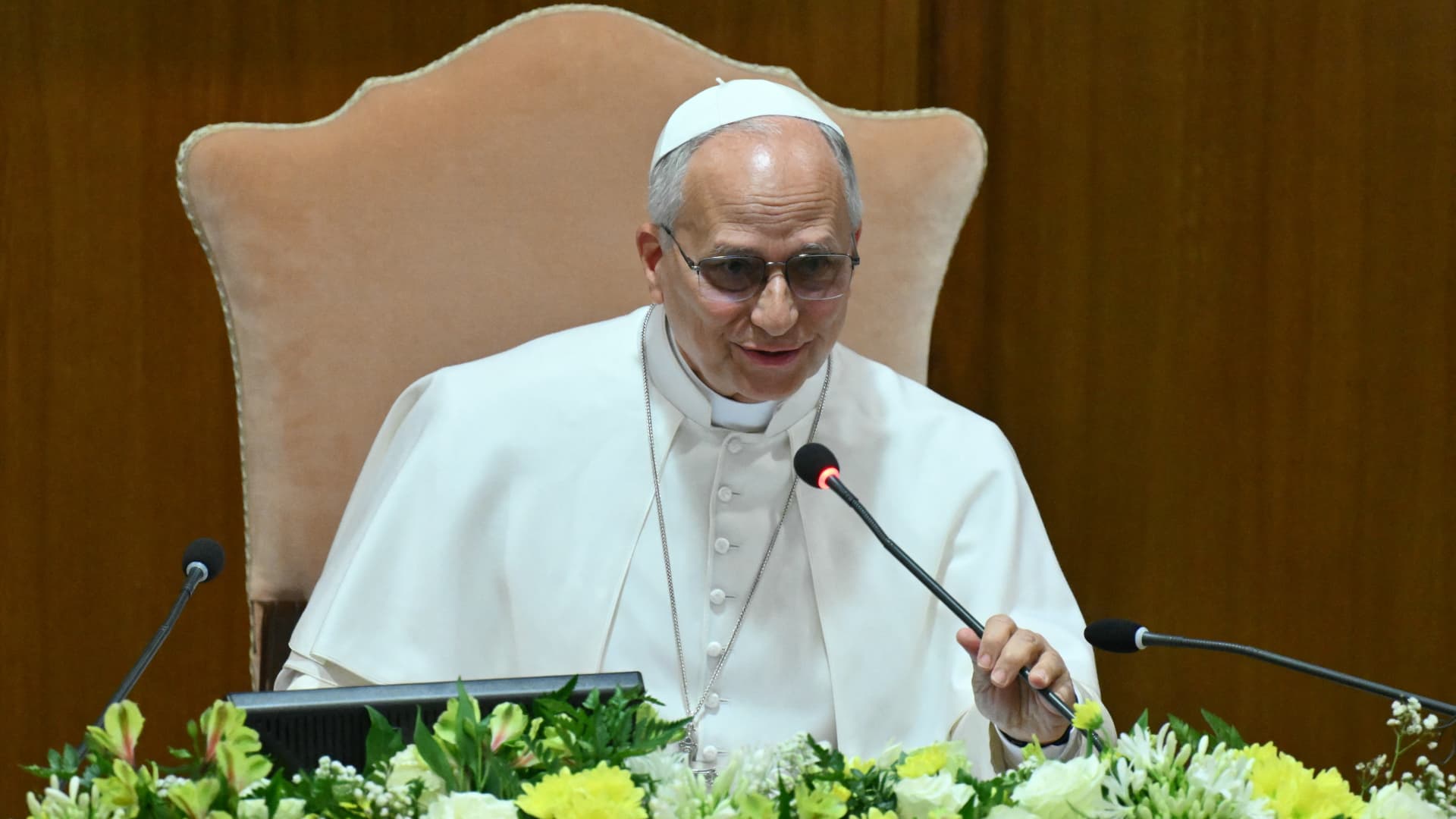
Interior Secretary Doug Burgum on Tuesday dismissed Pope Leo XIV’s warnings about artificial intelligence as the White House resists new guardrails on rapidly evolving technology, opening a new front in the Trump administration’s public feud with the Vatican.
“I didn’t know that technology commentary was part of the Pope’s role,” Burgum said in an interview on Fox Business, referring to Leo’s first encyclical, a 42,300-word document, in which he called for greater oversight of AI and warned that technology could displace workers, deepen inequality and put lethal weapon decisions beyond human control.
But Vice President J.D. Vance, the Trump administration’s highest-ranking Catholic and one of its most prominent contacts with Silicon Valley, praised the same message in an interview on NBC, calling it “profound” and the kind of “moral leadership” the church should provide at the beginning of the age of AI.
The division underscores the delicate politics facing President Donald Trump, who has made the ascendancy of AI and deregulation central to his economic agenda in his second term, while navigating a public conflict with the first American pope.
“The vice president seems to be retracting his earlier criticism that Pope Leo needs to learn more theology,” said Peter Casarella, a theology professor at Duke Divinity School who studies AI. “They put their skis out in front and paddled back.”
Leo’s comments follow President Trump’s decision last week to postpone an executive order that would have created a voluntary AI safety review process. The U.S. reversed course after pressure from the technology industry, with President Trump expressing concern that the surveillance could make the United States less competitive with China.
Some Catholics also warn that unchecked AI could overtake policymakers and worsen problems related to work, children and family life.
“The so-called tech right handcuffing the White House from acting rationally will be proven wrong,” said Michael Toscano, director of the Family First Technology Initiative, which supports the Pope’s push for more ethical AI guardrails. “I think the real danger is between now and November when the U.S. elections take place.”
The AI battle has become the latest flashpoint in the escalating battle between the White House and the Vatican.
In his first year as pope, Leo criticized Trump’s push for mass deportations, condemned his administration’s war on Iran, and declined an invitation to serve on Trump’s Peace Commission, saying the United Nations should remain at the center of crisis management.
Meanwhile, President Trump personally attacked Leo, calling him “soft on crime” and “terrible in foreign policy,” and accused the pope of pandering to the “radical left.” Trump also posted an image that appeared to show him dressed as Jesus Christ caring for a sick person. Leo responded, “I’m not afraid of the Trump administration.”
The publication of this encyclical added another political wrinkle. Leo released the document along with Christopher Oler, co-founder of AI giant Anthropic, which is already at odds with the Trump administration for refusing to give the U.S. military unfettered access to the technology.
Anthropic did not respond to a request for comment.
“This back-and-forth dialogue between a pope and a titan of industry is almost unprecedented, if not unprecedented,” said co-chair Paolo Carrozza, a law professor at the University of Notre Dame. meta Member of the Monitoring Committee and member of the Pontifical Academy of Social Sciences, appointed by Pope Francis. “This is a positive sign for many.”
For Trump, the dispute with the pope could create friction with Catholic voters, who make up a key part of his coalition. Trump won 55% of Catholic voters in 2024, compared to 43% for Kamala Harris, according to the Pew Research Center. Four years ago, Catholics were almost evenly split, with 50% supporting Joe Biden and 49% supporting Trump.
A public spat with the pope is unlikely to immediately change conservative Catholic support for Trump. Many conservative Catholics remain with him on abortion, religious freedom and cultural issues.
But his repeated clashes with Mr. Leo over immigration, war, and now AI could be problematic for Catholic voters who are less strongly identified with either party, especially when the disputes center on workers, families, and economic power.
“Inflation, gas, the war with Iran, all of those things combined are just another reason to lose voters in your own camp who didn’t want to be there in the first place,” said Ryan Burge, a political scientist who studies religion and politics at Washington University in St. Louis.
Burge said the tension could be especially important in the midterm elections, when Catholic voters could play a big role in battleground states such as Long Island, Pennsylvania, and Ohio, where Republicans have made inroads.
“Republicans need to be careful who they favor and who they alienate,” Burge told CNBC. “Next to white Christian voters, Catholics may become the most important electorate for Republicans.”
Another risk is that Democrats, labor groups, and AI safety advocates could use Mr. Leo’s warnings to argue that the administration has too much respect for Silicon Valley and too much disregard for concerns for workers, families, and national security.
“If I were a Democrat running in a predominantly Catholic district in the midterm elections, I would see Trump’s comments mocking the Pope all over my ads,” Burge said. “They write it themselves.”
