

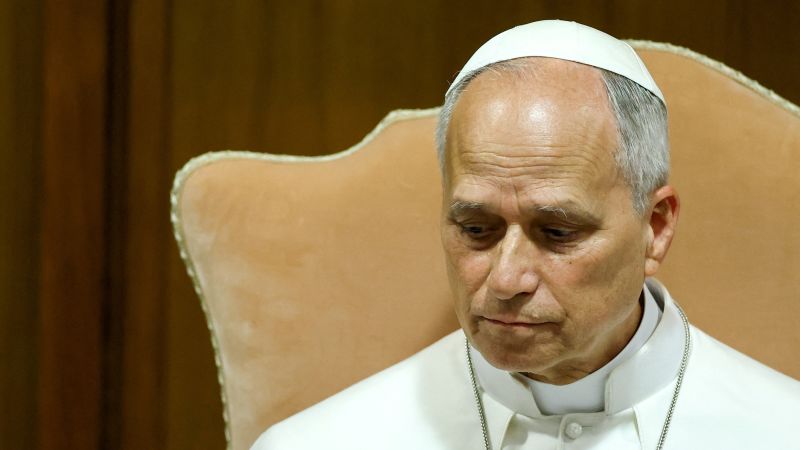
Pope Leo
These include protecting the “greatness of humanity” that stands out amidst rapidly changing technology and subjecting the use of AI in warfare to “the strictest ethical constraints.”
Although the encyclical focuses on AI, it also touches on the crises facing humanity beyond technological issues. Pope Leo said the doctrine of “just war” – the four Christian doctrines that define what circumstances justify war – is “now obsolete” and that military force can only be used “for self-defense in the strictest sense.”
He added that a “litmus test” for social justice is the treatment of immigrants and refugees, and apologized for the church’s delay in justifying slavery and condemning its scourge.
The Pope, who has made peace-making a central feature of his papacy, warned that the use of “force, violence and weapons” will ultimately “have dire consequences for civilians.”
“Building a world in a state of constant conflict is an evil that must be named for what it is,” the Pope wrote, adding:
“Humanity has far more effective and capable tools for promoting human life and resolving conflict: dialogue, diplomacy, and forgiveness.”
His opposition to just war comes after the Pope said, “Be careful when you talk about theological issues,” after Catholic spiritual leader J.D. Vance sharply criticized the joint U.S.-Israel attack on Iran and rebuked world leaders who invoked religious language to rationalize war.
Similarities between AI and “Tower of Babel”
In the document, the Pope calls for a series of principles to be applied to the development of AI, including a more equitable distribution of resources, human dignity, social justice, and respect for the environment.
Citing a Biblical story, the Pope warned that humanity risks building a “Tower of Babel” through AI. This was an attempt by a people to “make a name for themselves” with a single power and a single language. The Pope said the story was a warning against plans to “dominate and ultimately dehumanize” people, arguing instead that diverse voices and groups should contribute to the development of AI.
Leo argues that this technology must protect people’s jobs and “requires a strong legal framework, independent oversight, informed users and a political system that does not abdicate responsibility.”
Encyclicals are traditionally letters sent by the pope to bishops and the broader Roman Catholic Church, but their scope has recently expanded with Pope Francis using the first encyclical of the Holy See to call on the world to protect the environment.
Leo XIV’s document on AI, “Magnifica Humanitas” (“Magnificent Humanity”), is similarly considered a landmark document for his pontificate, dealing with groundbreaking themes that he addressed to Catholics and “all men of good will.”

Pope Leo has made AI a top priority and was the first pope to personally deliver an encyclical to the world from the Vatican.
Successive popes have typically delegated the role of submitting encyclicals to cardinals and other senior officials. Instead, the Pope oversaw the publication of a 235-page booklet with Chris Oler, co-founder of Anthropic, an AI company that is in a legal dispute with the Trump administration over the use of the technology in military and defense operations.
His writing outlines an approach to AI that neither rejects the opportunities offered by the technology nor sees it as opening up a utopian future. His encyclical seeks to bring the resources of Catholic social teaching, its engagement with political and civic life, to the debate about AI. Leo’s primary concern is maintaining the centrality and unique dignity of the human person.
To this end, the first American pope published a critique of “transhumanism,” the idea that technology can help humans overcome physical and biological limitations such as aging, and “posthumanism,” which questions human uniqueness and blurs the line between human and machine.
“We cannot assume that AI is morally neutral,” the Pope wrote. “Every technological tool embodies choices and priorities by what it measures, ignores, and optimizes, and how it categorizes people and situations.”
The choice of Antropic to present the encyclical reflects ongoing tensions between the Chicago-born pope and US President Donald Trump, who has continued to criticize the pope’s stance on the Iran war. The Trump administration has taken a hands-off approach to AI regulation, and the president has decided to delay signing an executive order that would ensure government review of new AI models, including Anthropic’s Mythos system.
But the inclusion of Ola on the launch platform shows that the Vatican is trying to directly influence those involved in technology development, rather than simply sitting on the sidelines. And a Vatican official said Anthropic’s participation “is not recognition, award, reward or canonization.”
Pope Leo has already brought up the topic of AI several times during his one-year pontificate, warning against “overly affectionate” chatbots, sending a message to tech executives holding a conference on AI at the Vatican, and urging priests not to use AI when writing sermons.
Days before the encyclical was published, the Pope made the unusual decision to create a Vatican cross-ministerial AI commission to investigate the impact of AI technology.
Rapid advances in AI may also have been a factor in Leo XIV’s choice of name. Addressing the College of Cardinals shortly after his election, the Pope noted that his namesake, Pope Leo
Pope Leo XIII wrote the groundbreaking encyclical “Rerum Novarum” in 1891. The encyclical covered a wide range of topics, including worker rights, fair wages, and private property rights. Pope Leo XIV told the cardinals that he wanted to provide the church’s social education in response to “the new industrial revolution and developments in the field of artificial intelligence.” He signed the AI encyclical on May 15, 2026. This was the same day that Realm Novarum was liberated 135 years ago.
“The time to talk about AI is now. It’s urgent,” Anna Rowlands, a theologian at Durham University who spoke with the pope at the encyclical’s launch, told CNN.
“This encyclical helps all of us, believers and non-believers alike, to ask the same fundamental question: What does it mean to be human at a time when human life faces unprecedented challenges from the development of various technologies?…This document is a rallying cry, a gospel cry, to build together a civilization of love and against a culture of mere power.”

The Pope’s encyclical builds on work the Vatican has already done on AI over the past decade, including dialogue with Silicon Valley and pushing for stronger regulation. Pope Francis also addressed world leaders on this topic during his first G7 address as Pope in June 2024. Last year, the Vatican’s Office for the Doctrine of the Faith released a document highlighting misinformation from AI, including deepfakes, and the Commission for Theology published a detailed review examining the threats posed by AI, transhumanism, and posthumanism.
The Vatican has seen firsthand how AI is being used. Pope Francis has been the subject of several deepfake images, but Pope Leo has revealed that he has refused permission for a “papal avatar” of Pope Francis to have a personal audience and answer questions.
But Vatican official Father Antonio Spadaro said Leo’s encyclical was a new moment, marking the “most significant institutional response” to AI by a major global religious community and perhaps the clearest signal yet that the Vatican intends to do more than issue intelligent warnings from the outside.
Now, the focus is on what happens next. Pope Francis timed his 2015 encyclical on the environment to influence the Paris COP21 climate change summit, and the document received attention both inside and outside the church as an inspiration for sustainability efforts.
Leos likely expect their writing to be a meaningful call to action, not just read and put on a shelf.
