

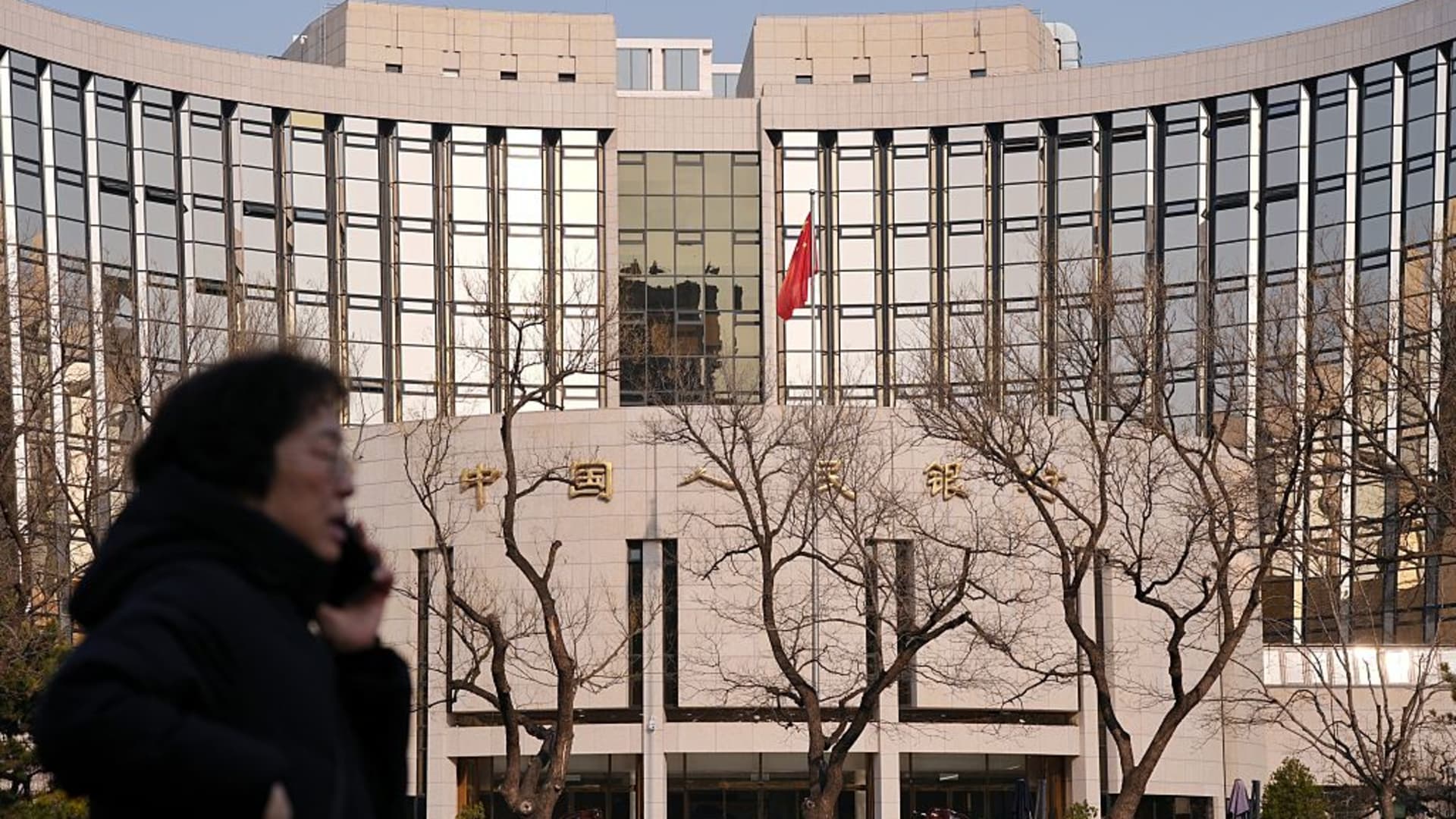
BEIJING, CHINA – DECEMBER 22: A woman walks in front of the People’s Bank of China (People’s Bank of China) headquarters on December 22, 2025 in Beijing, China.
Zhang Xiangyi | China News Service | Getty Images
China kept its benchmark lending rate unchanged for 11 consecutive months, keeping policy rates dry as policymakers weighed the economic fallout from Middle East wars against resilient growth at home and waning deflationary pressures that are reducing the urgency for Beijing to act.
The People’s Bank of China left the loan prime rate (LPR) unchanged on Monday, as soaring global oil prices due to escalating tensions in the Middle East are pushing up energy prices and clouding growth prospects.
The one-year LPR, which is the benchmark for new loans, was kept unchanged at 3.0%, and the five-year LPR, which is the standard for home loan interest rates, was left unchanged at 3.5%.
The decision came as the world’s second-largest economy grew by 5% in the first quarter, from 4.5% in the previous quarter, reaching the high end of its full-year target range. The Chinese government has lowered its 2026 growth target to a range of 4.5% to 5%, the least ambitious goal since the 1990s.
Ex-factory prices in China also rose for the first time in three years, rising 0.5% in March from the same month last year, showing import cost pressures are starting to seep into the economy. Consumer inflation recorded its biggest rise in more than three years, rising 1.3% in February but falling to 1% in March.
Strong economic growth in early 2026 has eased pressure for more stimulus, prompting economists to dial back expectations for rate cuts.
Yu Song, chief China economist at UBS Securities, said policymakers were likely to take a “wait-and-see” attitude as rising inflation would reduce the incentive for the People’s Bank of China to lower interest rates or deploy large-scale easing in the short term.
“The government may also need time to assess the impact of external uncertainties amid the Middle East conflict,” Song added.
The People’s Bank of China said it would maintain a “supportive” and “moderately accommodative” monetary stance this year to foster growth while maintaining currency stability.
Speaking at an International Monetary Fund meeting in Washington last week, Chinese central bank governor Ban Gongsheng warned that rising geopolitical tensions, protectionism and trade barriers are weighing on global economic growth and increasing volatility in financial markets. Pan called for greater international policy coordination to safeguard macroeconomic and financial stability.
Chinese Finance Minister Lan Huo’an reiterated Beijing’s call to boost domestic demand and boost consumption while providing more “global public goods” for the common good.
