

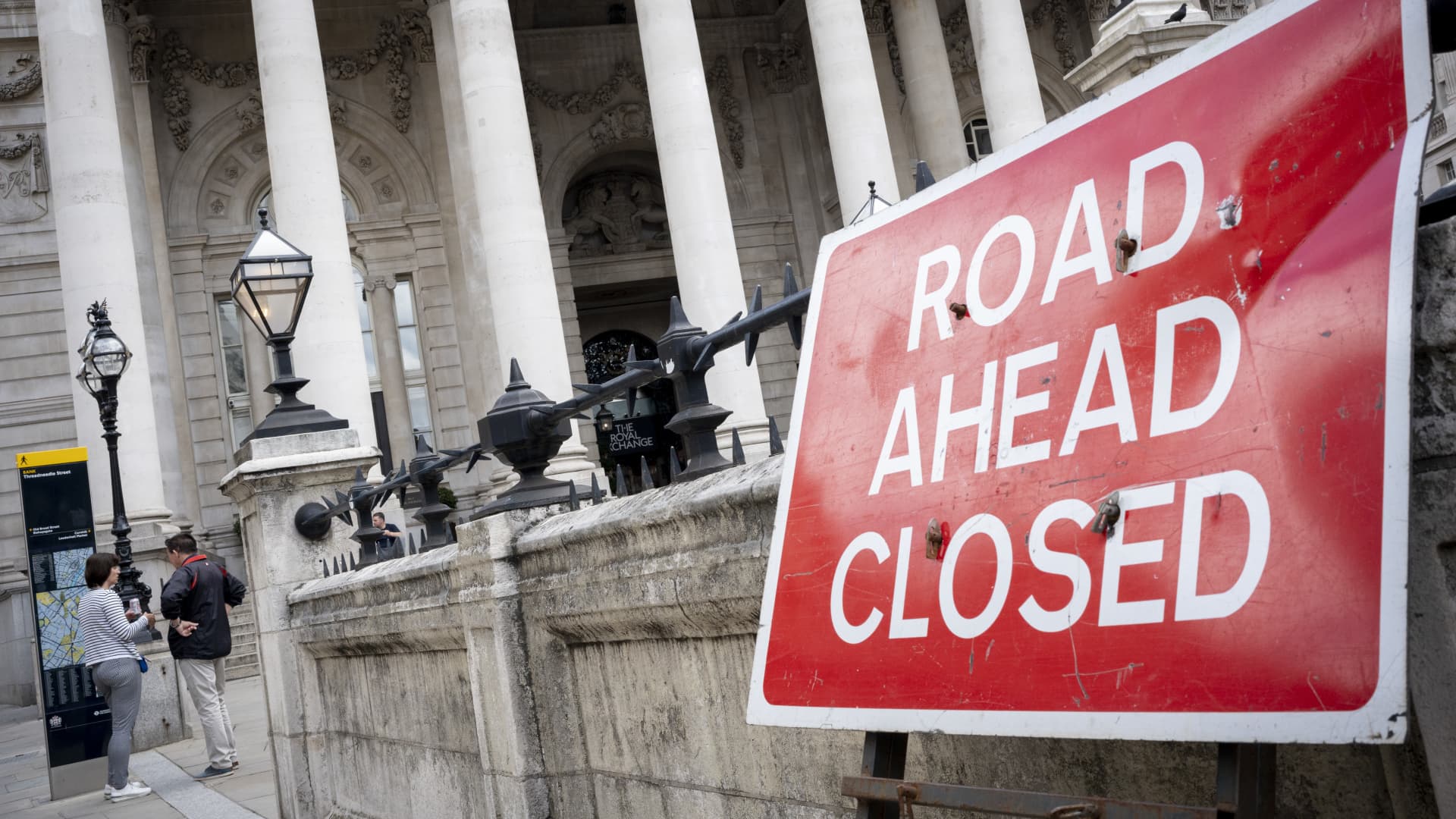
A road closure sign is placed against a wall outside the Royal Exchange in the heart of the City of London on June 13, 2022 in London, England.
By Richard Baker Photography | Getty Images
Before the Iran war broke out, the Bank of England was widely expected to cut interest rates at next week’s meeting.
However, economists predict that the U.S. and Israel’s attack on Iran, a major oil producer, and the turmoil that has engulfed the entire Middle East as the war escalates, will put a brake on any rate cuts in March.
“A BoE rate cut is possible in the first half of 2026, but March is off the table and geopolitical tensions need to be clearly calmed in April,” Alan Monks, chief UK economist at JPMorgan, said in an emailed analysis.
“Although we have now postponed the next rate cut to April, the risks are already shifting to a longer pause and greater impact on growth,” he added.
Economists were confident the central bank’s policy-setting committee, the MPC, would lean towards cutting interest rates to stimulate the UK economy amid lackluster growth, a weakening job market and falling inflation.
A worker looks out onto the weather deck of the Armada gas condensation platform operated by BG Group in the North Sea off the coast of Aberdeen, UK.
Simon Dawson | Bloomberg | Getty Images
The war damaged oil and gas infrastructure, effectively closing the Strait of Hormuz maritime corridor, plunging global supplies into a crisis and sending energy prices soaring.
Anna Titaleva, European economist at UBS Investment Bank, said on Monday that the March 19 meeting was likely to be overshadowed by growing uncertainty over the trajectory of energy prices and its impact on the inflation and growth outlook, and predicted that policymakers would want to “hold on hold pending more clarity” in March.
“The MPC will not be able to determine with sufficient certainty the nature of the shock before its March meeting, as the geopolitical situation remains highly uncertain,” he said.
He said the BOE could look out for “short-lived shocks,” but larger, more sustained shocks could require a monetary policy response.
UBS predicted the next rate cuts would be in April and July, rather than March and June. “However, we believe that developments in the Middle East and the impact on energy prices pose significant risks to our baseline,” Titaleva said.
energy price shock
According to 2025 data, the UK imports around 40% of its oil supply and up to 60% of its natural gas, despite a slight decline in its own oil and gas production in the North Sea, making it highly sensitive to changes in energy prices.
This will likely lead to higher energy prices for consumers.
Inflation in the UK had been high but had fallen in the spring on expectations that energy prices would fall. The previous inflation rate for January showed that price growth slowed to 3% in January from 3.4% the previous month.
This put the BoE’s forecast that inflation would fall toward the central bank’s 2% target on track, raising expectations that a rate cut from the current 3.75% level was justified and imminent.
What happens next will largely depend on how long the war with Iran lasts and how much energy supplies are disrupted, economists say.

“The current soaring energy prices present a major dilemma for the BOE,” said JPMorgan’s Monks.
“Interest rates remain tight and the job market continues to deteriorate, creating pressure for further easing.
“But absent a significant and rapid easing of the situation in the Middle East, Middle East banks now face a new wave of inflation,” he said.The BoE is “frightened by the persistence of UK inflation compared to other economies, and one of the vulnerabilities is the UK’s high dependence on natural gas.”
The UK Government said it is monitoring oil and gas prices and will do everything it can to protect the UK’s energy security. But Friday’s fact sheet also pointed out: “Oil and gas prices are determined by international markets, not the UK. We are price makers, not price makers.”
The report said the energy price cap – the maximum price households can charge for their energy supply – will protect households until early July, when the cap will be reviewed.
Household prices may rise thereafter, the government said, adding, “The biggest factor in determining energy prices for households and businesses is gas wholesale costs set by the international market.If they remain high, this could affect future rates.”
