

Washington Post | Washington Post | Getty Images
Robert Evans doesn’t need to watch the news to know about the economic turmoil that may give American consumers pause. He just needs to confirm the registration for the bike race.
“Every time something big is announced, like tariffs or attacks on other countries, our event registrations move like the stock market. People kind of stand back and take a wait-and-see attitude,” said Evans, CEO of Cycling Quest, which organizes high-end road races.
He says the wait-and-see attitude is now clear.
“Sometimes it’s a quick recovery, other times it’s a 20-30% decline. We’ve noticed that this is more pronounced in events that have lower entry prices and are more targeted to downstream markets,” Evans said, noting that events with higher prices seem a little more isolated. “But we are starting to see an economic downturn there as well,” he said.
The more an event is tied to travel and sports tourism, the less demand there will be due to higher airfares and travel costs. And every time you have a “joyful moment,” Evans says, a synergistic effect is created. Even for a medium-sized sporting event held in a small city like Boise, Idaho, or Provo, Utah, the cost per out-of-town participant equates to approximately $900 to $1,000 in registration fees plus ancillary economic activities (meals, lodging, gas, and ancillary expenses). Half of the participants typically stay at least one night, and 60% travel more than two hours to compete, Evans said.
“The stakes are high for the host community. As consumers start skipping events or choosing more familiar alternatives, spending evaporates while fixed costs remain for promoters. That means the biggest economic hit is not just event organizers, but local restaurants, hotels and retailers,” Evans said.
The same economic benefits apply to truly local events. For example, someone who has stopped going to an escape room game might just stay home instead of eating the dinner they would have stopped in for beforehand. This deprives local restaurants of revenue and tips from waitstaff.
Escape games, bowling, and game center troubles
The war’s impact on consumers was certainly uneven. Bank of America said debit and credit card spending rose by the largest amount in more than three years in March, led by a 16.5% increase in spending at gas stations, but non-gasoline spending also rose 3.6%. Tax law changes have also boosted the average IRS refund this year by more than 11%, another boost.
But overall, Americans are having less fun as higher gas prices and uncertainty cloud discretionary spending. The impact is reflected in the amount of money spent on escape rooms, bowling alleys and arcades.
“Placer.ai data confirms recent changes in consumer behavior, with shoppers reducing visits to discretionary retail and entertainment venues and instead prioritizing consumer staples to squeeze household budgets,” said RJ Hottovy, head of analytics and research at Placer.ai.
Bank of America CEO Brian Moynihan told CNBC on Wednesday. “Consumers are spending, and credit quality is very good and improving. … We’re all facing the same uncertainties, but U.S. businesses and consumers are doing well at the moment.”
However, consumer sentiment is fragile. The University of Michigan’s monthly survey of consumer sentiment was 47.6, a record low, down 10.7% from the March survey.

Consumer push and pull is having ripple effects across the U.S.
Bowlero operates more than 350 bowling entertainment centers across the U.S., and its traffic dropped an average of 10.6% in March, according to data from Placer.ai.
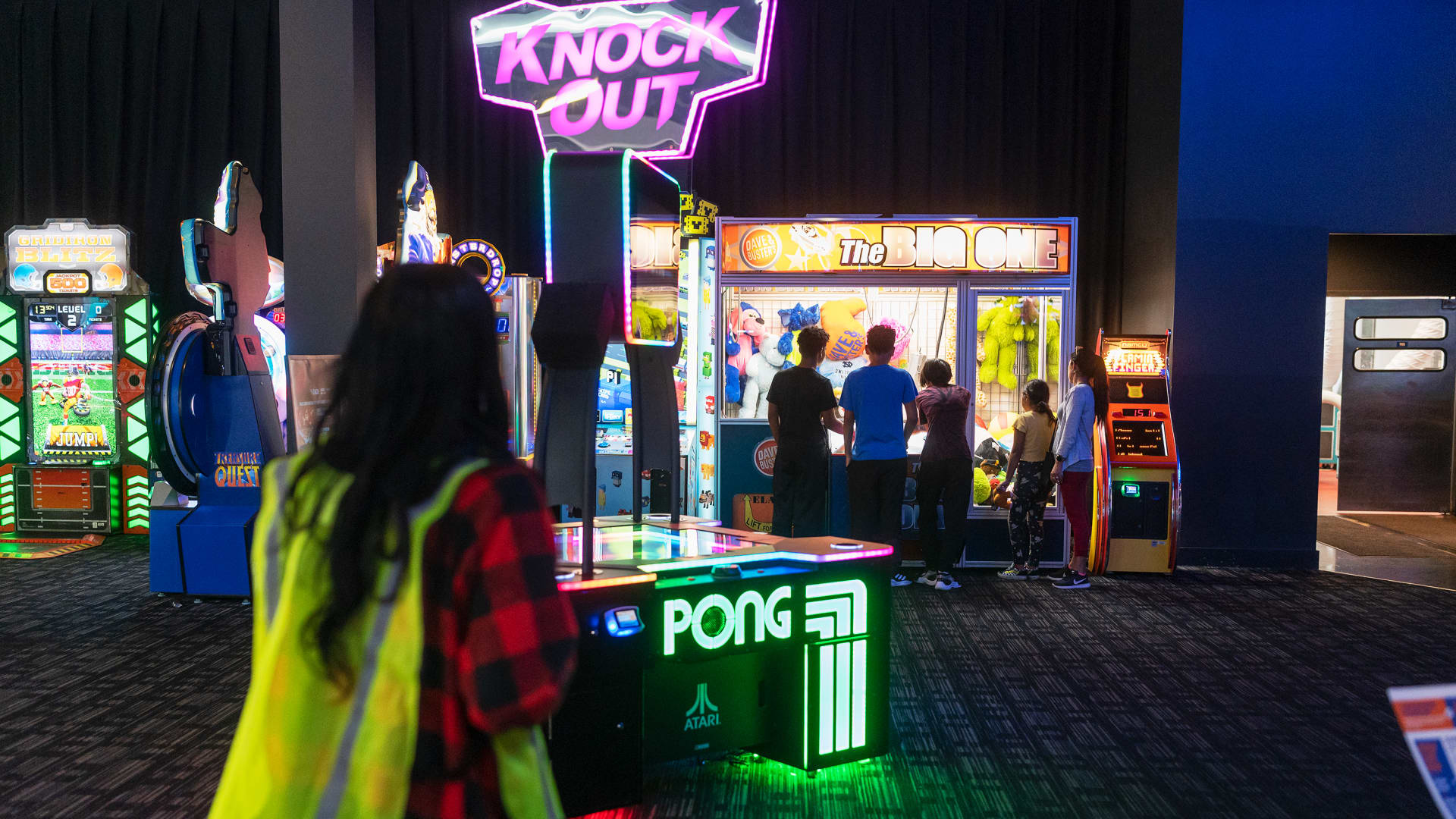
Dave & Buster’s, which operates 170 adult dining locations across the U.S., saw a 4.5% decline in foot traffic in March.
Main Event, which is owned by Dave & Busters and offers similar Etatainment activities in more than 50 stores, saw a 7.6% drop in traffic in March, according to data from Placer.ai.
Escape rooms in general were down an average of 6.7% in March.
Signs of US-Iran pre-conflict weakness
Yet, if you dig a little deeper, you’ll find that Americans are still willing to splurge for things they really want. Bowling alleys and other venues are crowded in March, but not movie theaters. “Movie theaters are bucking this trend, driven by strong new releases such as “Project Hail Mary” and “Super Mario Galaxy Movie,” Hottovy said.
For some entertainment-based businesses, consumer softening began before the war.
dave and buster stock has been under pressure dating back to mid-2024, with recent geopolitical issues further deteriorating investor sentiment. The new management team now leading the turnaround effort points to past management failures. But it’s clear Wall Street has war on its mind, with the company’s chief financial officer responding to a question from a Jefferies analyst on a March 31 earnings call about a world that “changed a lot in March.”
“There’s clearly a lot going on from a macro perspective, with gas prices and consumer sentiment,” Chief Financial Officer Darin Harper said. He said it was difficult for the company to assess the timing and macro impact of this year’s holiday changes, including Spring Break and Easter. “So, as is often the case in our business, we want to get through this spring break period and get a good handle on things. We certainly know it’s out there, but it’s too early to really parse out what impact it’s having,” Harper said.
Dave & Buster’s did not respond to a request for comment.

Dave and Buster’s Entertainment stock price performance in 2026.
Hotby said recent data showed a decisive impact from the war. “Visitors to Etatainment and escape game venues have been consistently decreasing year-on-year since mid-February,” he said.
Mark Flint, CEO and co-founder of Escape Games and Great Big Game Show, the nation’s largest escape game operator, said his company has noticed irregular traffic patterns consistent with Placer.ai data in the experience category and a change in spring break dates compared to previous years. “While we expected a year-on-year decline for this period, it appears some concepts and categories were more affected than expected,” Flint said of March’s numbers.
But he said the impact on his business was not as pronounced as in the overall category data, with year-on-year figures for April so far increasing year-on-year. In his view, running a business that people want to see “creates a buffer from what we think are temporary ebbs and flows of this kind of world situation.”
Flint said the company is investing $40 million in new stores and new experiences across the U.S. this year and does not anticipate any changes to its plans “regardless of the macro environment.” Flint added: “Playing a great game in great surroundings with the people you love is always valuable to our guests, but even more so when the going gets tough.”
There is still no reason to think about a permanent transition to a “fun” economy
Mark Johnson, a faculty fellow in investments and portfolio management at Wake Forest University School of Business, said this is typical consumer behavior when gas prices rise.
“When people are increasing their spending to fill up their tank, the first thing they do is fun discretionary items. Those are easy to put off, but things like rent, car payments and groceries aren’t.” Johnson said. Discretionary and “fun” spending may seem trivial, but it is not to the macroeconomy. “This is more important than people realize because discretionary spending is a big part of keeping local economies growing,” Johnson added.
The good news, Johnson said, is that this “joyful” withdrawal is usually more of a pause than a permanent shift, and that a swift end to hostilities in Iran means people are likely to return to bowling alleys and escape rooms. “When gas prices go down and budgets feel less tight, people tend to come right back,” Johnson said. The desire to go out and do something will not go away, it will only be delayed.
On Friday, President Trump again signaled the war was nearing an end, with Iran opening the Strait of Hormuz to full traffic and oil prices falling by as much as 9%. But by Saturday morning, Iran re-imposed control of the waterway amid gunfire.
“The key question is how long it will last,” Johnson said. “I think this rise in gas prices could last longer than many expect, which could spread inflation to more parts of the economy and start changing some discretionary spending habits in ways that are difficult to reverse,” he added.
A recent consumer sentiment survey conducted by Ernst & Young Parthenon found that 27% of consumers are cutting back on discretionary spending.
“Gasoline prices are not the only driver of discretionary price declines, but households are becoming more selective as they prioritize essentials,” said Will Auchincloss, Americas retail leader at EY Parthenon. “We are seeing targeted withdrawals in fitness and entertainment as dollars move into non-negotiables like groceries and housing.”
Mr Auchincloss said that although stress and uncertainty remain high, consumers are confident in managing their budgets and “consumer spending is likely to gradually recover” once broader cost pressures ease.
Meanwhile, back at Cycling Quest, Evans watches the registration anxiously. He explains that the registration recovery from COVID-19 has been long and complicated, but was completely thwarted by the tariffs.
“Last year we had events that tended to be well above normal, and then the tariffs were announced and registrations stopped. It stopped,” Evans said. It was a steady stream for a few weeks, just a trickle.
“As long as there’s geopolitical turmoil, there’s going to be turmoil in the fun economy. People are wondering whether to save money or just enjoy life. It’s unpredictable,” Evans said.
