

Osnabruck, Germany —
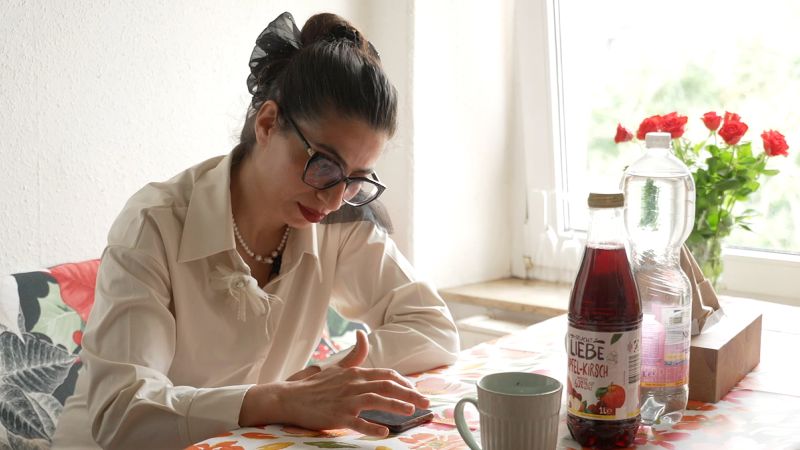
Niki Nikbakht comes from a close-knit family. She looks fondly at a photo of her two older brothers, Hadi and Fazlolla, at her home in Osnabrück, northwestern Germany.
In one photo, Hadi smiles back at her while hugging his two sons. He also has a 5-month-old daughter who has never met her father. He was sentenced to death by the Islamic Republic of Iran and has been imprisoned since before she was born.
“I always think: What if it really happened? What would I do if I never saw my two brothers again?” Nikbakht says, fighting back tears. “But then I tell myself, ‘Niki, you have to keep going. Keep fighting. Be strong. Don’t let this break you.'”
Hadi, 45, and Fazlollah, 50, are just two of dozens of Iranian political prisoners currently facing execution in Iran. The Oslo-based Iranian Human Rights Group (IHR), a non-governmental organization with members from Iran and abroad, has been documenting cases like these and believes the regime is using the conflict as cover to step up executions.
On Wednesday, the IHR condemned the execution of Mohammad Amini Dehaghani, who was arrested for participating in the January protests and sentenced to death following what rights groups believe was an “unfair trial.” So far this year, the regime has executed at least 47 political prisoners, up from 16 in the same period last year. CNN has reached out to Iran for comment.

When mass protests began across Iran late last year, US President Donald Trump warned Tehran’s leadership against a violent crackdown on demonstrators and said the US would “come to their aid.”
The Iranian regime has redoubled its use of lethal force to disperse demonstrators. Although the number of people killed is disputed, the US-based Human Rights Defenders News Agency (HRANA) has confirmed the deaths of more than 6,000 protesters and announced that another 17,000 deaths are under investigation. The Iranian government acknowledges more than 3,000 deaths, but blames most of the killings on “insurgents” who are part of an alleged Israeli-led organized conspiracy.
Still, Trump insisted his threats and subsequent decision not to intervene stopped further bloodshed.

Weeks later, as the United States and Israel launched an all-out war against Iran, President Trump called on Iranians to “seize the moment” and “take back” their country. “The United States is with you. I made a promise to you and I delivered on that promise. The rest is up to you, but we will support you.”
But as President Trump and the White House grew weary of the conflict and the global economic fallout worsened, their language softened and support for Iranian opposition waned. When the United States and Iran signed a 14-point memorandum of understanding on June 17, there was no mention of protesters, persecuted dissidents or human rights.
At the same time, Iran had already begun to ramp up executions in consultation with the United States, human rights groups say.
“With international attention focused on the war, the Iranian regime saw this as an opportunity to execute political prisoners, as under normal circumstances these executions would lead to international condemnation and have a high political cost,” IHR Director Mahmoud Amiri Moghaddam told CNN.
With each execution, the regime sends a chilling message. “We still have a responsibility and dissent will not be tolerated.”
While the world hopes for peace and the reopening of the Strait of Hormuz, the blank check seemingly given to the regime seems to hold little hope for Nikbakht compatriots.
The two were arrested at their home in Golpaigan ahead of large protests in January. Human rights groups say they were taken on October 25, 2025, when authorities tried to seize their land. The two brothers, who have been politically active for years and participated in campaigns for a referendum in the Islamic Republic, were accused of encouraging young people to protest against the authorities in early June and were sentenced to death on broad charges of “fesad fil altu” (a capital crime translated under Iranian law as “corruption on earth”).


“The Islamic Republic never wants to admit that it has political opponents or political prisoners. It always tries to portray politically active people as dangerous criminals, so it can claim that they are a threat to society and justify giving them death sentences,” Nikbakht said. “In reality, it’s creating fear in society.”
Iran said all prisoners in the Islamic Republic are afforded due process. But Nikbakht said the brothers had been held for months without a proper trial, and their cases and sentences were sped up after the war between the United States and Iran began.
“The war really had an impact,” she says.
Human rights groups say the regime relies on forced confessions to justify these executions.
Two such cases are Nasser Bakelzadeh (26) and Mehrab Abdulrazadeh (28). They confessed to serious crimes earlier this year.
“I took pictures of two police stations and sent them the pictures. I also took pictures of the hall of the Revolutionary Guard Corps (Sepah) compound where the soldiers were standing,” Bakherzadeh said in a video shared in Iranian state media on May 2, referring to the Islamic Revolutionary Guard Corps.
But in their final phone calls from prison to relatives and rights groups, both men denied the crimes they had publicly admitted, saying they had been tortured and forced to make false confessions.
“I was subjected to the most severe mental torture. They left me alone in that cell for 20 days at a time,” Bakerzadeh said. “I was losing my mind.”
“You are hearing my voice from Urmiye Central Prison, and it may be the last time,” Abdullahzadeh is heard saying in a December recording shared by the NGO Kurdistan Human Rights on February 19. “From the first day I was arrested, they used torture and threats to extort a confession from me that was completely false. None of the charges against me are true. They know it, and God knows it. I am innocent.”
Human rights groups say the reversals are not surprising.
“Of all the political prisoners executed in the past three months, our records show that they were all sentenced on the basis of confessions extracted after torture,” says IHR’s Moghaddam. “They are being held in solitary confinement for long periods of time, without due process, and without access to a lawyer of their choice.”
Both Bakherzadeh and Abdullahzadeh were hanged in early May.

Iranian Kurdish activist Hamid Chapati himself spent several months in West Azerbaijan’s notorious Urmiyeh Central Prison, sharing a cell with the two men.
“For Nasser (Bakerzadeh) and Mehrab (Abdullahzadeh) and all the prisoners sentenced to death, every day could be the last day, and in sleepless nights, every moment could be the last moment,” he told CNN.
Mr. Chapati recently fled Iran to Iraq, fearing he would be executed. He spoke to CNN from an undisclosed location.
Chapati said that a few days before his execution, Bakherzadeh sent him a message through a mutual friend asking to speak one last time. But that conversation never happened.
“When I heard the news of his execution, I felt like I was executed along with him,” Chapati said.
Because of these reports, Nikbakht feels unable to stop his efforts. She must become a voice for her brothers, using the international community and the media to raise awareness of the regime that sees them dead.
But it’s not an easy task.
“Sometimes I smile, but all I can do in front of other people is smile and look strong,” she says. “But in my mind I keep asking myself: Why is this happening? Why do people have to face situations like this to seek freedom? It’s incredibly difficult.”
