

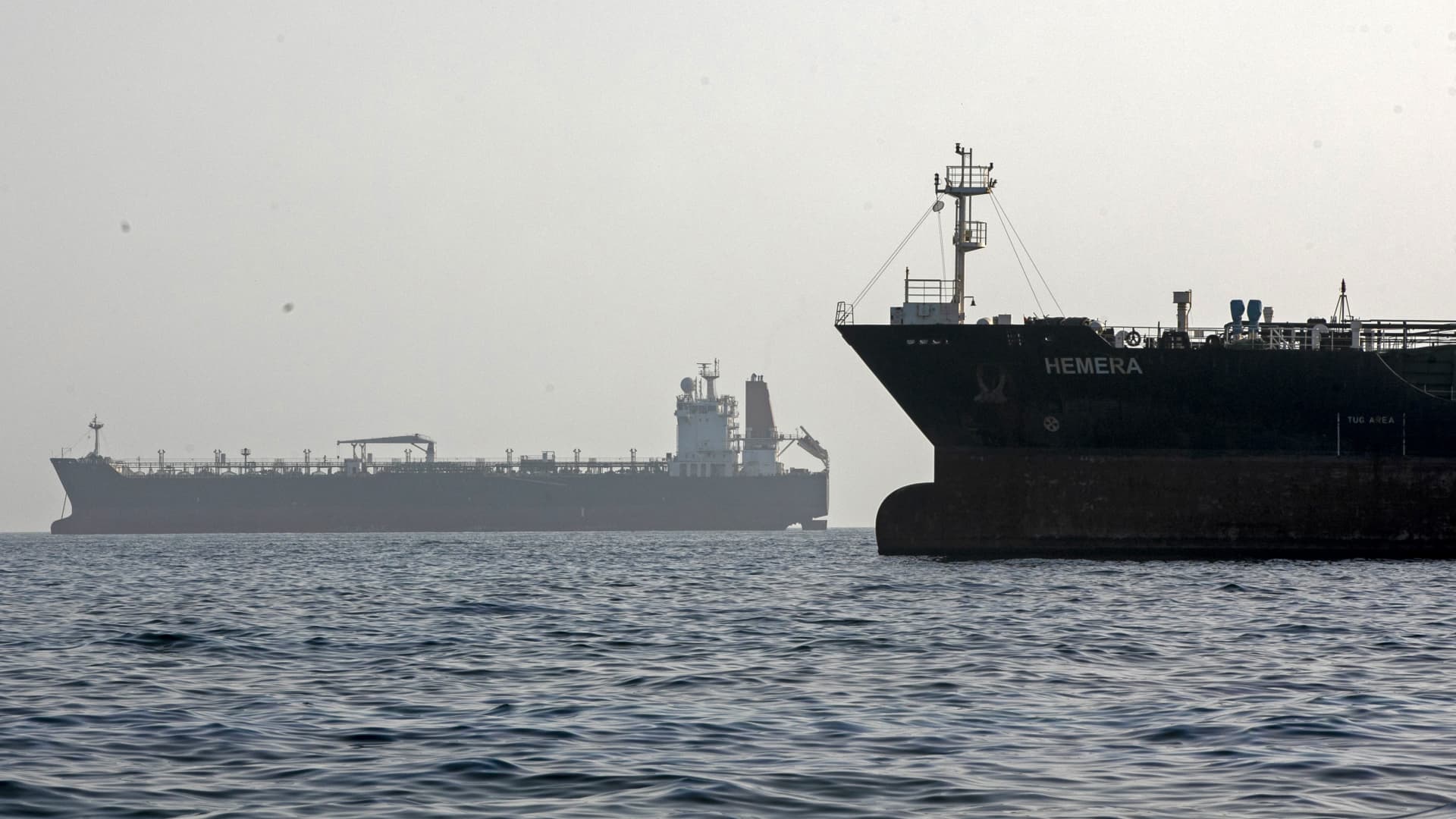
A ship remains anchored in the Strait of Hormuz near Larak Island, Iran, on May 16, 2026. Negotiations between the United States and Iran over the opening of the vital waterway have largely stalled as the two sides mutually reject proposals to end the war that began when the United States and Israel attacked Iran on February 28.
Majid Saidi | Getty Images News | Getty Images
President Donald Trump said Saturday that a peace deal with Iran that seeks to reopen the Strait of Hormuz is “largely negotiated” and will be announced soon. This could end a dispute that has choked global energy markets and pushed U.S. inflation to its highest level in years.
In a social media post, Trump said he held telephone conversations from the Oval Office with the leaders of Saudi Arabia, the United Arab Emirates, Qatar, Pakistan, Turkey, Egypt, Jordan and Bahrain, as well as Israeli Prime Minister Benjamin Netanyahu, all focused on finalizing a deal with the Islamic Republic of Iran.
“The deal has been largely negotiated and is subject to finalization between the United States, the Islamic Republic of Iran, and other countries,” Trump said in a post.
He said details of the agreement, including the reopening of the Strait of Hormuz, a key barrier for global energy trade, “are being discussed and will be announced soon.”
Iran’s Foreign Ministry announced on Saturday that the deal being discussed includes a memorandum of understanding as a first step, followed by broader consultations within 30 to 60 days.
Problem
Still, there appeared to be clear points of conflict between the two sides.
Iran’s Fars News Agency reported that the Strait of Hormuz will remain under Iranian control, according to the latest documents exchanged between Iran and the United States. The report rejected President Trump’s announcement to reopen the Strait as part of a “majority of measures.” The “negotiated” deal is “incomplete and inconsistent with reality.”
Trump also did not mention Iran’s nuclear program or the deal on highly enriched uranium, both of which the administration has repeatedly cited as essential to ending the war. Iran is seeking to postpone nuclear negotiations until hostilities formally cease.
Reuters quoted a senior Iranian government official as saying on Sunday that Tehran had not agreed to hand over its highly enriched uranium stockpile, adding that the nuclear issue was not part of the prior agreement with the United States.
An announcement from the Trump administration may be delayed because gunshots were heard in the immediate vicinity of the White House and a security lockdown began.
Reuters reported that US Secretary of State Marco Rubio, who is on a visit to India, said further news on the situation in Iran could be released later on Sunday, adding that progress had been made in the past two days towards resolving the conflict.
Earlier on Saturday, the Financial Times reported that the deal establishes a framework for nuclear talks, eases sanctions against Iran and could lift a freeze on Iran’s overseas assets.
There has been a fragile ceasefire since April 8, punctuated by skirmishes between the United States and Iran over the Strait of Hormuz. The conflict has sparked what Gulf countries call the worst global energy crisis in decades, fueling expectations that soaring U.S. energy prices could lead to higher inflation and the need for the Federal Reserve to raise interest rates.
Pakistani and Qatari negotiators met with their Iranian counterparts on Thursday and Friday, in regular contact with US special envoy Steve Witkoff, FT reported.
Iran’s top negotiator told his Pakistani counterpart that Iran would not violate their “legitimate rights” and expressed distrust of the United States, Reuters reported on Saturday.
Iranian Parliament Speaker Mohammad Baqer Qalibaf said, according to Reuters, that Iran’s armed forces have rebuilt capabilities that were damaged since the start of the conflict in late February.
A major sticking point is President Trump’s demands for Iran to hand over enriched uranium and permanently give up its nuclear weapons capabilities.
President Trump has also called on Iran to dismantle its nuclear facilities in Natanz, Fordow and Isfahan, which the United States bombed after joining Israel’s war against Iran in the early stages of the conflict last June.
“So far and so close”
Iran’s Foreign Ministry said the US had repeatedly come up with “conflicting positions” and said the two countries remained “very far and very close” to an agreement.
President Trump said on Monday that the United States refrained from any new attacks on Iran this week because “serious negotiations” were underway.
Gulf states including Saudi Arabia, Qatar and the UAE have called on President Trump to halt military strikes, fearing Iranian retaliation against the region and further damage to global energy markets.
Pakistani Prime Minister Shehbaz Sharif congratulated President Trump on a “very useful and productive” telephone conversation with regional leaders, adding in a post on X that “this consultation was a useful opportunity to exchange views on the current situation in the region and how to move forward with ongoing peace efforts to bring lasting peace to the region.”
Turkish President Recep Tayyip Erdogan’s office said Turkey was “ready to provide all kinds of support during the implementation phase of a potential agreement with Iran.”
– CNBC’s Azhar Sukri and Reuters contributed to this article.
