

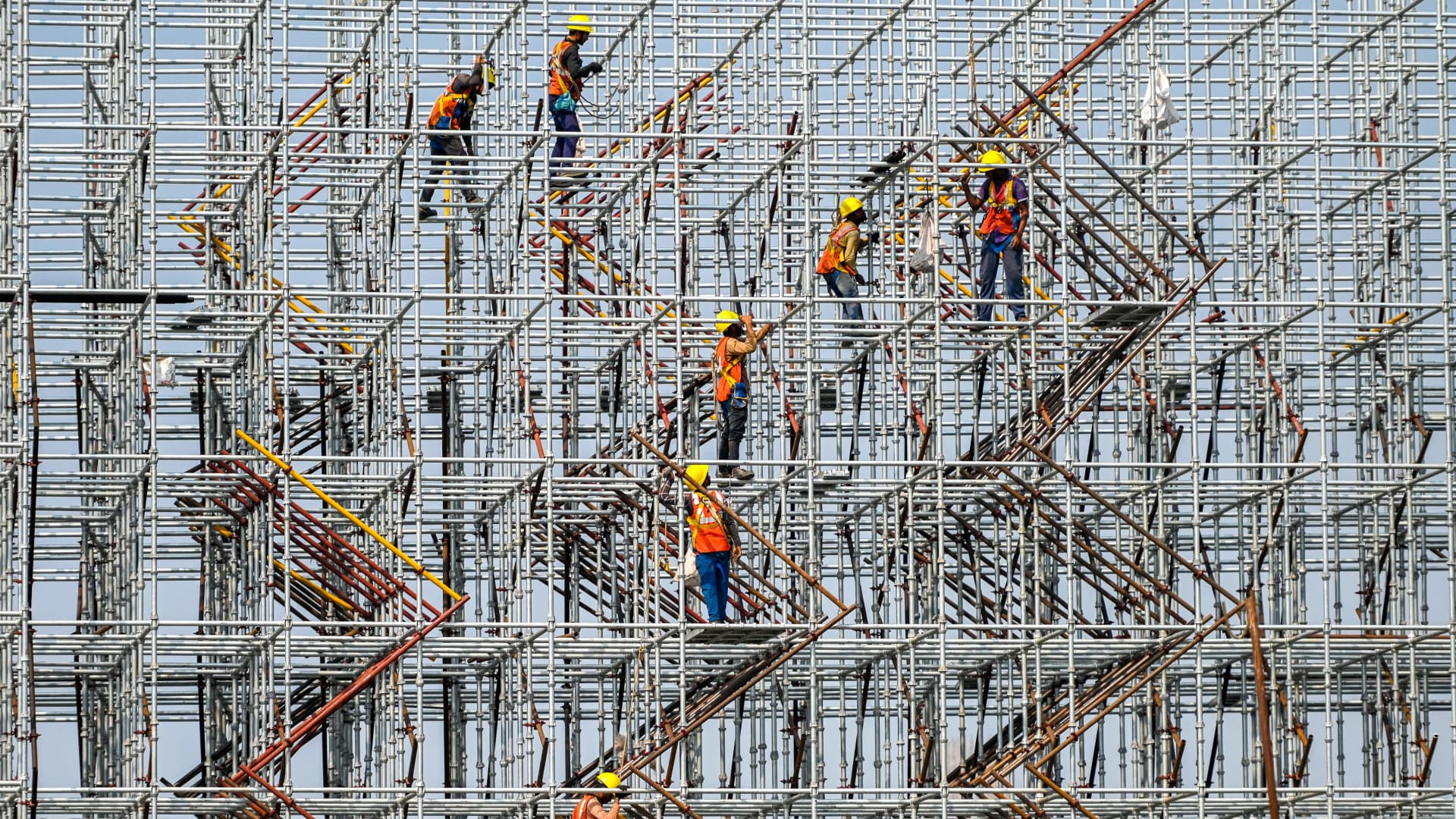
Workers work at the construction site of the coastal road project in Mumbai, January 12, 2022.
Punit Paranjpe | AFP | Getty Images
India expects economic growth in fiscal 2027 to be between 6.8% and 7.2%, faster than most major economies.
The world’s fourth-largest economy aims to conclude a trade deal with the United States “by the end of the year” and aims to achieve this growth on the back of a stable domestic economy and reduced external uncertainty, India’s Ministry of Finance said in its economic review for fiscal year 2026.
According to the International Monetary Fund, India is expected to remain the world’s fastest growing economy, with the country’s growth rate unchanged at 6.4% in 2026 and 2027. In contrast, the IMF expects the global economy to grow by 3.3% in 2026 and contract slightly to 3.2% in 2027. Major countries such as Germany, the UK and Japan are expected to grow in the low single digits.
Regarding the outlook for the Indian economy next year, the report states, “Despite global uncertainty, the economy is growing steadily, and caution is needed, but it is not pessimistic.”
Successful growth
As reported earlier this month, India’s economy is expected to grow by 7.4% in the fiscal year ending March 2026, higher than the 6.5% growth in the previous fiscal year.
Tariffs of more than 50% have been imposed on Indian exports to the United States since August, and although negotiations are ongoing, no agreement has yet been reached.
But economic surveys show that India’s economic growth is not being hampered by a slowdown in exports to the United States.
India’s main exports are textiles, seafood, gems and jewellery, auto parts and leather products, which have been affected by US tariffs. However, these products are finding alternative markets, according to data shared by the Indian government.

According to the report, Indian seafood products are now being sold in countries such as China and Malaysia, and exports of auto parts to the United Arab Emirates (UAE) are also increasing.
Despite the tariff shock, India’s growth has “accelerated” this fiscal year due to a number of structural reforms and policy measures, the finance ministry said.
Last September, India lowered the tax rate on goods and services across all products and services in order to expand domestic consumption. The country has also announced several trade agreements aimed at diversifying its export markets.
dangerous currency
However, as the global economic environment becomes increasingly uncertain, the weakening Indian currency is a cause for concern for the government, even as India maintains its growth story.
India has a trade deficit in goods, but the net trade surplus in services and remittances does not fully cover it. The country needs an influx of foreign capital to maintain a healthy balance of payments. As these flows dry up, the rupee depreciates, the report highlights.
In 2025, the rupee emerged as Asia’s cheapest currency due to record capital outflows from foreign investors. Most experts expect the currency to weaken further against the dollar.
While economic studies point to the global system as the reason why India’s macroeconomic success has not translated into currency stability or capital inflows, economic experts have a different view.
Global investors will not consider investing in India while global interest rates in other major economies remain high.
Anubhuti Sahai, head of Indian economic research at Standard Chartered Bank, said capital inflows would not come to India “if investors can make 4-4.5% returns in the US without currency risk.”
He added that while India’s growth story provides a strong investment rationale, India needs to improve the ease and speed of doing business in the country to attract capital.
Sahay said investors’ expected returns in a strong growth market like India are being undermined because it takes a lot of time to set up a business in India.
