

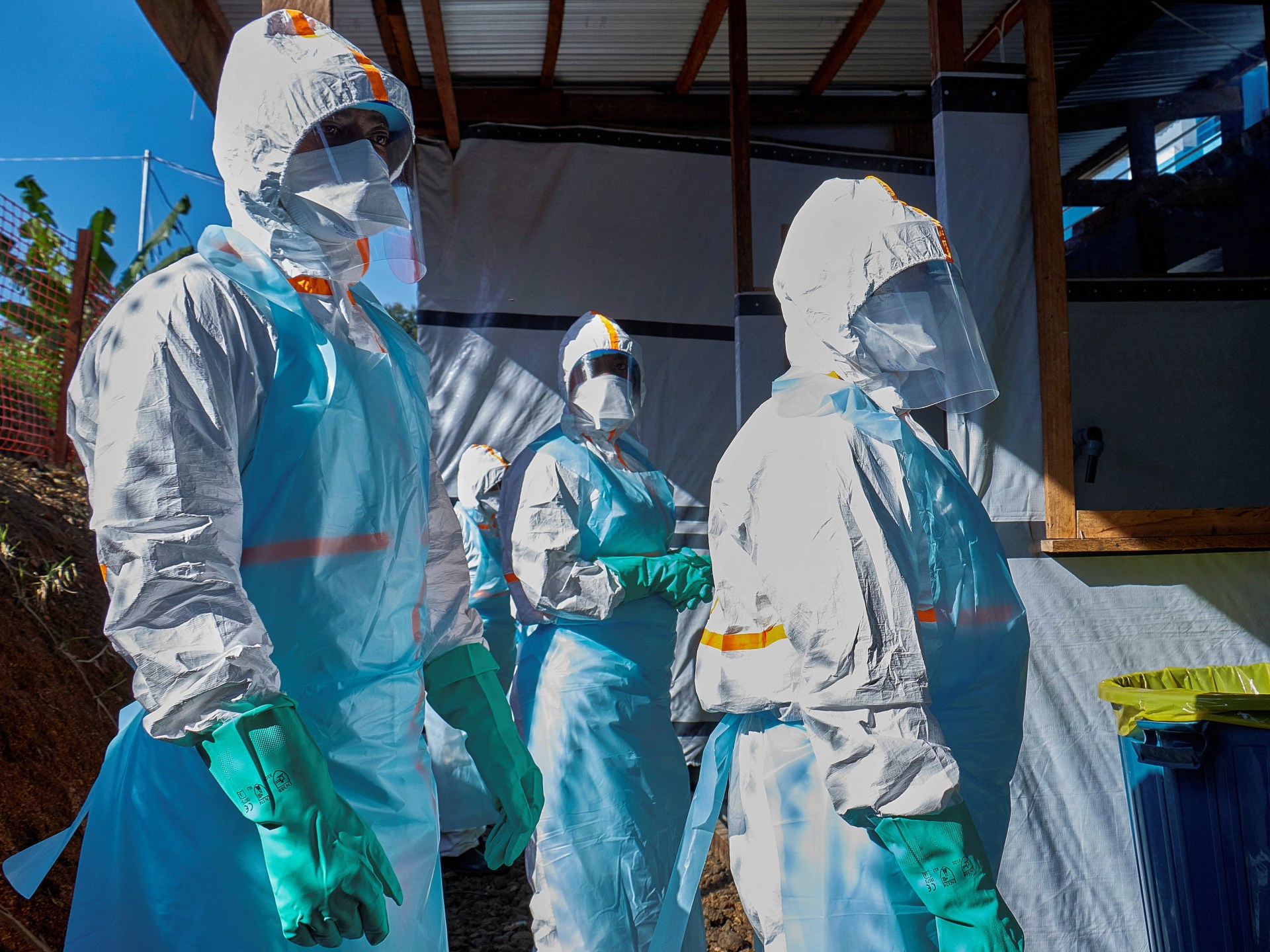
Fans from around the world are beginning to arrive in North America for the biggest World Cup in history, but an Ebola outbreak in East Africa has health officials in the host nation on high alert.
Authorities are working hard to contain the outbreak of the rare virus strain Bundibugyo, which was first declared on May 15 in the Democratic Republic of the Congo (DRC). Since then, at least 488 people have been infected and 86 have died in the Democratic Republic of Congo.
Recommended stories
list of 4 itemsend of list
The disease has spread to neighboring Uganda, and the World Health Organization (WHO) has declared the outbreak a “public health emergency of international concern.”
Uganda has confirmed 19 cases and two deaths and has largely closed its western border with the Democratic Republic of Congo to curb cross-border transmission, frustrating traders who rely on crossing the border for business.
The US Centers for Disease Control and Prevention (CDC) has warned that the outbreak could become the largest Ebola outbreak in history, rivaling the 2014-16 outbreak in West Africa.
With more than 1 million fans expected to travel to North America for the World Cup, here’s how authorities in the United States, Canada and Mexico are preparing to stop the spread of Ebola during the tournament.
Travel restrictions and airport screening
A joint statement from the three countries said the World Cup hosts announced “adjustments to public health travel measures for individuals coming from African regions at highest risk for Ebola,” but details of the adjustments were not disclosed.
In May, the United States barred entry to all noncitizens who had traveled to the Democratic Republic of the Congo, Uganda, or South Sudan in the past 21 days. The ban then extended to green card holders who had been in those countries in the past 21 days.
Many U.S. airports, including Washington Dulles Airport and Hartsfield-Jackson Atlanta Airport, are also implementing enhanced screening measures for travelers from affected areas.
Canada has temporarily barred the entry of residents of the Democratic Republic of the Congo, Uganda and South Sudan for 90 days, according to the country’s public health authorities.
Canadian citizens, permanent residents and other foreign nationals who have been in an infected area in recent weeks and do not have symptoms will be required to quarantine for 21 days, and the new rules will take effect from May 30.
Mexico’s health secretary outlined stepped-up Ebola testing at airports, called on citizens to avoid traveling to the Democratic Republic of the Congo, and asked those arriving from the country to adhere to a 21-day quarantine.

Democratic Republic of the Congo, forced quarantine in Belgium
The Democratic Republic of the Congo, which qualified for the World Cup for the first time since 1974, canceled its scheduled pre-World Cup training camp in the country due to the Ebola outbreak and are instead based in Belgium.
Andrew Giuliani, executive director of the White House’s World Cup Task Force, confirmed to ESPN on May 23 that the Congolese delegation must remain in a bubble in Belgium and quarantine for 21 days or risk being denied entry to the United States.
The team’s World Cup preparations were further thrown into turmoil after a warm-up match against Chile scheduled for Spain was canceled due to concerns about the spread of the virus.
Juan Franco, the mayor of La Linea de la Concepción in southern Spain, said: “We have signed a decree banning the June 9 match between the Democratic Republic of the Congo and Chile.”
DRC coach Sébastien Desabres offered to play the match behind closed doors instead.
“The only thing I can say is that we are used to adapting and whatever happens, we can adapt to all these situations without any problems,” he added.
The East African squad will be based in Houston, Texas, during the tournament, and will play Portugal in their first Group K match on June 17th.
DRC will then face Colombia in Guadalajara, Mexico, on June 24th, followed by the final group match against Uzbekistan in Atlanta, Georgia, USA, on June 28th.
Tracking the outbreak
Boston University’s Center for Emerging Infectious Diseases will monitor the World Cup and track outbreaks of infectious diseases.
Their BioThreat Outbreak Analysis and Communication Network (BEACON) program aims to “keep public health officials, participants, and the international community informed, safe, and ahead of the curve,” the website update states.
The National System for Special Pathogens (NSPS) also recently conducted a tabletop exercise to simulate a response to an outbreak of illness during a tournament.
Their mock scenario focused on an outbreak of Middle East Respiratory Syndrome during the World Cup.
The exercise emphasized “the importance of timely action, coordinated efforts and comprehensive planning,” the NSPS said.
‘The risk is very low’ for fans
Despite these measures, health experts are not too concerned about the risks fans traveling to North America face this summer.
“If you’re a casual visitor to the World Cup from all over the world, I think the risk of contracting Ebola is very low,” Oliver Johnson, a global health scholar at King’s College London, told Reuters.
“Ebola has never caused an actual outbreak in high-income countries, with only rare cases occurring.
“That’s because it’s not airborne. It usually requires direct contact with someone with severe symptoms, and there’s usually good contact tracing. If a case occurs, it’s identified quickly,” he added.
Johnson said fans traveling for the tournament should follow basic precautions such as proper hand hygiene and avoiding close contact if unwell.

