

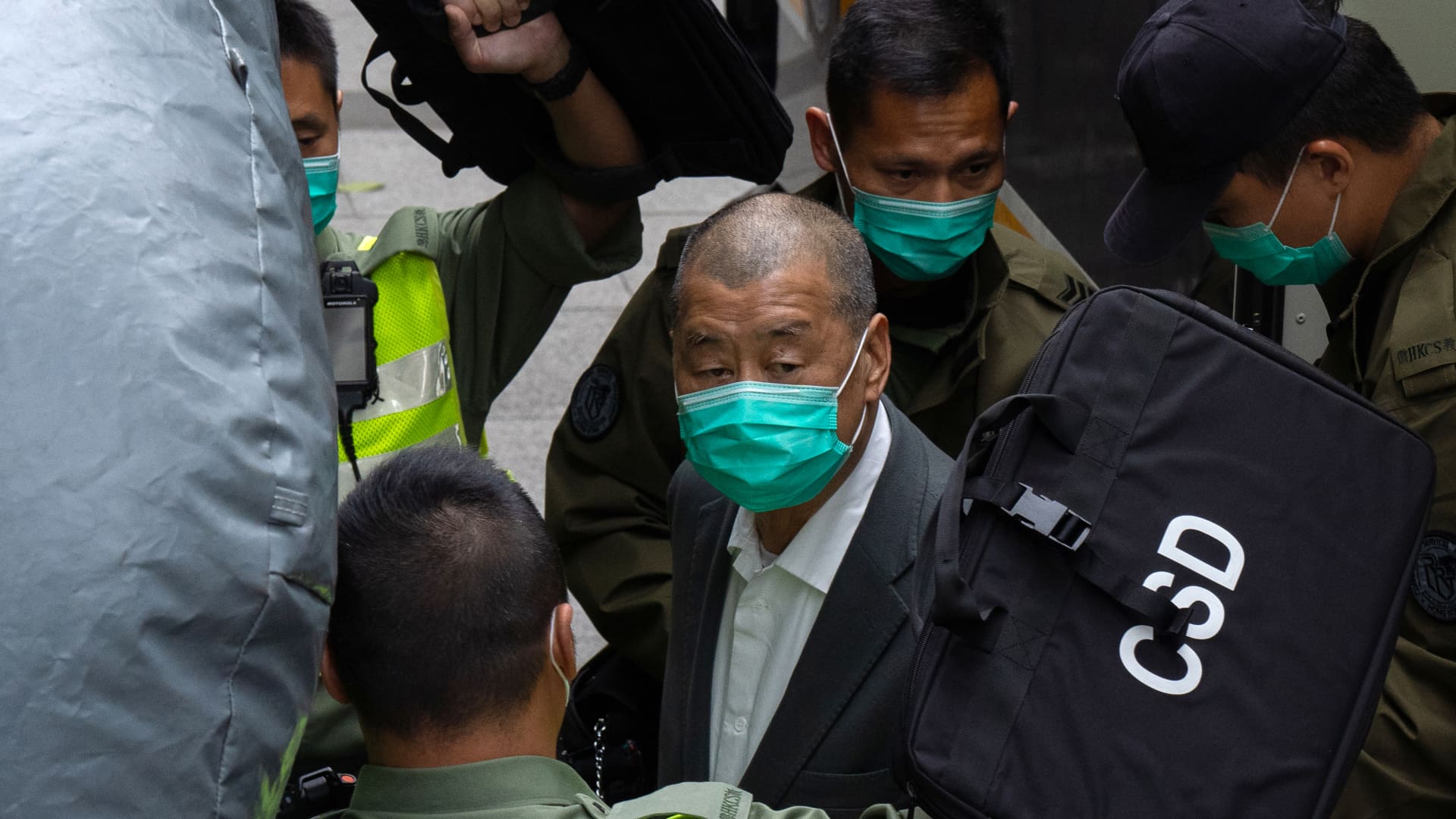
Hong Kong democracy activist and media mogul Jimmy Lai was found guilty of sedition and foreign collusion by a Hong Kong court on Monday.
The 78-year-old was charged under Hong Kong’s controversial national security law enacted by the Chinese government in 2020 after pro-democracy protests swept the region in 2019.
The court said Lai was guilty of “conspiracy to conspire with a foreign country or external forces to endanger national security.”
It also said that Mr. Li and the tabloid Apple Daily called on countries and entities outside China to “improve sanctions, blockades, or other hostile activities” against Hong Kong and China.
The court said in its 850-page judgment that the businessman “has harbored resentment and hatred for the People’s Republic of China for a long time in his adult life.”
Lai, one of the Chinese Communist Party’s most vocal critics, had pleaded not guilty to two charges under the National Security Law: collusion with foreign forces and conspiracy to publish inflammatory material.
Mr. Lai has been arrested since 2020, and his trial will begin in December 2023. Mr. Lai’s sentence is scheduled to be handed down on January 12.
Speaking immediately after the ruling, Andrew Collier, a senior fellow at the Harvard Kennedy School, said the ruling was “not very good” from a foreign investor’s perspective, adding: “People want an independent court system that protects the rights of the public and the financial community.”
He said the verdict against Mr Lai was expected, but said the Hong Kong issue was about investor confidence.
Collier said the city is expected to see an increase in the number of IPOs in 2025, but “if investors are uncomfortable with the court system because of cases like Jimmy Lai’s, that’s not good for Hong Kong’s future.”
Lai, the founder of Asian clothing brand Giordano, newspaper company Apple Daily, and digital media company Next Digital, was mentioned by US President Donald Trump during his meeting with Chinese President Xi Jinping in South Korea in October.
According to Reuters, Trump pressed Xi to release Lai during the meeting.
The court said Lai’s “sole intention” was to seek the overthrow of the Chinese Communist Party, adding: “Even if the ultimate price was sacrificing the interests of the people of the People’s Republic of China and the Hong Kong Special Administrative Region (Hong Kong is a special administrative region of China). This was the ultimate purpose of the conspiracy and separatist publications.”
In an interview with CNBC before the ruling, veteran investor David Roche suggested that a more lenient approach could have a positive impact on Hong Kong’s business environment. “I think it will help give the most important impression, and thus confidence, to people in the financial industry that Hong Kong is back to normal, business-driven and dynamic.”
Mr Lai acquired British nationality before Hong Kong was handed back to China in 1997.
The court ruling is the latest development in Hong Kong’s political landscape, which has seen the decline of democratic opposition in one of Asia’s financial hubs since the enactment of the national security law.
Hong Kong’s electoral system changes in 2021 have drastically reduced the number of directly elected members of the city council, and only “patriots” who have been vetted by the election commission can run for election.
Monday’s ruling came on the heels of Sunday’s dissolution of Hong Kong’s last pro-democracy party after 31 years and a “patriots-only” legislative election that had the second-lowest turnout in the region’s history.
Kenneth Roth, a visiting professor at Princeton University’s School of Public and International Affairs and former director of Human Rights Watch, said in a response to CNBC that the decision “underscores the complete end to the political freedoms that once made this city great.”
