

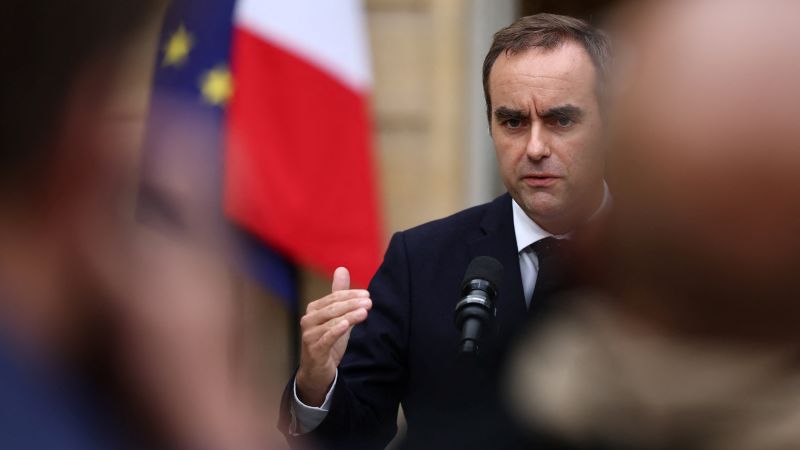
France’s presidential palace announced Prime Minister Sébastien Lecornu’s new cabinet structure on Sunday, but most key ministers were left in place as the opposition demanded a political shift to win support for emergency budget talks.
Lecorne, who was reappointed as prime minister last week after just 27 days in office, promised to deliver a cabinet with “renovation and diversity” but stuck to most of his previously chosen jobs.
It remains to be seen whether the new Lecorne cabinet will satisfy the opposition. The far-left France Inboud (LFI), along with the far-right National Rally, has announced it will introduce a no-confidence motion on Monday, meaning the new government will face a tough vote by the end of this week.
Meanwhile, the Socialist Party, which will almost certainly need government support to survive such a vote, remains open to options.
After the government’s announcement, Socialist Party leader Olivier Faure wrote “no comment” on X.
L’Ecornu, whose last cabinet lasted only 14 hours, reappointed Laurent Lescure, a close ally of President Emmanuel Macron, as finance minister. The government must formally submit its budget in the coming days, but it faces a perilous road through parliament, which is deeply divided and many set their sights on the race to succeed Mr Macron in 2027.
Lecorne also retained Foreign Minister Jean-Noël Barrault and Justice Minister Gerard Darmanin.
“A single imperative guides my decisions: to serve my country and the people of France,” Darmanin wrote in a post. “Without abandoning any of my beliefs, I therefore take a leave of absence from all partisan activities.”
The most notable change in cabinet nominations is Interior Minister Laurent Nuñez, the Paris police chief, replacing Bruno Retailot, the leader of the conservative Republican Party and who himself has presidential ambitions.
Mr. Nuñez is a graduate of the elite National Administration School and has held key positions across France’s security services, including as head of the domestic intelligence agency DGSI. Last year, he kept Paris safe during the Olympics.
Former Prime Minister Elisabeth Born lost her post as education minister and was replaced by civil servant Edouard Jeffrey.
Center-right veteran Catherine Vautrin replaced Lecorne as defense minister. She previously served as labor minister in the government of former prime minister François Bayrou and as a minister under former president Jacques Chirac.
Mr L’Ecornu met with Mr Macron on Sunday night to work out the list. Two days after Macron was reelected as prime minister, France was in the midst of its worst political crisis in decades.
BFM television reported that Macron wants to be nominated by the government before leaving for Egypt late Sunday to attend meetings aimed at ending the war in Gaza.
The presidential administration says it needs to prepare a budget bill by Wednesday to meet constitutional deadlines. Establishing a cabinet is a formal prerequisite for submitting a budget.
France is in crisis as a series of minority governments struggle to pass deficit-cutting measures through a tight parliament divided into three ideological blocs.
In a sign of the instability in French politics, L’Ecornu said on Sunday he would not rule out another resignation.
“If the conditions are no longer met again, I will leave,” he told La Tribune Dimanche. “I’m not going to go along with anything.”
Pensions and wealth taxes remain important issues
The Socialist Party wants Lecorne to repeal Macron’s pension reforms and introduce a wealth tax, an idea rejected by the right.
“Any discussion is possible as long as it is practical,” Lecorne said on Saturday, hinting at the possibility of flexibility on pensions.
If he fails to win parliamentary support, France will need an emergency stopgap bill to authorize spending from January 1 until a full budget is adopted.
