

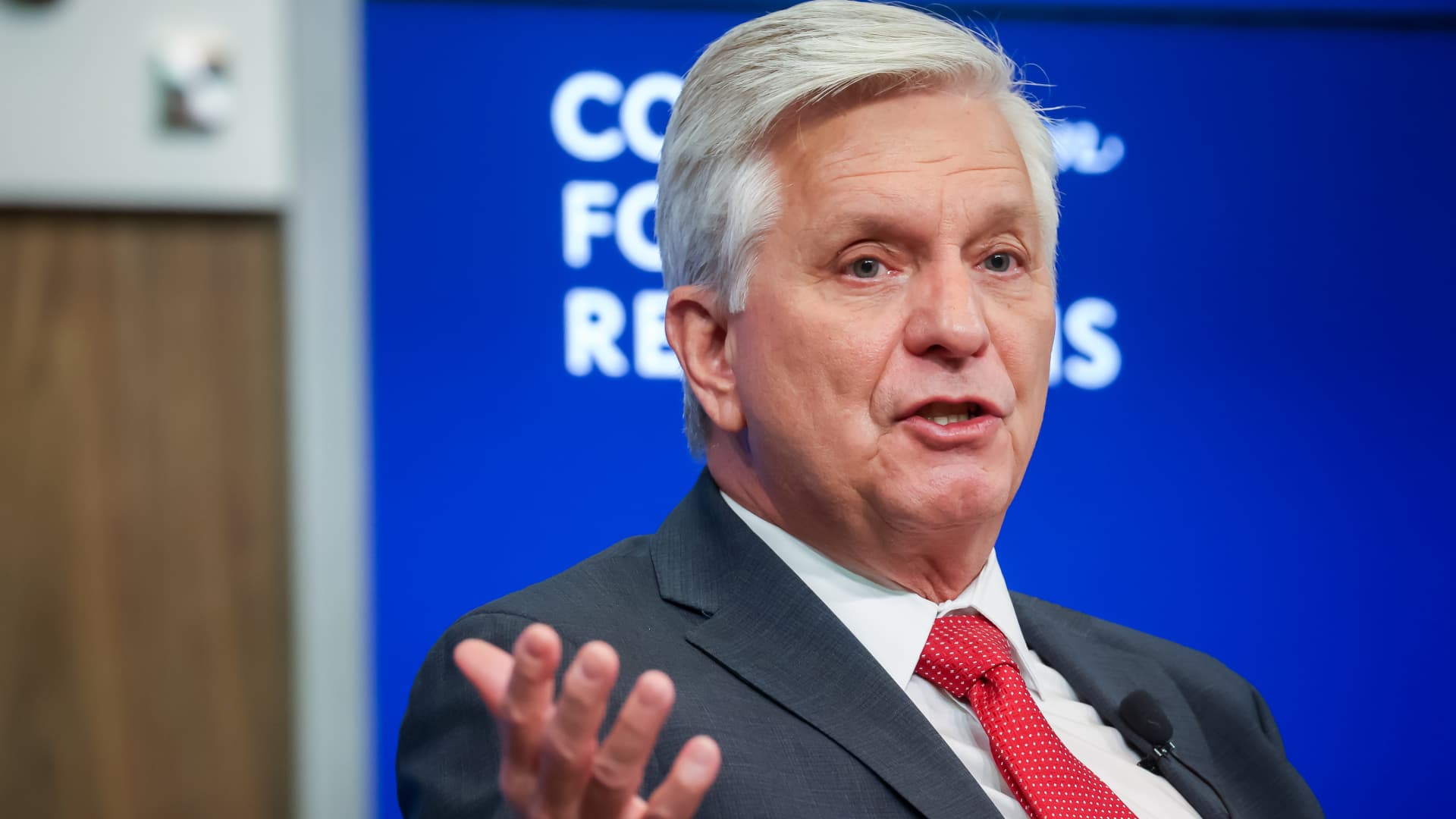
U.S. Federal Reserve Governor Christopher Waller speaks at the C. Peter McCollough International Economic Series at the Council on Foreign Relations in New York, USA, on Thursday, October 16, 2025.
Michael Nagle | Bloomberg | Getty Images
Federal Reserve President Christopher Waller said Friday that current economic conditions complicate their approach to interest rates, as policymakers face a potentially prolonged inflation shock and a labor market that appears stable despite a lack of job growth.
Against this backdrop, Waller said the Fed may have to suspend policy for an extended period until there is more clarity on the direction of the economy.
“Higher inflation and a weaker labor market will be very complex for policymakers,” the central bank president said in a speech in Alabama. “Faced with this situation, the risks of the Fed’s dual mandate need to be balanced to determine the appropriate path for policy. If the risks to inflation outweigh the risks to the labor market, that may mean keeping policy rates in their current target ranges.”
The speech came as markets expected the Fed to keep policy unchanged this year amid an uncertain economic outlook.
For Waller, the speech marked a departure from previous assessments of the labor market. He had expressed concern in recent months about low employment levels, but on Friday he said there was mounting evidence that the break-even point – where the pace of hiring maintains the unemployment rate – could be close to zero.
Mr. Waller has been a supporter of rate cuts, but in March he voted to keep the federal funds benchmark level in the range of 3.5% to 3.75%.
However, he said there were still concerns about the labor market.
“My sense is that employers are walking a tightrope between the old challenge of finding qualified workers and the future direction of the economy, leaving them vulnerable to economic shocks that could upend their operations and lead to significant job cuts,” he said.
On inflation, the other side of the Fed’s dual mandate, Waller said he is less optimistic than other policymakers and forecasters who see the impact of the Iran war as temporary.
“Beyond the length of these disruptions, and because this economic shock comes on the heels of higher prices from import tariffs, I think this series of price shocks could lead to a more sustained rise in inflation, as we have seen with the series of shocks during the pandemic,” he said.
