

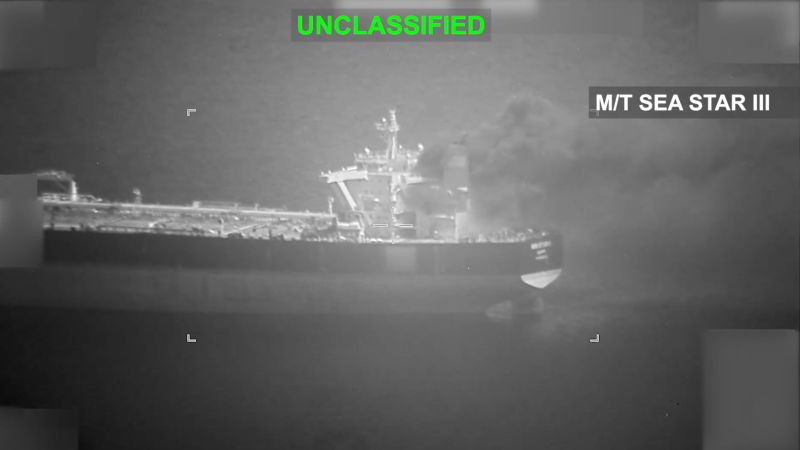
The U.S. military said Friday that American warplanes disabled two Iranian-flagged tankers by firing precision munitions into their funnels, demonstrating the accuracy of the weapons used.
The US Central Command, which oversees military operations in the Middle East, released a video showing the tankers Sea Star III and Sevda being attacked by US Navy F/A-18s. The ship was said to be in violation of the US blockade of Iranian ports.
Video shows a slight plume of smoke rising from Seastar’s chimney, with dark smoke billowing up after the attack.
In Sevda’s clip, thick black smoke rises immediately after the fiery explosion.
Video provided by CENTCOM does not reveal any damage beyond the funnel or chimney area. The announcement did not mention casualties on the tanker.
Military experts told CNN that Navy jets likely used 500-pound laser-guided bombs to hit the tanker with such precision.
Peter Leighton, a researcher at the Griffith Asia Institute and a former Royal Australian Air Force officer, explained how the F/A-18 could have carried out the double attack.
“If you fly, say, at 5,000 feet straight toward the ship, use the aircraft’s thermal imaging targeting pod, place a laser spot on the chimney, and drop it as you get closer, you should be fine,” he said.
He said it was likely that the U.S. planes did not drop bombs directly into the exhaust vents, but instead targeted the entire smokestack.
“This is a laser spot. The bomb needs to be aware of the spot for at least the last 10 seconds. If the spot disappears down the chimney as it flies over, it becomes inaccurate,” Leighton said.
Sal Mercogliano, a shipping expert and professor at Campbell University in North Carolina, said a review of the video showed the munitions hit the bottom or base of the ship’s smokestack.
CNN military analyst Cedric Layton, a retired U.S. Air Force colonel, said the Navy plane may have fired inert munitions at the tanker, or just enough to disable it but not sink it.
Analysts said the use of inert bombs, or low-yield bombs, could explain the lack of large explosions or secondary detonations that high-explosive warheads can cause.
According to CENTCOM, twin-engine F/A-18s take off from a U.S. aircraft carrier, in this case the USS George H.W. Bush.
It can carry a variety of air-to-air and air-to-ground weapons, including several types of laser-guided bombs that were likely used in the latest attacks, analysts said.
Centcom said the tanker was empty and heading to an Iranian port in the Gulf of Oman in an attempt to avoid a U.S. blockade.
These were the second and third Iranian warships to be attacked by US F/A-18s in the past three days.
On May 6, a Navy jet fired several shots from a 20mm gun to disable the tanker’s rudder.
“All three vessels are no longer transiting to Iran,” Centcom said, adding that several vessels were disabled by the United States in an attempt to evade Iranian port blockades.
“And more than 50 people were redirected by CENTCOM forces to ensure compliance,” the report said.
