

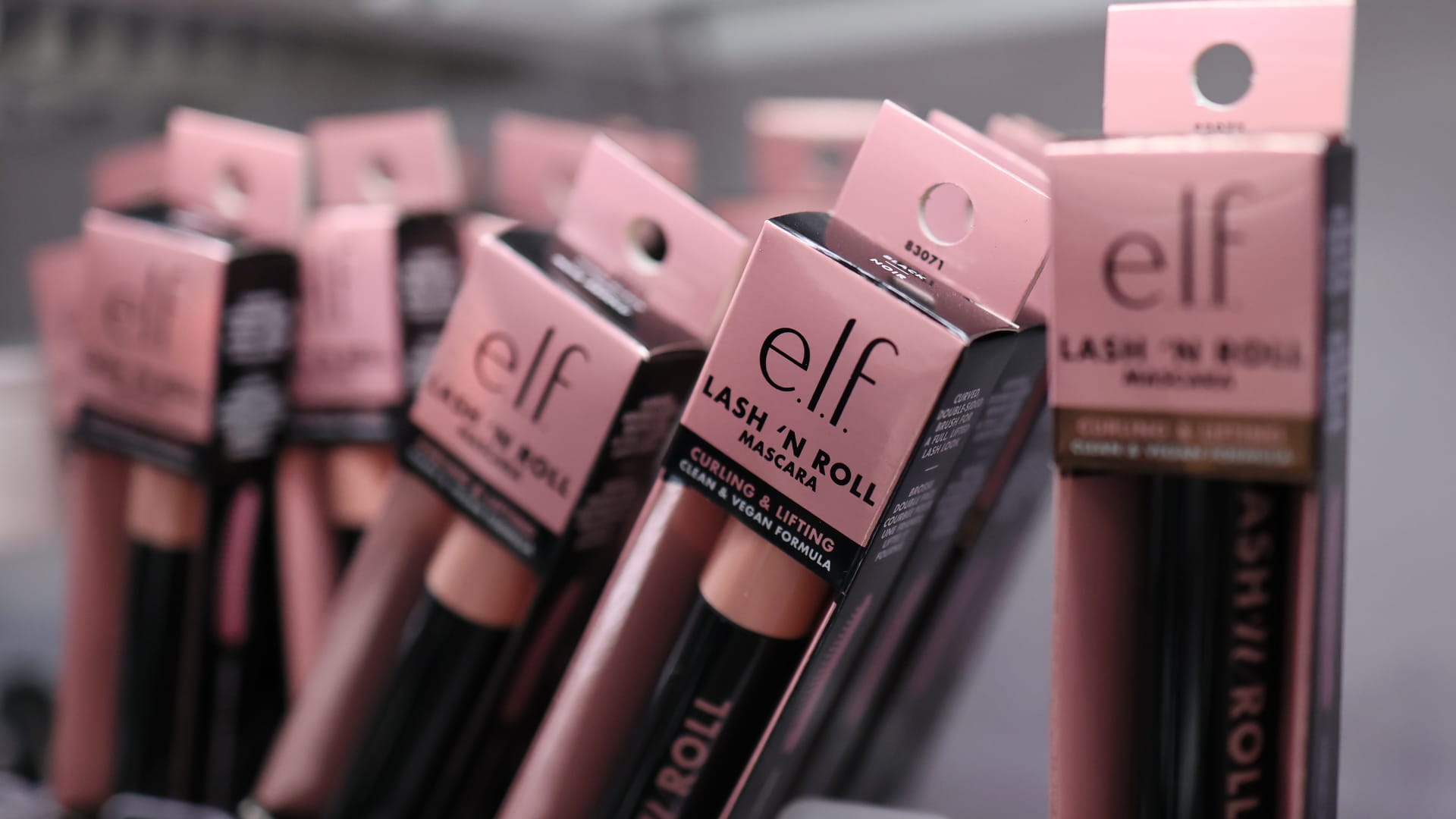
elf beauty The company plans to reverse some of the tariff hikes it implemented less than a year ago as demand slumps after surging in recent months as consumers contend with soaring gasoline prices.
CEO Taran Amin said in an interview with CNBC: “When you have a price increase this big, you’re going to see unit prices come down, but I think we’ve seen unit prices come down a bit more in recent months as consumers have particularly struggled with higher costs.” “This is one of the reasons we want to strengthen the value we offer.”
Elf recently tested the $18 Halo Glow Skin Tint at a $4 discount and saw a nearly 40% increase in business. Amin said this showed the company how “sensitive” consumers are to pricing now.
As a result, the company plans to test additional price reductions on certain product families to see if they lead to increased unit sales. Last August, the company increased prices by $1 on its entire Elf range.
“We also have additional items that we are testing for lower pricing so that we can really strengthen our value proposition at a time when consumers are struggling,” Amin said.
Elf announced plans to cut prices after the company reported fourth-quarter results on Wednesday that beat Wall Street expectations on revenue and bottom line, but the guidance it released failed to surprise.
Here’s how the beauty retailer performed for the quarter compared to Wall Street expectations, based on a survey of analysts by LSEG.
Earnings per share: 32 cents adjusted, 29 cents expected; Revenue: $449 million, $423 million expected.
Elf shares rose about 7% in after-hours trading Wednesday.
For the three months ended March 31, Elf posted a loss of $49.4 million, or 82 cents per share, compared with a profit of $28.3 million, or 49 cents per share, in the year-ago period.
Elf’s loss was primarily due to $57.6 million in costs related to the acquisition of Lord, which the company incurred under the terms of the transaction, following the brand’s better-than-expected performance. Excluding this charge and other one-time charges, Elf’s net income was $19.4 million, or 32 cents per share.
Sales were $449 million, an increase of approximately 35% from $332.6 million in the same period last year.
During the quarter, Elf’s gross margin increased 1.4 percentage points to 73%. This is mainly thanks to the price increase while the company is currently reducing the prices of some of its products. Asked how these cuts will impact future margins, Amin said the company expects a $55 million tariff rebate, which will offset the impact on profitability.
Still, the company’s fiscal 2027 outlook was weaker than expected. Elf said analysts surveyed by LSEG expect revenue to be between $1.84 billion and $1.87 billion, primarily below expectations of $1.87 billion.
Profitability prospects appear to be worsening. The company said it expects adjusted earnings per share to be between $3.27 and $3.32, well below expectations of $3.61 per share.
“I’m really proud of the profitability we just delivered in the face of 55% tariffs. The team did a really great job navigating through a pretty crazy tariff environment,” Amin said. “Over the next year, we have steered our gross margins to be flat, which we believe is very strong in the environment we operate in. We still face tariffs at the 35% level, which is what we modeled this year and continued our retail expansion of Lords thereafter.”
The celebrity beauty brand has been a major driver of Elf’s overall growth since its acquisition of Lorde, which was announced about a year ago. Over the past year, sales have increased 80% with expansions into Sephora North America, Sephora UK and Mecca. Lorde currently holds the No. 1 brand position across all three retailers.
Lorde is set to launch in 19 European countries this fall in partnership with Sephora, so Amin said there is still a “huge void” for the brand.
Over the past few years, Elf’s growth has been primarily driven by super popular product launches. Lorde is currently driving growth, but it’s unclear how much runway the brand still has and what that ultimately means for the company. Amin said “balanced growth” defines the story moving forward across the company’s brand portfolio, and said he is open to expanding the brand.
“Our top priority is to achieve organic growth in our existing portfolio. We have very high bar for M&A,” Amin said. “But the good news is that we are the destination of choice for the strongest founders in the industry, given our approach of supporting founders’ vision and being able to lend our capabilities to continue accelerating growth. So I would say M&A is definitely part of our future.”
