

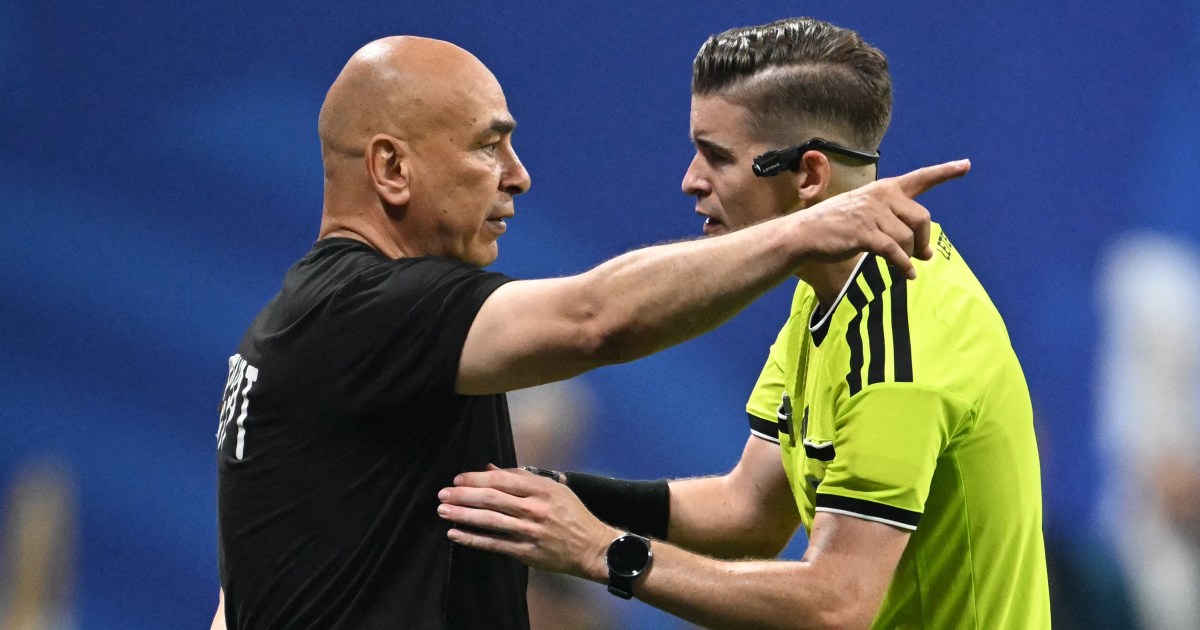
The Egyptian Football Association has criticized refereeing decisions during Egypt’s dramatic 3-2 loss to Argentina in the World Cup Round of 16, saying it will not remain silent about the alleged inappropriate use of the Video Assistant Referee (VAR) system.
EFA announced on Wednesday that several decisions during the match had a direct impact on the result.
Egypt looked set for one of the tournament’s biggest upsets on Tuesday when they led defending champion Argentina 2-0 with 11 minutes remaining, but conceded three goals late on and suffered a crushing defeat.
“Several important incidents have raised serious concerns and left serious questions about the consistency and fairness of decisions that directly affect the course of the match,” the federation said in a statement posted on social media.
“Many domestic and international soccer experts and professional analysts have covered controversial and influential officiating incidents during matches.
“This underlines the importance of maintaining the highest standards of integrity, fairness and transparency in match officiating, especially in a match with the status and importance of the 2026 FIFA World Cup at stake.”
According to multiple media reports, EFA president Hany Abo Rida has lodged a formal complaint against French referee François Letexier and his assistant.
FIFA did not respond to Al Jazeera’s request for comment on the reported Egyptian complaint.
Much of the controversy centered on Egypt’s Mostafa Zico’s goal in the 62nd minute that doubled his team’s lead. A VAR review confirmed a foul by the Egyptian player during the build-up and the goal was disallowed.
Egypt’s frustration deepened late in the game when Hamdi Fathy was brought down in a challenge and his call for a penalty was denied, but Argentina scored the winning goal in the 92nd minute.
A leading sports industry expert has questioned why VAR officials raised the issue when the on-field umpire did not call a foul when Egypt’s Marwan Attia tugged on the shirt and stepped on Lisandro Martinez’s foot.
“The logical solution to the VAR issue would be for fans and viewers to hear the assessment of the alleged violation, hear the various arguments and have a clear insight into the rationale for the decision,” Simon Chadwick, professor of African and Eurasian sports at Emlion Business School in Shanghai, told Al Jazeera.
Chadwick said Egypt’s players should not have been overwhelmed with emotion, but acknowledged that “the VAR decision caused a sense of unfairness”.
“This technology was supposed to minimize doubts and bring consistency. Instead, its use in this match had significant cognitive and behavioral effects,” he said.
Egypt coach Hossam Hassan and captain Mohamed Salah expressed their disappointment after the match, while former players and TV pundits also questioned the referee.
Former England goalkeeper Rob Green said of the foul that led to Zico’s goal being canceled on Fox’s live broadcast of the game: “Certainly this is not within the scope of VAR.”
“It’s the distance of the entire pitch.”
Former England captain Alan Shearer also criticized the decision-making process.
“Both fouls or neither foul. But they said they wouldn’t retry it,” the Premier League’s all-time leading scorer wrote on social media.
Former Arsenal striker Ian Wright pointed to another incident involving Salah.
Wright told ITV: “If Argentina are going to pull the ball back on the edge of the box to not concede a goal, they have to pull the ball back in this game with Mo Salah. He’s been caught. Whatever we say, it may be minimal, but he’s been caught. And they go up at the other end.”
Former Liverpool defender Jamie Carragher also questioned the consistency of VAR application.
“If it had been in the Premier League, La Liga or Serie A, it would have been a goal even after the VAR review,” he said.
