

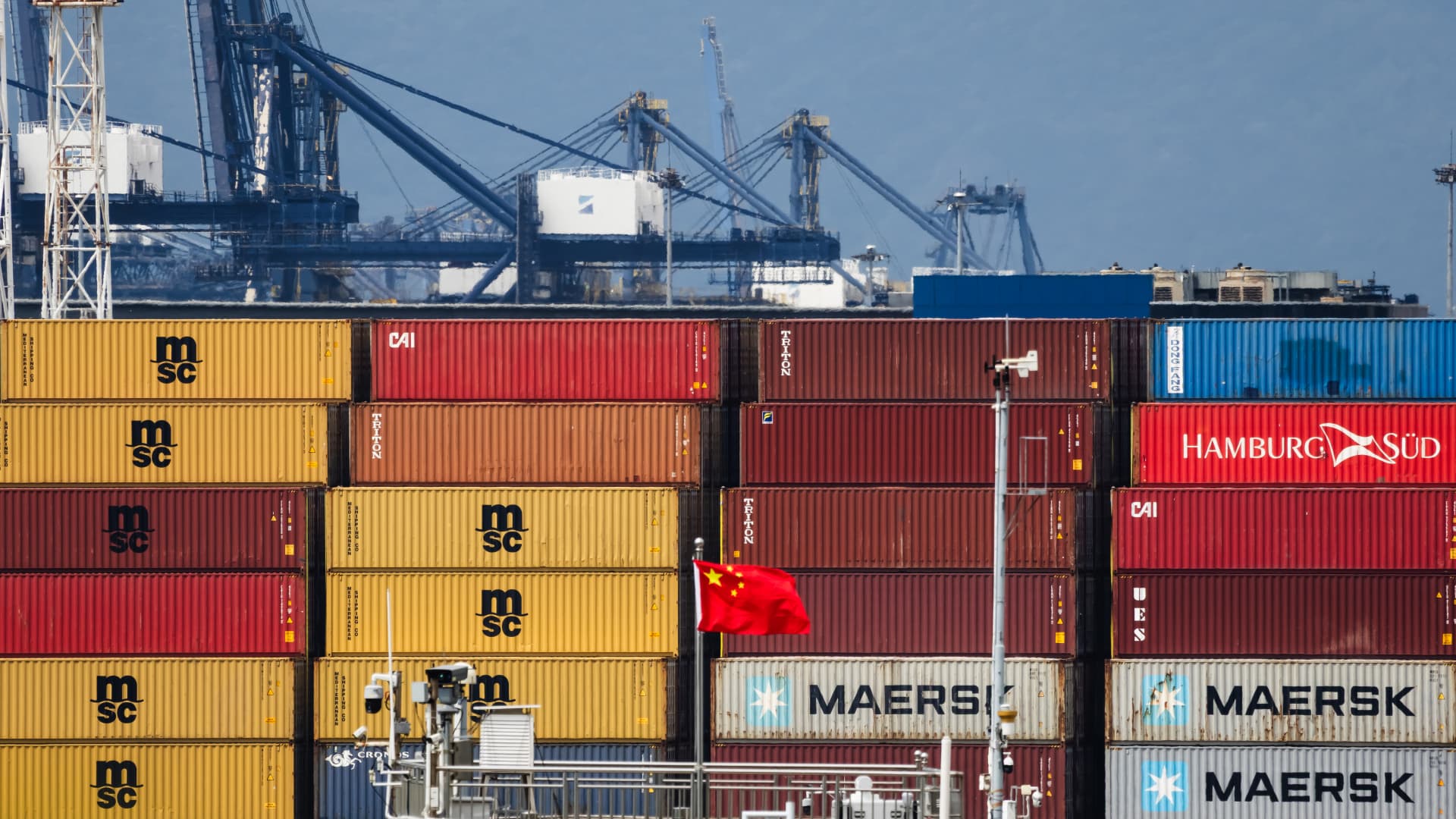
SHENZHEN, CHINA – MAY 1: A Chinese flag is raised in front of a stack of shipping containers bearing the brands of MSC (Mediterranean Shipping Company), Maersk and Hamburg Süd at Yantian Port in Shenzhen, Guangdong Province, China on May 1, 2026.
Chen Xin | Getty Images News | Getty Images
China’s trade growth exceeded expectations in May, with shipments to the U.S. registering the strongest growth in five years, as a surge in AI-related exports helped cushion the economy from the disruption caused by the Iran war.
Customs statistics on Tuesday showed overall exports rose 19.4% year-on-year in US dollar terms, accelerating from a 14.1% increase in April. Economists polled by Reuters had expected growth to be 15%.
“The war has increased demand for green exports such as electric vehicles, batteries, solar products, and AI-related technology products,” said Sheena Yue, senior economist at Oxford Economics, predicting that the “outperformance” of high-tech exports will continue.
Exports of overall integrated circuits increased by 32% from the previous year to 39.7 billion units. High-tech exports in May increased by 50% year-on-year in value terms, while imports increased by 47%.
Shipments to the U.S. surged nearly 35.4% in May from the same month a year ago, according to Wind Information, the highest growth since March 2021 and extending a recovery from double-digit declines most of last year due to President Donald Trump’s tariffs.
Tiancheng Xu, senior economist at the Economist Intelligence Unit, said China’s tariff disadvantage against Southeast Asian countries has also narrowed, providing a tailwind for exports. Additional tariffs imposed on Chinese goods under President Trump’s Section 301 review will likely be smaller than those imposed on rival exporters, giving Chinese manufacturers an additional competitive edge, Xu added.
Import growth continued to gain momentum, rising 27.4% in May, higher than April’s 25.3% and above economists’ expectations for a 25% rise. This increased the trade surplus in May to $105.4 billion.
In the first five months of this year, China’s import growth accelerated sharply, increasing by 24.5% year-on-year, exceeding exports of 15.5% in the same period, and the trade surplus narrowed year-on-year.
Economists at Bank of America Global Research said the surge in imports was largely due to rising input costs, and was concentrated in a few categories, particularly semiconductor chips and gold, with “little sign of rebalancing”.
“Recovering true trade balance remains a long way off due to weak overall demand and continued domestic substitution,” BofA economists said, adding that the export boom has reduced the urgency for meaningful policy stimulus from the Chinese government.
After a strong first quarter, China’s economy is showing signs of slowing down. Growth slowed across the board in April, with industrial production and retail sales posting their weakest growth in years. In May, the official index of manufacturing activity also fell to 50, the dividing line between expansion and contraction.
Strengthening stockpiling and AI
Chinese exporters have so far weathered the fallout from the Middle East conflict as overseas buyers scramble to secure supplies before energy costs rise even higher. But economists warn that the tailwind may not last long. If overseas stockpiling slows down, sluggish domestic consumption will not be able to fill the gap.
“We expect the AI boom to support production and trade,” said Xianglong Yu, chief China economist at Citibank, as higher prices for high-tech and semiconductor products boost headline growth. Yu added, “Domestic demand may continue to be weak.”
Yu predicted that retail sales growth, a proxy for consumption, could fall to zero in May as the impact of trade-in subsidies wears off, slowing further from the 0.2% growth in April, the lowest in three years.

The continued weakness in the job market is also exacerbating the pressure on consumer spending. “Despite a surge in exports, the number of manufacturing jobs continues to decline” as productivity gains from automation reduce demand for workers, said Frederick Newman, chief Asia economist at HSBC Bank.
The sustained appreciation of the Chinese yuan this year has put some pressure on the country’s exporters, which have long held large amounts of dollars, as mounting foreign exchange losses begin to weigh on profits.
“Despite global economic uncertainty and a strong renminbi this year, China achieved strong export growth,” said Zhiwei Zhang, president and chief economist at Pinpoint Asset Management, adding that strong export growth could increase policymakers’ tendency to postpone meaningful economic stimulus measures until July.
The offshore yuan has appreciated 2.8% against the US dollar since the beginning of the year to 6.7802 yuan, while the onshore yuan has appreciated 3% to 6.7787 yuan, according to LSEG data. Neither side moved much after Tuesday’s trade data release. The CSI300 index rose 0.6%.
uneven growth
China’s economy has developed into what economists call the “K-speed” growth paradigm, with booming manufacturing and export sectors contrasting with persistent weakness in the real estate market and consumer spending.
Exports remain a bright spot for the world’s second-largest economy, driven by strong global demand for AI technology and renewable energy products.
Although demand remains weak, rising commodity prices due to disruptions to energy flows through the Strait of Hormuz are helping to ease deflationary pressures that have plagued China’s economy for years.
Economists expect the country’s producer inflation, to be released on Wednesday, to accelerate to 3.8% in May, the highest level in nearly four years, as manufacturers absorb higher input costs, according to a Reuters poll. Consumer inflation is expected to rise modestly to 1.3%.
According to Fitch Ratings, China held about 15% of the world’s oil stocks before the outbreak of war, and could run out of oil reserves by late October if it is forced to draw down stocks to make up for supply shortfalls.
“China’s stable power supply may provide a buffer, but the supply shock from the energy crisis will still hurt the Chinese economy through supply shortages and price hikes,” said Jing Wang, China economist at Nomura.
