

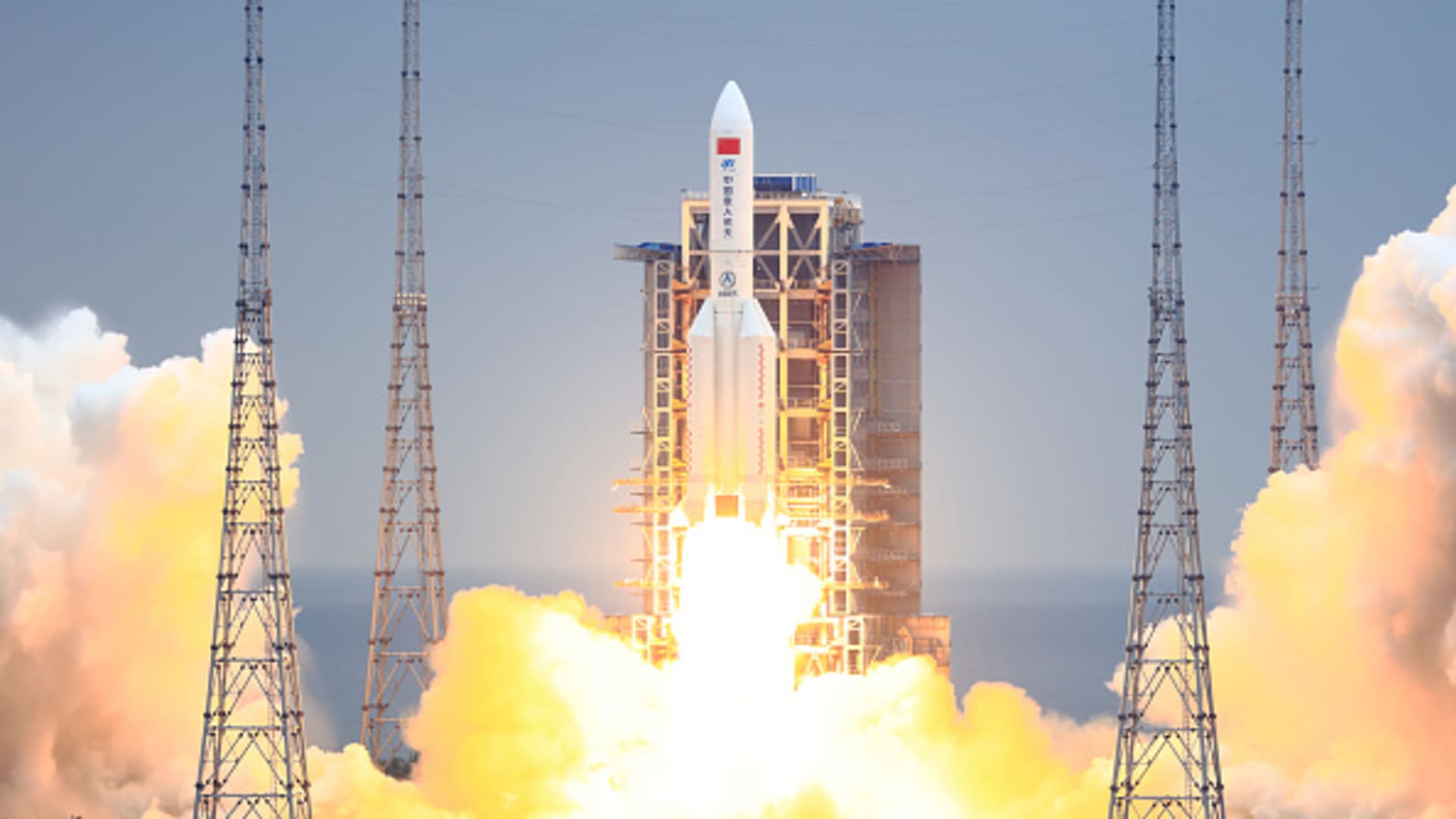
China’s space program has recently reached a number of milestones.
In 2025, China conducted more than 90 orbital launches, setting a new record for orbital launches in a single year. In the past five years, China has returned the first samples from the far side of the moon, completed its own low-Earth orbit space station, and landed a rover on the surface of Mars.
“We’ve seen multiple statements about President Xi Jinping and what he calls the Chinese space dream,” said Dave Cavossa, president of the Commercial Space Federation, a trade group representing the commercial space industry. “They see space and AI as the types of industries that can help lead and catapult China to global leadership.”
The Commercial Space Federation, along with Arizona State University’s New Space Initiative, recently released a report warning that the United States could soon lose its space dominance to China.
“When it comes to space, the United States remains by far the world leader today,” Cavossa told CNBC. “You know, we still have the strongest private space industry. We still have the most powerful launch capability on the planet. But what we’re seeing is that China is moving very quickly to catch up. And if we don’t do something, China will overtake us here in the next five years.”
Investment in China’s commercial space sector, including private and government sources, rose from $340 million in 2015 to about $3.81 billion in 2025, according to data from space research firm Orbital Gateway Consulting.
Over the past decade, China has spent more than $104 billion on civil, military and commercial space efforts, said Jonathan Roll, a research analyst with ASU’s NewSpace Initiative and co-author of the China Space Report.
“The question you’re probably going to ask me right away is, did the U.S. spend an equivalent amount of time? Our estimate was more than five times as long,” Rohr said. “But the real story is that China continues to increase spending, which means China is moving towards its goal of becoming a leader, if not the leader, in space science.”
In China, the space sector is supported by a combination of local governments, universities, state-owned enterprises, and private enterprises. The result is a robust network of space activity centers distributed throughout the country.
These bases include rocket and satellite manufacturing facilities, as well as launch sites and universities.
“The real, real uptick, the hockey stick moment, has been since 2014. In 2014, one of China’s regulatory bodies released a document known colloquially as ‘Document 60.’ And what that essentially does is open up the space domain and the ecosystem not only to private investment, but also to private ownership,” Rohr said.
China is doubling its rocket production.
The country has more than a dozen private rocket manufacturers, some of which are working on reusable rockets like those made by Elon Musk’s SpaceX.
The country has also made great strides in building satellite infrastructure.
In 2020, China launched the last satellite needed to complete its own global satellite navigation system called Beidou, which will compete directly with the US GPS satellite constellation. It is also developing thousands of Internet satellites, most of which have yet to launch, in direct competition with SpaceX’s Starlink fleet.
Space is also a key part of the country’s Belt and Road Initiative.
The Belt and Road Initiative, launched by Mr. Xi in 2013, is a massive international infrastructure and economic development program aimed at expanding China’s influence and economic reach.
“They’ve been building and launching satellites for other countries for a long time, and now they’re starting to build ground stations, and some countries like Egypt and Pakistan are starting to build entire facilities,” Rohr said. “But they’re also kind of drawing countries into a China-centric world through the standards, technology, and services that they’re getting from BeiDou…So this is soft power. In diplomatic terms, it’s gray power.”
Still, experts say there is much the United States can do to maintain its leadership in space.
These include investing in spaceports, streamlining commercial launch licenses, and allocating sufficient spectrum for satellite operations.
“Today’s space race is not about flags and footprints,” Casossa said. “This space race will result in the nation building the strongest commercial space industrial base.”
Watch the video to learn more.
