

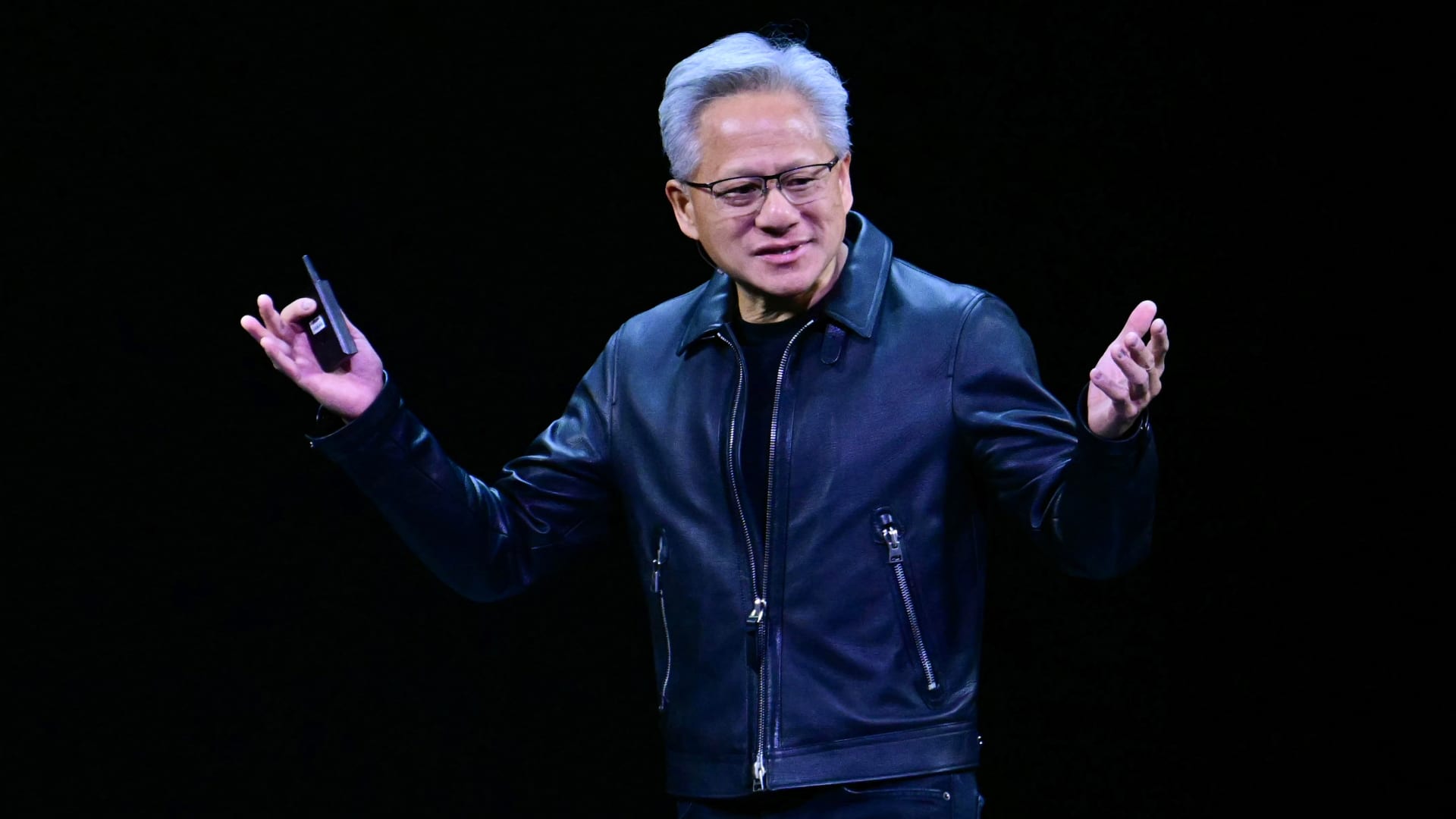

Nvidia reported better-than-expected fiscal third-quarter profits on Wednesday and gave a strong outlook for the current quarter.
Wall Street welcomed the report, and NVIDIA stock rose after the announcement and during the conference call. Other stocks in the so-called artificial intelligence industry also rose.
A closer look at Nvidia’s report shows that the company continues to dominate the market for AI chips called GPUs, and CEO Jensen Huang expressed confidence in the company’s products and was bullish about the company’s prospects on a call with analysts.
Nvidia said it expects revenue to be about $65 billion for the current quarter, which ends at the end of January. This represents a 65% growth on an annual basis.
Here are three key takeaways from Nvidia’s earnings.
Nvidia rejects bubble talk
During an earnings call with analysts on Wednesday, Huang began his comments by rejecting the premise of an “AI bubble” held by some investors concerned about the billions of dollars being spent on Nvidia chips and the potential return on investment.
“People talk a lot about the AI bubble,” Huang said. “From our perspective, we see something completely different.”
Huang said there are three types of applications for AI that are currently growing, and all three are contributing to the boom in infrastructure investment.
He said non-AI software such as data processing is increasingly running on the company’s GPUs, that AI will create new types of apps, and that “agent AI” that doesn’t require user input will require additional computing power.
Huang said people will soon start to realize what’s going on beneath the surface of the AI boom, rather than “a simple view of what’s happening with capital expenditures and investments.”
Bernstein analysts said in a note that Hwang’s comments helped allay investors’ fears of a bubble following the recent selloff in AI stocks, saying, “Perhaps the AI industry is not dead yet after all.”
“More than just good numbers, we believe investors needed cooperation from Mr. Jensen, and he has been generous in providing it,” the analysts wrote.
“$5 trillion” prediction is on track
Last month, Hwang said at a conference in Washington, D.C., that the company has orders for $500 billion in AI chips in 2025 and 2026.
The company said Wednesday that its outlook remains on track. Nvidia’s long-term outlook is important to the technology industry because Nvidia counts many of the most powerful technology customers among its customers.
Nvidia said Wednesday that its backlog does not include several recent announcements, including the deal with Anthropic and this week’s expanded contract with Saudi Arabia.
“The numbers will grow,” Chief Financial Officer Colette Kress said on a conference call, adding that the company is on track to meet expectations. “We’ll probably get more orders.”
“We think we have an opportunity to grow for quite some time,” Huang said.
Multiple analyst notes on Thursday drew attention to the $500 billion forecast and the addition of recently announced deals.
Jeffries said Nvidia “answered the bell” with its earnings call, and said the numbers should help stabilize AI trading through the end of the year.
“While we do not expect all AI bears to be satisfied, these results and additional context from management regarding the demand outlook should provide short-term reprieve,” the analysts wrote.
“Not important” orders from China
Nvidia fought over the summer to win a license to export its H20 chips, a slowed-down version of the 2022 technology, to China. Some analysts estimate that Nvidia’s China operations could be worth $50 billion a year.
The company finally received its license this summer after Mr. Huang met directly with President Donald Trump and struck a deal that would give the U.S. government 15% of its sales in China.
However, sales of the H20 chip during the quarter turned out to be “minor.” Kress told analysts that the company had sales of $50 million in the same period.
“Due to geopolitical issues and increased competition in the Chinese market, large orders did not materialize in the quarter,” Kress said.
Nvidia has argued that the U.S. government should allow exports of its cutting-edge chips because it is better for national security for Chinese developers to familiarize themselves with Nvidia’s technology, rather than being forced to use and improve on Chinese chips.
Although the H20 is an older technology, NVIDIA hopes to get approval to ship a version of the current generation Blackwell chip to China.
“While we are disappointed in the current inability to ship more competitive data center computing products to China, we will continue to engage with the U.S. and Chinese governments and continue to advocate for America’s ability to compete globally,” Kress said.
Analysts at Melius predicted on Thursday that Nvidia would generate nearly $400 billion in free cash flow over the next nine quarters, saying the number was “even more unusual” because of the lack of sales in China.
“Currently, NVIDIA does not provide products to China, and we do not expect this situation to improve,” the company said.
CNBC’s Sam Subin contributed to this article.
