

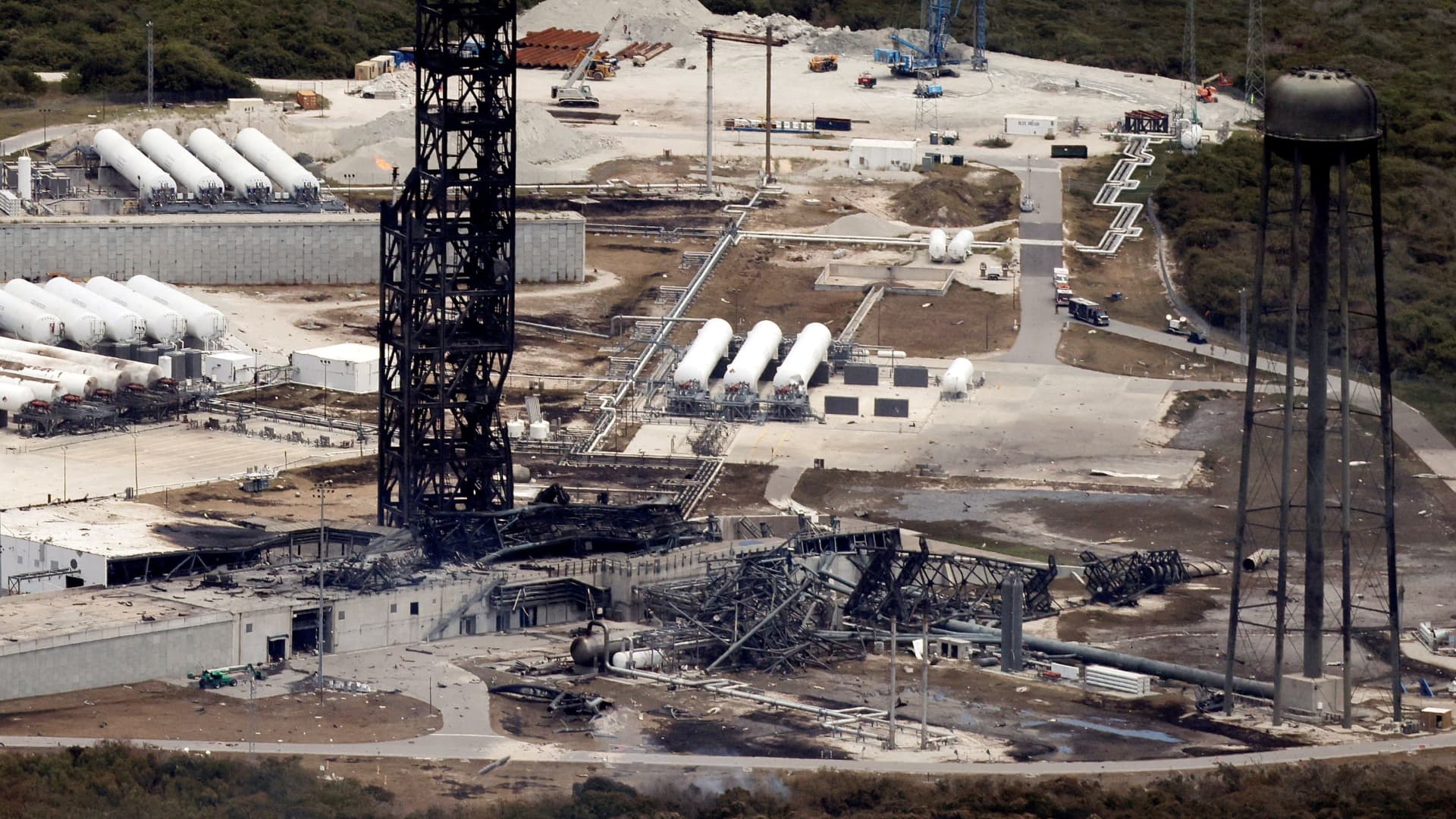
Damage to the launch pad site after an unmanned Blue Origin New Glenn rocket explodes during a test at Cape Canaveral Space Force Station, Cape Canaveral, Florida, USA, May 29, 2026.
Joe Skipper | Reuters
Blue Origin CEO Dave Limp said the company “doesn’t intend to rebuild the same pad” where one of its New Glenn rockets recently exploded in preparation for resuming flights this year.
Company founded by Amazon Founder Jeff Bezos was conducting a high-temperature test on a giant New Glenn rocket at a Florida launch site last month when the craft exploded in a fireball. New Glenn is a key part of Blue Origin’s efforts to compete with Elon Musk’s companies. space xhas established a significant lead in reusable rockets and launch services.
In a memo posted on Blue Origin’s website, Limp said the company intends to employ a “horizontal/vertical hybrid” launch configuration using existing infrastructure already in development for a larger, more powerful New Glenn variant called a “9×4.”
“We take our responsibility as a launch provider very seriously and are committed to returning to flight with the reliability required for the mission,” Limp wrote.
In a post on X, Limp wrote that the new pad configuration “has the added benefit of also improving flight rhythm.”
Blue Origin’s New Glen accident had bad timing. Blue Origin is a key partner in NASA’s Artemis mission, which aims to return humans to the moon. The agency is working with Blue Origin to launch an unmanned Blue Moon lander atop New Glenn later this year.
Companies including Amazon and AST Space Mobile It also relies on Blue Origin for rocket launch capabilities to put internet satellites into orbit. The May explosion occurred just days before Blue Origin was scheduled to launch a series of Amazon Leo satellites.
Low-orbit satellite internet services have been rapidly developed in recent years, but their growth has been constrained by a lack of supply of rocket launches. Blue Origin has emerged as a candidate for a heavy-lift rocket to replace SpaceX, and New Glenn could carry larger payloads.
Limp said Blue Origin continues to “actively investigate” the cause of the May launch anomaly. Initial results suggest the rocket’s “rear part of the first stage” may have been the culprit, he added.
Reconstruction of the damaged launch pad is underway, and the company has determined that the lightning tower, transport erector, and hydraulic cylinders have been lost.
“But we also got a lot of rest, so we’re going to make the most of it,” Limp said.

