

In early December, hundreds of women lined up for a marathon on the Iranian resort island of Kish, wearing matching shirts and leggings, with their hair tied loosely behind their backs.
In a country where flouting dress codes can result in hefty fines and jail time, runners focused on the course in front of them, ignoring government instructions and the free headscarves race organizers placed in their marathon starter packs in anticipation of a violation.
In October, a band played the riff of “Seven Nation Army” to a headbanging crowd on the streets of Iran’s capital Tehran, and Jack White, the American guitarist behind the White Stripes hit, reposted it and spread it on social media.
Shopkeepers, bazaar traders and students took to the streets in several Iranian cities this week, shouting anti-regime slogans as they were unable to pay their rent after the currency hit a record low. The protests were the largest since nationwide riots in 2022, sparked by the death of 22-year-old Martha Amini in police custody after she was arrested on suspicion of wearing a headscarf inappropriately.
In a post on X, the US State Department expressed concern over reports that protesters were facing “intimidation, violence, and arrest” and called on authorities to end the crackdown.
“First the bazaar. Then the students. Now the whole country. Iranians are united. We have different lives, but we have one demand: that our voices and rights be respected,” the State Department said in a post on X’s Farsi-language account.
Although limited so far, the protests mark the latest chapter in Iran’s growing discontent, while its people are quietly reclaiming public space and personal freedoms through acts of disorderly defiance. The Islamic theocracy, which has long opposed Western cultural influence, appears to be overlooking the rise in civil disobedience as it focuses on its own survival.

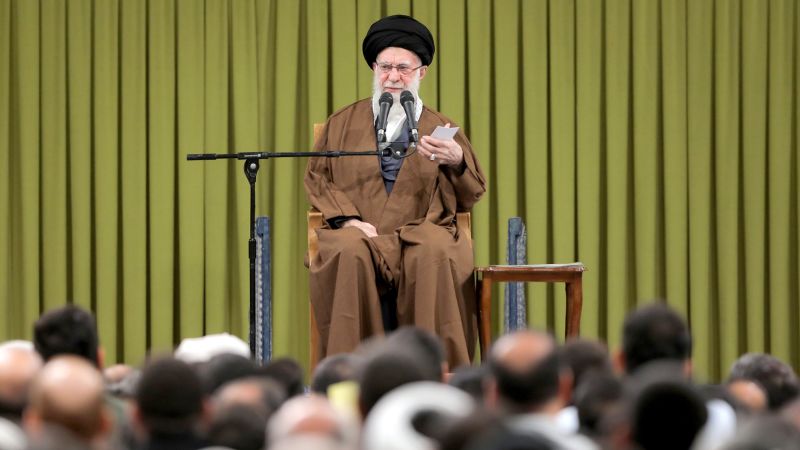
At the helm is Iran’s frail 86-year-old Supreme Leader Ayatollah Khamenei, who has spent decades trying to shore up his regime against threats both domestic and foreign, but now must contend with a strategy that has failed. At home, disaffected youth have staged an unprecedented defiance of Islamic norms, the country’s currency has plummeted to record lows, Iranian cities are drying up, and protests have begun. Outside its borders, arch-enemy Israel continues to lobby the United States for further military action against the Islamic Republic.
With limited options, Khamenei is currently taking a cautious wait-and-see approach, avoiding major decisions or drastic strategies, despite the country’s growing challenges.
Mohammad Ali Shabani, editor-in-chief of Amwaj Media, a London-based news site focused on Iran, Iraq and countries in the Arabian Peninsula, told CNN: “Many observers convey a sense that no one is home. That no one is making big decisions or that Khamenei is not allowing real decisions to be made.”
“At the moment, it appears that Khamenei is refraining from making any major decisions because whatever decisions he makes are likely to have significant downsides,” he said.
The Supreme Leader, or Waliyeh Faqih – an important title that gives its holder ultimate authority over all national and religious matters – was reportedly cut off from communication and confined to a secure bunker for his own safety during the 12-day war with Israel in June. The conflict caught Iran by surprise despite decades of preparation.
Khamenei emerged from the conflict with a weakened military, a severely damaged nuclear program, and a rapidly eroding public trust in the once revolutionary leader’s 36-year policies.
In the months that followed, Iran’s beleaguered people watched the country become increasingly crippled by a growing crisis. Prolonged power outages, record inflation, and soaring unemployment have left the people disillusioned with their ineffective leadership.
Smog has filled Iran’s skies this winter as the government, desperate to maintain electricity, switched to cheaper, lower-quality fuels that are dirtier than natural gas.

Twenty provinces across Iran have been hit by the country’s worst drought in more than 40 years this year. The poorly managed water crisis has become so severe that President Masoud Pezeshkian has publicly proposed the idea of evacuating residents from Tehran to relieve the heavy strain on the capital’s dwindling supplies.
Inflation is skyrocketing and the economy is suffering. This month, the real price hit a historic low, prompting protests by shop owners as essential goods became difficult to obtain. Years of massive money printing have significantly devalued the currency, with the government’s latest budget amounting to thousands of rials.
Iran’s once cunning and innovative foreign policy has stalled, with no diplomatic breakthrough in sight as the West tightens its grip with unrelenting sanctions. The Revolutionary Guards’ network of militant proxies, long the linchpin of Iran’s regional influence and deterrence, has been severely weakened amid near-daily targeting from Israel and lost a key territorial advantage when Syrian rebels overthrew the Iran-aligned Assad dynasty last year.
The Islamic Republic of Iran has long been accustomed to crises and unrelenting pressure. Immediately after the 1979 revolution, the country was embroiled in a brutal eight-year war with Saddam Hussein’s Iraq, but it endured that conflict with fierce determination and ultimately survived.
Inheriting a war-ravaged and regionally isolated state, the young Khamenei faced the difficult task of rebuilding a shattered economy and society. He had to manage internal dissent and conflict within Iran’s complex clerical circles and confront unrelenting international economic pressure, while upholding the revolutionary ideals of sovereignty and independence.

As Iran’s current crisis deepens in the aftermath of yet another war and the country’s political elite engages in a heated blame game, its aging supreme leader watches on, doggedly adhering to his familiar strategy of launching a slew of missiles and drones, scrambling to rebuild a battered regional agency, and rejecting Western negotiating preconditions.
“All Iranians want change. Hardliners want a return to the past, reformers want to move to the future, and many moderates want some change. No one is satisfied with the status quo,” said Amwaj Media’s Shabani.
Khamenei has spent decades dutifully reinforcing the Islamic revolution across all strata of Iranian society, so his inevitable demise, whether through death or overthrow, will be a monumental moment that could significantly alter Iran’s trajectory, depending on who comes after him.
“Without a doubt, his departure from the scene will be the most pivotal moment in the history of the Islamic Republic… and there will also be a chance to change Iran’s geostrategic direction, but that depends on who and what comes after Khamenei,” said Ali Baez, director of the International Crisis Group’s Iran project.
It remains unclear whether this system is prescribed for the succession of the supreme leader. Analysts say possible candidates include Mojtaba Khamenei’s son, the influential cleric Mojtaba Khamenei, and Hassan Khomeini, the grandson of the founder of the 1979 revolution.
“The outside world has very little influence on who comes next. It really depends on the internal dynamics and the balance of power between internal forces,” Baez said.
“Equally important is whether the West will offer a way out for Iran’s new leadership…If the West is ready to take advantage of Iran’s moment of change, it needs to start thinking about it now,” Baez said.

Amid protests, civil disobedience, and a co-occurring disaster, Khamenei now faces a new external threat: Israeli Prime Minister Benjamin Netanyahu. Prime Minister Netanyahu visited the United States this week to pressure President Donald Trump to take more aggressive action and to sound the alarm about Iran’s ballistic missile program.
Sheena Tousi, a nonresident senior fellow at the Center for International Policy, said President Trump has repeatedly declared the destruction of Iran’s nuclear program, politically closed the nuclear file and eliminated Israel’s strongest historical justification for supporting the U.S. war against Iran.
“Prime Minister Netanyahu’s turn to missiles should therefore be interpreted not as the discovery of a new threat, but as an effort to create a bellicose situation to replace the nuclear debate after it collapses,” Tusi said.
“We’re hearing that Iran is trying to expand its power again. If that’s the case, we’re going to have to defeat them,” Trump said after meeting with Prime Minister Benjamin Netanyahu, adding, “We will crush them once and for all.”
