

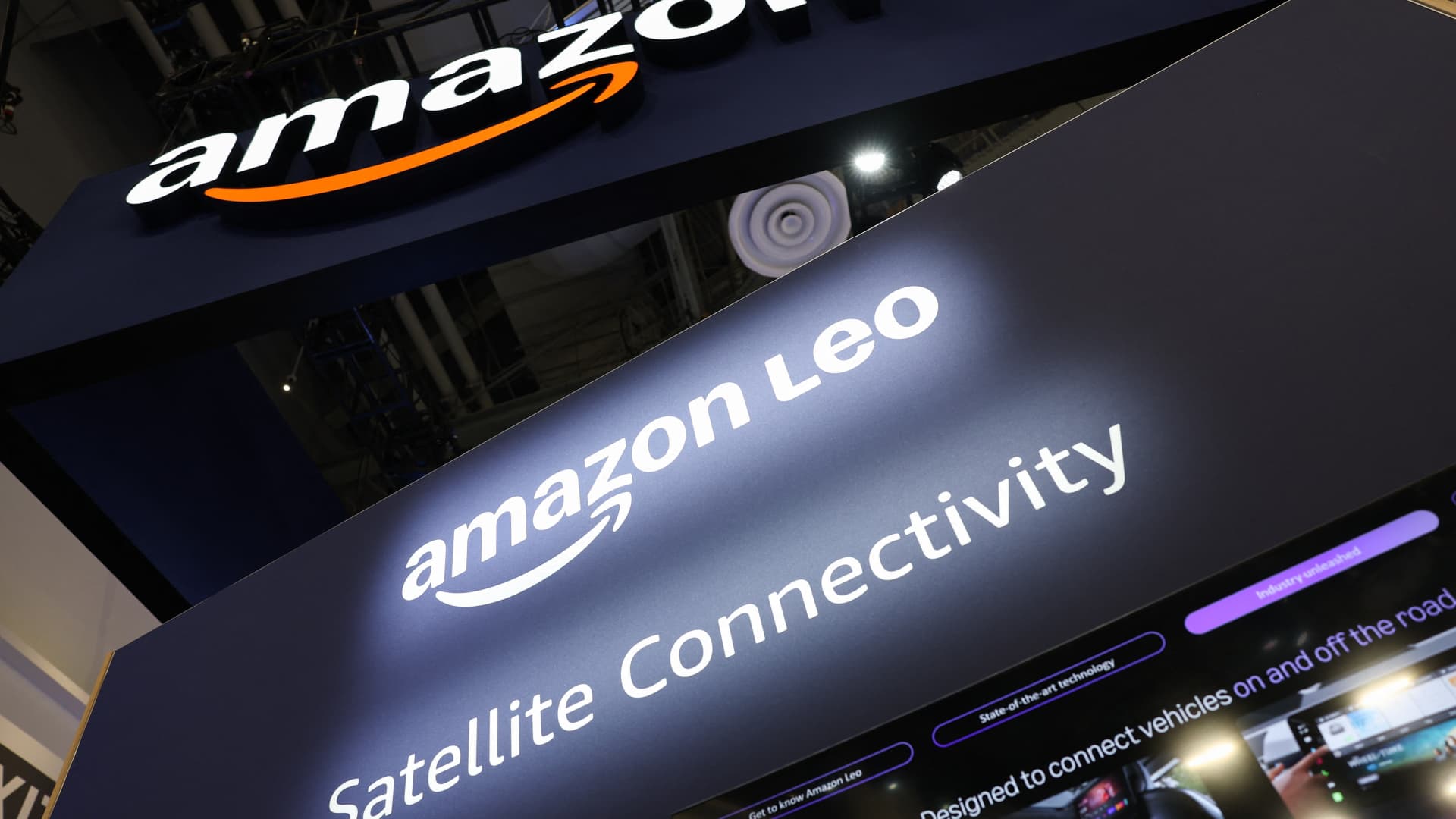
Amazon is making big moves to advance its space ambitions, but they’re expensive and face competition from tough incumbents. It also could end up being a big winner for e-commerce and cloud giants. The Seattle-based company announced this month that it plans to buy satellite carrier Globalstar for $90 a share in a cash and stock deal valued at about $11.6 billion. The deal is expected to close in 2027 and will power Amazon’s up-and-coming space-based internet service, called Amazon Leo, which is expected to launch commercial broadband services in mid-2026. It also helps Leo take on SpaceX, the dominant player in the satellite internet space led by Elon Musk. The move strengthens Amazon’s commitment to the expensive and far-reaching task of building satellite internet services, an effort that for years has given some investors pause, with questions about price and time-to-reward. Previously known as Project Kuiper, it began in 2019 when Amazon founder Jeff Bezos was still CEO. Reacting to the deal with Globalstar, Jim Cramer said Leo has the potential to “become a huge business out of nowhere.” “It’s a sudden pillar. This will be discussed in the future.” He added: “We’ve gone from being tired of hearing about losses to thinking there’s a lot of profit to be made here.” Globalstar is Amazon’s second-largest acquisition in history, after Whole Foods in 2017 for $13.7 billion. At first glance, spending nearly $12 billion on a company expected to generate less than $300 million in revenue this year seems like a big deal. Whole Foods had sales of $16 billion in 2017. Additionally, the acquisition comes at a time when Amazon is already spending heavily on AI-related enhancements, which will likely result in negative free cash flow in 2026. This comes after Amazon’s free cash flow fell 71% to $11.2 billion in 2025. However, the strategic rationale does exist. In defending the partnership with Globalstar, Morgan Stanley said its size is small compared to Amazon’s large capital expenditures, and analysts argued that the partnership “has future applications in AMZN’s broader business, including providing connectivity for warehouse automation and drones, among other things.” In fact, Leo’s importance to Amazon goes far beyond its bottom line revenue stream. It could be worth it. For a company whose revenue is expected to be around $800 billion this year, making big changes will take a lot of effort. Leo also has the potential to strengthen Amazon’s retail and cloud businesses, justifying the company’s prior commitment to invest at least $10 billion in the project. That now justifies the acquisition of Globalstar. AMZN 1Y Mountain Amazon’s stock price performance over the past 12 months. Learn more about Globalstar Globalstar operates a fleet of low Earth orbit (LEO) satellites connecting more than 120 countries and holds radio frequency licenses around the world. Notably, Globalstar is also Apple’s technology partner for the iPhone maker’s emergency satellite texting and “Find My” device services. Apple and Amazon have agreed to continue their relationship and collaborate on future Leo services. Globalstar currently operates approximately 24 satellites in space and has agreed to acquire and deploy approximately 50 new satellites from Canada’s MDA Space. The Globalstar fleet will join the 240 satellites Amazon has launched into LEO since April last year. Amazon has received authorization from the Federal Communications Commission to launch about 7,700 satellites over the next few years. The company had planned to have 1,600 planes in the air by July to meet the FCC’s requirements. Amazon applied for a 24-month extension in January. But perhaps Globalstar’s most coveted asset is its ownership of spectrum licenses. Spectrum is a highway that enables wireless communication. But because it’s a finite, naturally occurring resource, it’s carefully managed by regulators around the world to ensure traffic runs smoothly and traffic lights don’t overlap. Therefore, you need a license to “drive” it. Globalstar’s license is key to operating so-called direct-to-device (D2D) services. This allows regular smartphones and other devices to connect directly to the satellite. There is no need to go through a cell phone base station or install any special hardware first. This helps fill the gap in rural areas without traditional cell phone coverage. Globalstar’s partnership with Apple is an example of a D2D service. Why this matters: When Amazon Leo launches commercially, scheduled for this year, it will first provide broadband internet to homes, businesses, and government agencies. Starting in 2028, Amazon plans to deploy a next-generation direct-to-consumer satellite system that integrates with broadband systems to deliver voice, data, and messaging services directly to mobile phones. Owning Globalstar “will enable us to more quickly deploy direct-to-consumer connectivity at scale in areas where terrestrial deployments are delayed, cost-prohibitive, or prone to disruption,” Amazon said in a press release. Morgan Stanley noted that the Globalstar license allows Amazon to launch a direct-to-consumer network “completely independent” of mobile network operator partnerships for spectrum. Verizon, AT&T, and T-Mobile are the major mobile network operators in the United States, and European players include Deutsche Telekom, Swisscom, and Vodafone. This will help close the huge gap between Leo and SpaceX’s Starlink, which is an industry leader with more than 10,000 satellites in orbit and more than 10 million users. SpaceX is aiming for a major initial public offering (IPO) in late June. Musk’s SpaceX started with its Starlink broadband service and has taken steps to expand into direct-to-consumer services in recent years. As part of that push, SpaceX in September announced a deal to buy radio frequency licenses from EchoStar, the parent company of Dish TV and Boost Mobile, for $17 billion. SpaceX is also partnering with T-Mobile to access spectrum. Wall Street firm Citizens estimated Starlink’s annual revenue at $10 billion to $11 billion, assuming monthly revenue of $90 from 10 million subscribers. He also said Starlink appears to be profitable. “Importantly, despite Amazon’s late arrival, this opportunity is so large that it can support multiple companies,” Citizen analysts said in a letter to clients last week. “PWC estimates that consumers spend $799 billion on mobile communications services worldwide, rising to $1.2 billion when fixed broadband and fixed voice services are included.” Citizen has a Market Perform rating on Amazon and a $315 price target. AST SpaceMobile, which was in the news last week after a satellite deployment incident by Bezos’ private rocket company Blue Origin, is another player in D2D services. AT&T and Verizon are working with AST to provide cell phone service from space. How Leo strengthens Amazon Complementary broadband and D2D services will help Leo reach its full potential as far as both consumers and investors are concerned. In his recent annual letter to shareholders, Amazon CEO Andy Jassy discussed Amazon’s satellite internet ambitions and emphasized the scale of the opportunity to expand access to high-speed internet to billions of people around the world who don’t have it. “Without a broadband connection, you won’t be able to participate in many digital activities,” Jassy wrote. Jassy added that Amazon Leo has already received “significant revenue commitments” from both governments and businesses. Delta has selected Leo for its future Wi-Fi starting in 2028 on 500 aircraft. Other Leo’s loyal customers include JetBlue, AT&T, Vodafone, DIRECTV Latin America, and NASA. Of course, Apple will join that list if the partnership with Globalstar is approved by regulators. A key advantage for Leo in the commercial and government markets is the existing customer base of Amazon Web Services, arguably the world’s largest cloud computing service by revenue. Any company that relies on AWS for some of its computing needs is a natural potential customer for Leo. “Leo’s sales activity into these accounts is significantly easier than for a single operator,” William Blair analysts wrote in a note to clients this week. “Early wins already show that Amazon is gaining traction in the enterprise segment, even though the service is not yet commercially available. Starlink, by contrast, has had to essentially build its enterprise efforts from scratch, and so far the strongest traction has been with consumers rather than traditional enterprises.” William Blair estimated the company’s opportunity at about $100 billion. “Enterprise customers can seamlessly move data directly from remote sites to AWS workloads through Amazon Leo,” wrote analysts at the company, which outperforms Amazon stock. This shows how Leo can strengthen the appeal of AWS, which is already a profit driver for the company. To attract consumers, Amazon could bundle Leo’s connectivity service into Prime, which has more than 200 million members worldwide. At the same time, Leo could expand its pool of potential Prime users. Consider a person who lives in a rural area and has reliable internet service thanks to Leo. That theoretically makes Prime Video more appealing to them. This is in line with Amazon’s recent efforts to increase its delivery capabilities to rural areas. William Blair also highlighted the wide range of internal use cases for Leo at Amazon, particularly across the fulfillment and logistics network. Analysts believe Leo’s connectivity could help Amazon’s delivery fleet in rural areas where cell phone coverage is limited. They said Leo could also serve as a primary or backup connection at Amazon’s fulfillment centers and grocery stores, thereby “potentially driving cost savings and profit growth across the business.” The company also cited growth opportunities with Prime Air, Amazon’s drone delivery service, in areas where access to ground delivery may be more difficult. After all, Amazon is still a long way from realizing its full space ambitions, and will likely need more funding in the future to make it a reality. But acquiring Globalstar is a smart move that emphasizes the company’s commitment to satellite connectivity, and will likely keep Amazon’s flywheel moving for years to come. We continue to maintain our Amazon rating of 1 and price target of $250. Amazon will announce its first quarter results on Wednesday night. (The Jim Cramer Charitable Trust is long AMZN, AAPL. See here for a complete list of stocks.) As a subscriber to Jim Cramer’s CNBC Investment Club, you will receive trade alerts before Jim makes a trade. After Jim sends a trade alert, he waits 45 minutes before buying or selling stocks in his charitable trust’s portfolio. If Jim talks about a stock on CNBC TV, he will issue a trade alert and then wait 72 hours before executing the trade. The above investment club information is subject to our Terms of Use and Privacy Policy, along with our disclaimer. No fiduciary duties or obligations exist or arise from your receipt of information provided in connection with the Investment Club. No specific results or benefits are guaranteed.
