

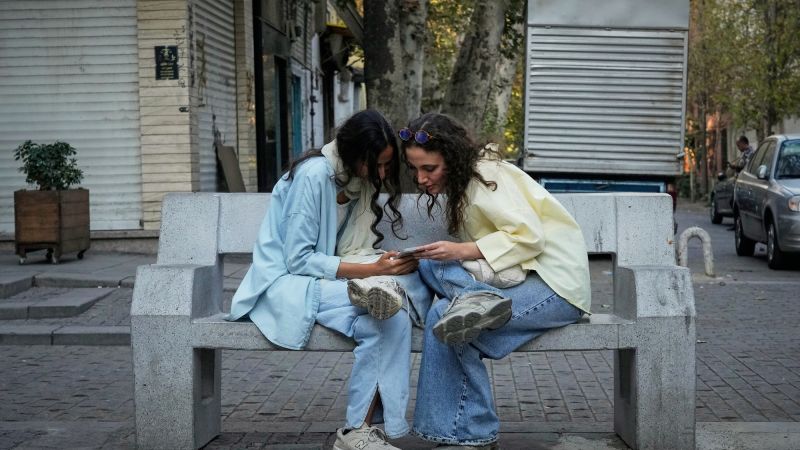
Iranians reacted with a mix of skepticism, alarm and cynicism on Tuesday after internet monitors reported a partial restoration of online access after months of near-total isolation under a nationwide lockdown imposed by Iranian authorities.
“Yes, I’m connected, but I have to use a VPN. But don’t get too excited. The internet is not completely open. It’s just not completely shut down,” a 46-year-old man from Tehran told CNN on condition of anonymity due to security concerns.
A VPN (virtual private network) essentially creates a private digital tunnel to protect your online activities from hackers, advertisers, and trackers.
Others voiced their dissatisfaction online, criticizing the restoration of limited access as too little, too late.
An Iranian woman who previously participated in anti-government demonstrations said in a post on X that the regime “wants to revive the ‘filternet’ and is using it to create such a big spectacle.” South Korea and Japan “do not lecture their citizens to the same extent, even though they have fast internet speeds,” she wrote, adding that Iranian officials “create this hype around basic internet connectivity.”
Meanwhile, some Iranians appeared to be using the moment as a symbolic show of resilience, posting selfies on Instagram for the first time in months.
“There will be more people coming online, posting, and sending messages in the next 24 hours. They will need time to set up their VPNs,” another Iranian resident told CNN, adding that he is helping others reconnect via VPN, asking not to be identified or reveal their location due to security concerns.
Monitoring group NetBlocks announced on Tuesday that internet activity in Iran had partially recovered after President Massoud Pezeshkian directed authorities to restore access, Iranian state media reported, citing the Ministry of Communications.

NetBlocks said it was restored 88 days after the power outage, calling it “the longest nationwide internet shutdown in modern history.”
According to NetBlocks, the measure could be the beginning of the end of the longest power outage imposed in any country in modern history, although it remains unclear how far restoration will go or if the order will be fully enforced.
Iran began restricting internet access in late December 2025 following massive anti-government protests caused by soaring inflation, a collapsing currency and a deepening economic crisis, according to NetBlocks and other monitoring groups.
As the protests expanded into broader demands for political change, the Iranian government tightened restrictions. By the end of February, authorities had imposed a near-total shutdown amid U.S. and Israeli military attacks.
In a subsequent post to X on Tuesday, NetBlocks said that the internet filtering system known as “FilterNet” is still in operation in Iran, but that it can be bypassed in some cases. The group added that WhatsApp remains restricted, requires workaround tools to access, and some users are still offline.
The slow recovery highlights how tightly internet access is controlled in Iran.
Internet governance in the country is highly centralized, with multiple tiers of state institutions ultimately accountable to the highest leadership. At the center of this is the Supreme Council for Cyberspace, an institution established in 2012 by then-Supreme Leader Ali Khamenei, whose members include politicians, judiciaries, intelligence and religious officials with differing views on how much access Iranians should have to the outside world.

This helped to entrench deep inequalities in access. A small number of Iranians use smuggled Starlink devices for direct connectivity, others rely on expensive VPNs to circumvent restrictions, and some government-approved users retain access to the open internet.
However, internet access remains limited and uncertain for most ordinary people as governments consider how much connectivity to allow.
Nevertheless, some Iranians in Tehran and other cities signaled the return to access restrictions with quiet but powerful acts of defiance, including posting selfies on Instagram for the first time in months. It was a small sign that they were determined to be seen again after weeks of forced silence.
