

Few countries in the world experience earthquakes as frequent and damaging as Japan. Japan is an island nation located on the border of four plates, a slab of the Earth’s crust that is constantly changing.
It also lies on the Pacific Ring of Fire, a 45,000-mile arc around the Pacific Ocean that is home to the world’s most active volcanoes and produces the most earthquakes.
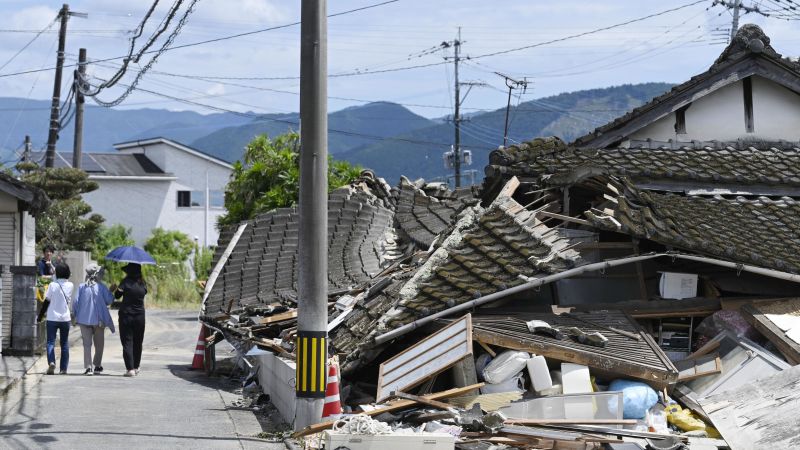
The effects of these earthquakes were on full display after a deadly 6.8 magnitude earthquake struck the southern part of Japan’s Kumamoto prefecture this week, sending thousands of emergency responders into search, rescue and rescue operations.
But Japan is well prepared for such a disaster, having invested billions of dollars in cutting-edge earthquake detection technology, response and evacuation systems, and seismic infrastructure.
For residents, earthquakes are part of everyday life, and children begin earthquake and evacuation drills in kindergarten. But the threat looms large in the public’s imagination, especially as the Japanese government regularly warns that Japan could eventually be hit by a once-in-a-century “giant earthquake.”
Tuesday’s earthquake had killed at least 13 people as of Wednesday. The total number is unknown, but some are still missing or injured.
There are still concerns that people could become trapped under damaged or collapsed infrastructure. A shopping mall in Kumamoto was reportedly partially destroyed by an explosion following the earthquake, leaving many people trapped. Authorities cited a possible gas leak as the cause.
Separately, a large number of employees at a paper mill are also reported missing.
Local police and fire departments are currently working with military personnel on relief efforts. “People are still waiting for help and every second counts,” Prime Minister Sanae Takaichi said on Wednesday.
The Kumamoto region was just recovering from the devastating 2016 earthquake that caused widespread damage and killed more than 270 people.
Japan’s history is full of devastating earthquakes.
Throughout classical and feudal times, earthquakes regularly struck cities and towns, destroying buildings made of wood and paper that were highly vulnerable to fires that occurred in the aftermath. A particularly devastating earthquake in 1498 is thought to have killed more than 30,000 people, although estimates vary.
The Great Kanto Earthquake of 1923 was another devastating moment, destroying large areas of the capital Tokyo and killing approximately 140,000 people.
Japan began implementing stronger building codes in the 1980s, and their effectiveness was proven during the 1995 Great Hanshin-Awaji Earthquake, which killed more than 6,000 people. Nearly all of the buildings that collapsed were built before the new standards, marking the beginning of a major effort to improve the country’s earthquake resistance and emergency response systems and retrofit older buildings to new standards.

As one of the world’s wealthiest countries, Japan was in a strong position to embrace technology and spending to strengthen itself against tectonic threats.
However, technological progress has its limits.
The 2011 Tohoku disaster is the worst disaster in living memory. A magnitude 9.1 earthquake and tsunami caused a meltdown at the Fukushima nuclear power plant, killing nearly 20,000 people. Thousands more were never discovered. It remains one of the strongest earthquakes of this century.
Small earthquakes can still cause death on a daily basis. In 2024, a magnitude 7.1 earthquake occurred in Noto, western Japan, killing more than 700 people.
Countries such as Chile, Indonesia, the Solomon Islands, and the West Coast of the United States are all located on the Pacific Ring of Fire on either side of the Pacific Ocean. This is where the Pacific Plate (the oceanic plate beneath the water) meets the surrounding continental plate. When these plates move against each other and create friction, energy is stored and released in earthquakes.
“About 10% of the world’s magnitude 6 and above earthquakes occur in or around Japan, so the risk is much higher than in places like Europe or the eastern United States, where earthquakes are rare,” Shoichi Yoshioka, a professor at Japan’s Kobe University, told CNN in 2024.
“Each time, we witness tragic loss of life, collapsed buildings and devastation caused by the tsunami, leaving a lasting impression of horror,” he added. “This fear is likely shared by many citizens, and I think this is a major contributing factor to why Japan is so prepared.”
Among other earthquake-prone countries, Japan is known as a world leader in earthquake preparedness and resilience.
Buildings require earthquake-resistant technology, such as walls and floors that absorb vibrations and shaking, and flexible structures that do not collapse even if the building moves during an earthquake. “Most buildings are fairly resistant to earthquakes,” a government website for tourists advises.
But travelers remain frightened by the threat.
Last summer, a spate of earthquake-related “prophecies” caused superstitious travelers across East Asia to cancel or postpone vacations to Japan. These included a Japanese comic book that warned of a “real catastrophe,” a psychic who predicted mass destruction, and a feng shui master who advised people to stay away.
The Japanese government itself has fueled these fears, warning for years that a Nankai Trough earthquake, the most powerful of its kind, could soon occur.
The Nankai Trough is a 700-kilometer (435-mile) long subduction zone that refers to the phenomenon in which tectonic plates slide beneath each other. According to the government’s Earthquake Research Commission, severe earthquakes are recorded in the region every 100 to 200 years.
By calculating the spacing between each major earthquake, the government warned there was a 70% to 80% chance that another Nankai Trough earthquake, expected to be between magnitude 8 and 9, would rock Japan within 30 years.
But science is controversial. Some people dispute these predictions, arguing that earthquakes do not occur at predictable intervals. Even those who believe in this prediction say that making inaccurate predictions over such a long period of time is not necessarily beneficial.
Experts told CNN that the best thing Japan can do now is fill gaps in parts of the country that are less prepared and raise public awareness of emergency preparedness.
