

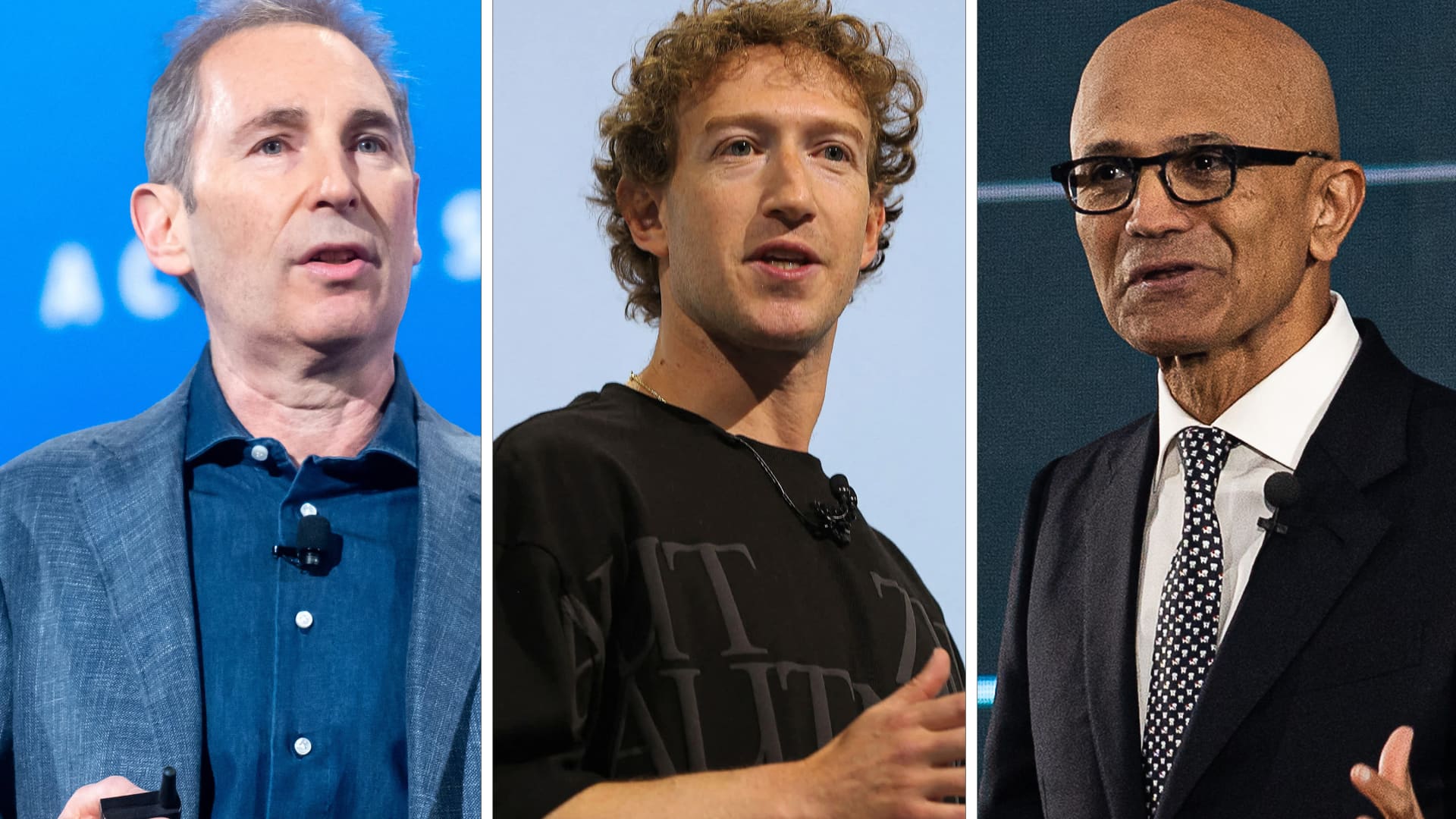
Amazon President and CEO Andy Jassy, Meta CEO Mark Zuckerberg, and Microsoft CEO Satya Nadella.
Noah Berger | Manuel Orbegoso | Reuters | Peerapong Boonyakiat | SOPA Images | Light Rocket | Getty Images
alphabet has long been a popular hyperscaler on Wall Street for its expertise in turning expensive capital investments into profits.
But investors expressed displeasure at the internet giant’s plans to boost its 2026 capital spending forecast, announced Wednesday along with its second-quarter results, as it rushes to open new data centers for artificial intelligence.
Shares of Google’s parent company fell 7% on Thursday; Amazon, meta and microsoft All fell similarly, with increased scrutiny on infrastructure spending highlighting uncertain returns and dwindling cash reserves. The three megacap companies are scheduled to announce their quarterly results this week.
In recent quarters, investors have welcomed increased capital spending, interpreting it as evidence of healthy demand and a maturing earnings book. Alphabet has one of the highest valuations on Wall Street, with its stock price up about 70% over the past year. That’s because the company’s cloud infrastructure business is growing faster than its competitors, and its Gemini model and services are gaining traction in a market dominated by OpenAI and Anthropic.
But if last week’s report is any guide, Google can no longer give itself the benefit of the doubt. Mark Mahaney, head of internet research at Evercore ISI, also wrote in a note Wednesday that Alphabet’s boost in capital spending “increases the likelihood of similar actions” from Amazon and Microsoft.
Microsoft and Meta will next test investor appetite when they report after the close of trading on Wednesday. Amazon will follow on Thursday.
As demand for AI chips eats into memory supplies, Microsoft in April predicted annual capital spending and finance leases would be worth $190 billion, with $25 billion of that expected to come from rising component prices.
“As you can see from Google’s reaction[last week]if they raise capital spending again, that will probably put selling pressure on the stock,” Cowen analyst Derrick Wood said in an interview on CNBC. Analysts surveyed by Visible Alpha expect $190.1 billion from Microsoft.
Amazon’s consensus rose nearly $2 billion to $207.4 billion following Alphabet’s report, according to Visible Alpha.
“Increasing AI fatigue”
In February, Amazon projected capital spending of $200 billion in 2026, the highest in the group until Alphabet raised the upper end of its forecast to $205 billion. The company maintained that forecast in April, with CEO Andy Jassy telling investors at the time that “the plan is pretty much the same.”
Analysts wrote in a research note earlier this month that they expect Amazon to ramp up spending on big-ticket investments such as AI, custom chips and early satellite internet services, and raise its capital spending guidance this year to account for soaring memory prices.
Jake Dollarhide, CEO of Longbow Asset Management, whose largest shareholder is Amazon, wrote in an email that the online retailer may struggle to impress investors in “an environment of growing AI fatigue, sudden doubts about meteoric capital spending budget increases, and significant levels of debt taken on by Silicon Valley and MagSeven to fund massive data center construction.”
Amazon’s long-term debt increased 81% to $119 billion from Dec. 31 to March 31. Alphabet’s long-term debt rose 111% to $98 billion in the first half of 2026, but the company, long seen as a money-printing machine, turned cash flow negative for the first time in the second quarter.

Amazon, Meta, Microsoft stock price charts
Wedbush analysts wrote in a note Thursday that Alphabet’s report suggests that production capacity remains constrained despite strong demand and that there is an “appetite to spend.” But they don’t see Amazon’s potential increase in capital spending as entirely negative.
“We believe this tradeoff is worth it given the reacceleration of AWS and the expansion of Amazon’s platform advantages across Bedrock, Alexa, and its logistics network,” the analysts wrote, recommending Amazon stock as a buy.
Although Google’s cloud is growing rapidly, Amazon Web Services still leads the cloud infrastructure market, with Microsoft in second place. Google’s cloud was 30% of AWS in 2020 and nearly 50% in the first quarter of 2026. The company’s cloud business expanded 82% in the second quarter, the fastest growth since at least 2020, following a 63% increase in the previous quarter.
AWS revenue rose 28% in the first quarter, and analysts surveyed by FactSet expect it to rise nearly 32% in the second quarter. Microsoft’s revenue from Azure and other cloud services rose 40% in the first quarter, compared to a FactSet consensus of 39% for the second quarter.
Mahaney wrote that “demand appears to be relentless” for the cloud, but noted that it is “hard to find a company that can match” Google’s cloud growth rate in the quarter.
Meta, the only hyperscaler without an established cloud business, is expected to record $138.9 billion in capital spending this year, and told investors in April that number could reach $145 billion. The company is currently considering selling its computing power to third parties.
For now, Meta is still throwing cash around. Analysts surveyed by FactSet expect Microsoft’s free cash flow to be negative in the fourth quarter for the first time since at least 2001.
Amazon’s free cash flow turned negative in the first quarter, and analysts surveyed by FactSet expect it to remain in the red for the rest of the year. Free cash flow was last negative in 2021 and 2022 as the company doubled its warehouse space in response to a surge in e-commerce demand due to the pandemic.
“I think you need to be patient with these stocks, because I think they’re going to be AI winners over the medium to long term,” said Tiffany Wade, a fund manager at Columbia Threadneedle who held positions at Alphabet, Amazon and Microsoft at the end of June.
During Alphabet’s earnings call, CEO Sundar Pichai argued that his company’s strategy of relying on outside vendors for additional computing power to meet its cloud demands, while costly, will yield attractive returns within a few years.
“I think that’s probably the right thing to do,” Wade said. “You don’t want to turn away customers because you don’t have capacity.”
Attention: Investors reward business models that minimize capital expenditures while punishing those who spend too much on AI

