

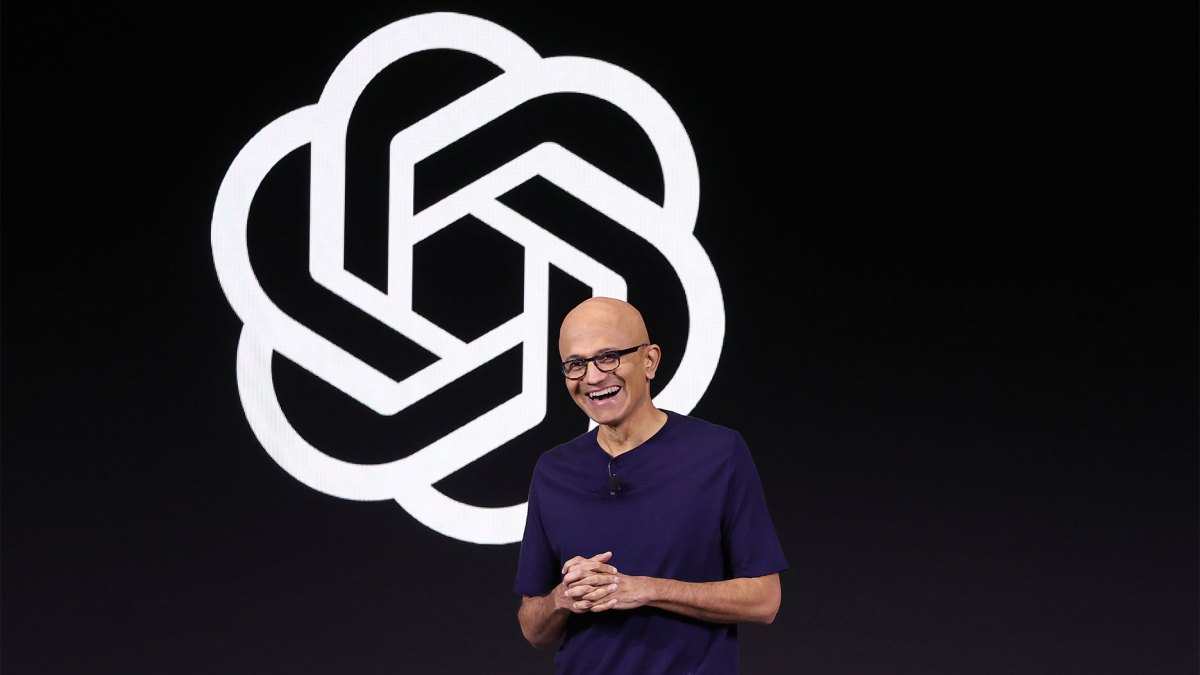
On Sunday, Microsoft CEO Satya Nadella doubled down on the shocking warning he issued earlier this month to companies using AI, and this time he took it a step further. He predicts that companies that rely entirely on their own AI labs for their AI needs will ultimately not survive.
He said this on CNN’s “Fareed Zakaria GPS.” When Zakaria asked Nadella to explain what it meant for companies to overshare with AI model providers, he said companies need to be careful about everything they hand over, from data to prompts.
Nadella called for a setup where “every time you use a model, you retain all the metadata around it, so you can use all of that to maybe train your own weights or your own open model.” (Weights are the trained parameters of the model and are essentially the brains of the model. Nadella’s takeaway: Companies should keep their own usage data so they can ultimately build their own models.)
“I would argue that companies that don’t have this control cannot survive as companies because they are essentially outsourcing their thinking,” he added.
That means companies that don’t have their own models, or a layer of AI infrastructure called an AI gateway that separates the prompts from the model itself, will be in trouble, Nadella said.
He specifically wants companies to stop relying on AI Labs’ built-in coding tools known as harnesses (Anthropic’s Claude Code and OpenAI’s ChatGPT Codex are examples).
“By keeping the harness separate from the model and the context and memory separate from the model, you can use multiple models to do what they do best, while still being in control of your destiny no matter which model goes away,” Nadella said.
As a reminder, Microsoft has invested in two of the largest AI labs: Anthropic and OpenAI. Coding agents are a particularly popular way for companies to use AI models, and no matter how you look at it, modelers are making tons of money.
Still, Nadella cautioned companies against becoming too dependent on them. Naturally, Microsoft will benefit from that warning. That’s because the company’s cloud business now also sells alternative infrastructure, such as the one he recommends.
Despite his obvious self-serving fear tactics, he’s not wrong. Increasingly, companies are realizing that they need more model options, especially cheaper options, and are turning to openweight models that can be tweaked and run on their own hardware, meaning that the underlying code is publicly available. This means you also need a way to manage multiple models and a coding agent that is not tied to a specific model provider.
However, Nadella’s point is not just that the budget is out of control. He predicts that once companies “outsource the thinking” to models, there will be little to stop AI labs from eventually offering competing services of their own. This risk increases as companies adopt AI agents and give them access inside the enterprise.
This is the kind of warning the startup world has been shaking with for years. What will stop model makers from wiping out startups by imitating and competing with them?
For example, in May, OpenAI CEO Sam Altman announced that all Y When he offered to invest in Combinator startups with AI credits, seed investor Jason Calacanis issued a similar message warning buyers, posting, “If you receive these tokens, there’s a non-zero chance that OpenAI will look into exactly what your startup is doing, copy your ideas, and incorporate your app into a free offering. This is a classic platform strategy. Founders, beware!” he posted.
Mr. Nadella is now making the same claims against companies.
There is one caveat. Nadella’s concerns about oversharing with AI models only apply to businesses, not individuals. When Zakaria asked Nadella specifically how everyday people can protect themselves, Nadella brushed it off, saying that data sharing is just the price consumers pay for services, especially those that are free.
“In the consumer space, there has to be some level of value exchange, where you’re probably getting something for free for data. That’s how the advertising business model has worked,” Nadella said.
If you buy through links in our articles, we may earn a small commission. This does not affect editorial independence.
