

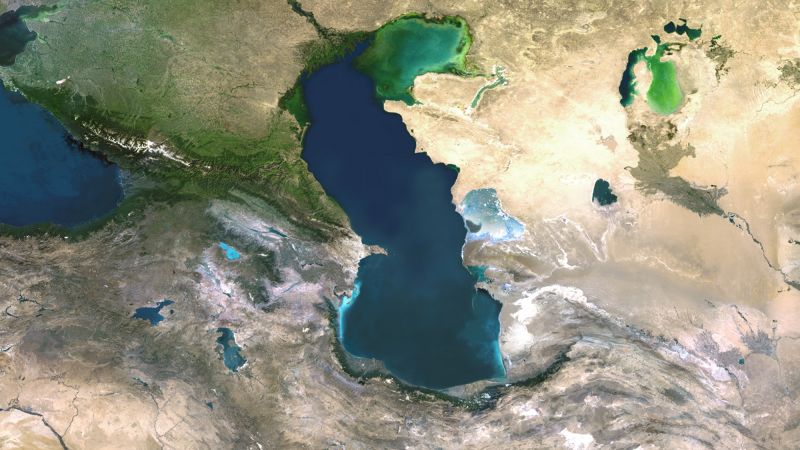
The Caspian Sea has become the latest region to become embroiled in the escalating conflict between Iran and its rivals. Especially since it is a key artery in the growing relationship between Iran and Russia.
Over the weekend, Ukraine announced that drones had attacked two Russian ships carrying military cargo in the Caspian Sea, the world’s largest inland body of water. Both men claimed to have left Iran for Russian ports.
Ukrainian President Volodymyr Zelenskiy said in a post on X Saturday that the targets included “not only warships, but also vessels involved in transporting military cargo from Iran,” which Ukrainian security services later identified as Russian missile boats.
Iran countered that a merchant ship carrying a cargo of iron was hit, killing one sailor and injuring three others.
The ship, which did not reveal its name, was sailing from the Russian port of Astrakhan to Anzali, Iran, which Iranian regional governor Hadi Hagshenas described as a “safe and reliable corridor for commercial exchanges between the two ports.”
Tensions escalated further on Monday when Iranian Foreign Ministry Spokesman Esmail Baghaei said: “We will never remain unresponsive to Ukraine’s dangerous adventurism.” Meanwhile, Ukraine’s chargé d’affaires in Tehran was summoned to the Ministry of Foreign Affairs over the incident.

The accusations reflect the growing importance of the Caspian Sea, which borders five countries including Iran and Russia. The closure of Iranian ports in the Persian Gulf and Gulf of Oman has given the Caspian Sea new importance as a trade route.
Bijan Kajepour, managing partner at the Vienna-based consulting firm Eurasian Nexus Partners, said the Caspian Sea could help Iran toward a “multilateral trade strategy, especially if it facilitates trade via rail with Russia, the Caucasus, Central Asia, China, and indirectly with Eastern Europe.”
Khajepour told CNN that this is “a strategic complement, not a replacement, to Iran’s existing maritime access through its southern waters.”
Cargo crossing the Caspian Sea includes Russian grain and steel. Iran has developed several important ports at sea, including Anzali Port. Oil and gas from Kazakhstan is transported from the Caspian Sea to the Black Sea hub.
For Russia, the Caspian Sea is an important conduit to Central Asia and Iran, and an important route for expanding its strategic partnership with Iran, which includes military elements as well as Russia’s role in Iran’s civilian nuclear program and Iranian oil exploration.
“The recent U.S. blockade (of Iranian ports) has highlighted the strategic value of the Caspian Sea route,” Kajepour said. It is also less susceptible to international sanctions because it is landlocked and largely controlled by Iran, Russia and neighboring countries beyond the reach of Western navies.
Why are the seas so valuable to Iran and Russia?

The Caspian Sea has become a passageway for growing military connections between Moscow and Tehran. Although not a mutual defense pact, Iran and Russia have extensive strategic agreements that include economic and military cooperation.
Russia received the first batch of Iran’s Shahed attack drones via the Caspian Sea early in the war with Ukraine, and has been producing the new drones at factories on Russian territory ever since.
The Caspian Sea route, which connects ports in northern Iran with the Russian port of Astrakhan, has been a target of Ukraine before. In August last year, the cargo ship Port Oriya 4 was destroyed while reportedly carrying Shahed-136 drone parts and Iranian munitions.
In 2024, CNN reported that a Russian cargo ship allegedly carrying Iranian ballistic missiles for Moscow’s war against Ukraine was spotted at a Russian port in the Caspian Sea. The US Treasury Department assessed that the Russian Ministry of Defense “used the vessel Port Olya 3 to transport CRBMs (short-range ballistic missiles) from Iran to Russia.”
US Secretary of State Antony Blinken said at the time that the US government believed that the Russian military had received a shipment of Iranian-made Fatah-360 ballistic missiles and “will likely use them against Ukrainians in Ukraine within the next few weeks.”
At the same time, the US National Security Council warned of deepening military cooperation between Iran and Russia. “The transfer of Iranian ballistic missiles to Russia would dramatically increase Iran’s support for the Kremlin in invading Ukraine,” Spokesman Sean Savet told CNN at the time.
At the time, Iran denied providing military aid to Russia.
Ukraine’s drone attacks on ships and energy infrastructure in the Caspian Sea over the weekend demonstrate the country’s growing long-range capabilities and its goal of damaging industries that support Russia’s war effort.
It also recognizes that Iran, like North Korea, plays an important role in supplying arms to Russia.
Above all, Ukraine’s timing is sensitive, with President Zelenskiy visiting Washington this week to meet with President Donald Trump. In addition to the Caspian Sea attack, President Zelenskiy said that according to Ukrainian intelligence, Russia had provided satellite data to Iran to attack U.S. facilities in the Middle East.
Message: We are on the same side.
