

Sixteen teams will compete in the postponed 2026 Women’s Africa Cup of Nations, vying for qualification to the 2027 Women’s World Cup and bragging rights on the continent.
Action in Morocco begins on Sunday, four months after its originally scheduled start.
Recommended stories
list of 4 itemsend of list
Nigeria will aim to defend the title they won a year ago, while Ghana, Zambia and Morocco are also among the pre-tournament favorites.
There will be no shortage of world-class talent at the tournament, with big names set to compete, including Zambia’s pair Rachel Kundananzi and Barbra Banda, Nigeria’s Rashidat Ajibade and Malawi’s Chawinga sisters Thabitha and Temwa.
Here’s what you need to know about WAFCON 2026.
When does WAFCON start and when are the finals?
The Confederation of African Football (CAF) Women’s Africa Cup of Nations 2026 begins on Sunday, with Algeria facing Senegal in the tournament’s opening match, while hosts Morocco play Kenya on the same day.
The final will be held in Rabat on August 16th, concluding the 22-day tournament.
Group Stage: July 26th – August 6th
Quarterfinals: August 8th and 9th
Semi-finals: August 12th
Playoffs: August 13th
Last day: August 16th
Kick-off times will be 17:00 GMT and 20:00 GMT throughout the tournament, except for the final. The final will be held at 19:00 GMT.
WAFCON is held every two years, but due to logistical issues, the 2024 event was postponed by a year to July 2025, making the gap between tournaments shorter than usual.
Why was WAFCON rescheduled?
The tournament was originally scheduled to run from March 17th to April 3rd, but just 12 days before it started, CAF announced it would be postponed due to “certain unforeseen circumstances.”
CAF did not provide details on the reason for the postponement, but news agencies such as Reuters reported that host country Morocco had requested a change of date.
Speculation has increased over Morocco’s desire to host the tournament after on- and off-field controversy marred the men’s AFCON final in Rabat in January, where Morocco lost 1-0 to Senegal in a dramatic battle.
However, two months later, CAF awarded Morocco a 3-0 win as several Senegalese players left the pitch in protest of being awarded a penalty.
Where will the competition be held?
As in the 2022 and 2024 editions, Morocco will once again host WAFCON.
Matches will be held in five stadiums in the cities of Rabat and Casablanca.
⚽Moulay El Hassan Stadium (Capacity: 22,000) – Rabat
⚽Olympic Stadium (capacity: 21,000 people) – Rabat
⚽Al Medina Stadium (capacity: 18,000 people) – Rabat
⚽Larbi Zauri Stadium (Capacity: 20,000) – Casablanca
⚽Mouret Rachid Stadium (capacity: 25,000) – Casablanca
The match was originally scheduled to be held in the city of Fez, but was moved to Casablanca.
The venue for the final has not yet been confirmed, but it will be either the Moulay Hassan Stadium or the 69,500-capacity Prince Moulay Abdellah Stadium in Rabat. The latter also hosted this year’s men’s AFCON final.

How many teams are participating?
This tournament will feature 16 teams for the first time, compared to the previous two 12-team formats. This decision to expand the format was announced by CAF in November, just four months before the start of the tournament, after the qualification phase ended.
Based on the FIFA World Rankings, the top four teams from the losing teams in the final round were selected to participate.
Nations are divided into four groups:
⚽Group A: Morocco, Algeria, Senegal, Kenya,
⚽Group B: South Africa, Ivory Coast, Burkina Faso, Tanzania
⚽Group C: Nigeria, Zambia, Egypt, Malawi
⚽Group D: Ghana, Cameroon, Mali, Cape Verde
Of the 16 teams that qualified, nine also participated in the 2024 tournament.
Botswana, Democratic Republic of the Congo and Tunisia, which had qualified in 2024, did not participate this time, but Cape Verde and Malawi will be participating for the first time.
Cape Verde’s WAFCON debut came on the heels of the men’s team achieving a historic last-32 finish at the 2026 FIFA World Cup.

What is the tournament format?
Each team will compete in a round-robin match, with the top two teams from each group advancing to the knockout stage, which begins with the quarterfinals. Next, the semi-finals and final will be held, and there will also be two playoffs between the losing teams in the semi-finals for World Cup berths.
In the knockout stage, if the match is tied at the end of regular match time, it will proceed to 30 minutes of extra time, after which penalties will be assessed if necessary.
How does Women’s World Cup qualification relate to WAFCON?
This year’s WAFCON has special significance as it also serves as a qualifying tournament for the Women’s World Cup to be held in Brazil next year.
All four WAFCON semi-finalists will qualify for the 2027 World Cup, while those eliminated in the quarter-finals will participate in a playoff match to determine the two African teams that will qualify for the FIFA Inter-Confederation Playoffs.
Of the 16 participants in WAFCON 2026, four from Morocco, Nigeria, South Africa and Zambia were participating in the 2023 Women’s World Cup.

Who are the previous WAFCON champions?
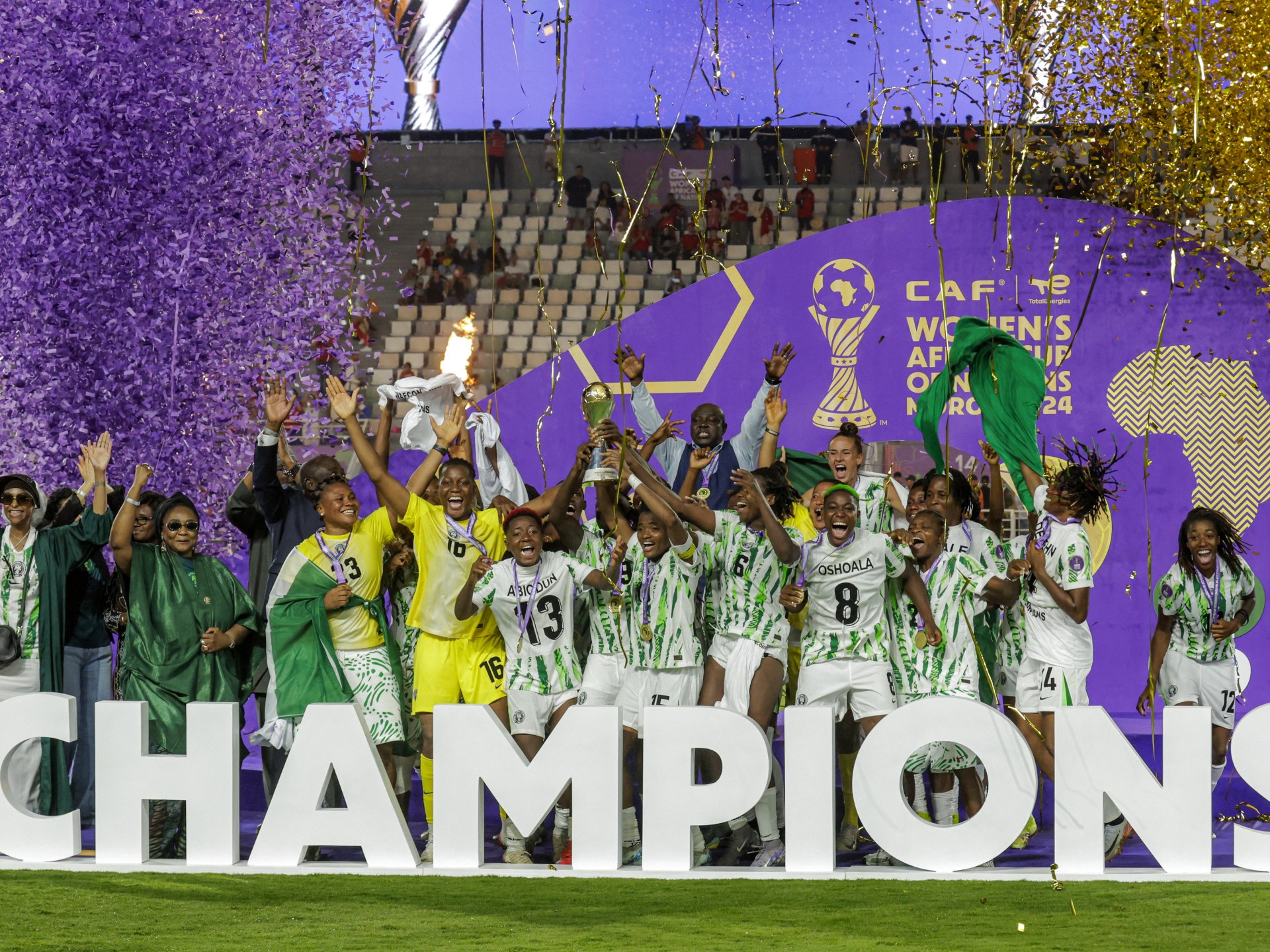
Nigeria are the most dominant team in African women’s football, having won a record 10 WAFCON titles. Their title win at the 2024 tournament was called completing “Mission X.”
Apart from powerhouse Nigeria, Equatorial Guinea won the tournament in 2008 and 2012 as the host country, and South Africa won the 2022 tournament, becoming the third country to win.
The only countries other than the defending champions to reach the WAFCON finals are Morocco, Ghana and Cameroon.
Who is this year’s winning candidate?
Nigeria, the most successful African nation in women’s football, remains the team to beat as the Super Falcons seek a record-extending 11th crown. They are also the top-ranked team on the continent.
However, Ghana, who have appeared in the finals three times, have scored seven goals in the qualifying stage and have not conceded a goal, and are expected to advance against a strong opponent.
Zambia, who also had a dominant performance in the qualifiers and qualified for WAFCON for the fourth year in a row, are also on the list, while Morocco, who finished runners-up in the past two tournaments, will once again be looking to turn their strong domestic support into a silver medal.

Who are the top players at WAFCON 2026?
Many of the star players competing in this tournament play club soccer in Europe and America.
Zambian forward Kundananji joined Bay FC in the American top-flight NWSL for a then-world record fee two years ago and has been a key figure in the southern African nation’s rise in recent years. Her teammate Banda is Zambia’s striker and captain and is widely considered one of the top players in women’s football.
Fans should also pay attention to the Chawinga sisters. Tabitha is a forward for French club Lyon, and her younger brother Temwa also plays in the same position for Kansas City Current. Temwa is a two-time NWSL MVP and Golden Boot Award winner.
PSG forward Ajibade, who was named Player of the Tournament at the last WAFCON, is a standout member of reigning champions Nigeria, while Moroccan veteran Ghislain Chebak, who was top scorer in the last edition with five goals, remains one of Africa’s best finishers and continues to have an impact on the team.
How much is the prize money at WAFCON?
The WAFCON 2026 champion will win $2 million, double the previous prize money. But that’s still significantly less than the $10 million awarded to this year’s men’s AFCON champion.
The runner-up won $750,000, an increase of 50%, increasing the total prize money from $3.475 billion to $5.8 million.
Where can I buy tickets and watch WAFCON?
Ticket sales for the tournament began only on Wednesday.
Fans can purchase tickets here. Category 3 tickets cost about $2, while Category 1 tickets start at $5.
