

new delhi —
Streets and parks in the heart of India’s capital have been abuzz for days with the largest demonstrations in years. Young protesters are demanding changes to the national exam system, which they say deprives millions of people of a fair chance.
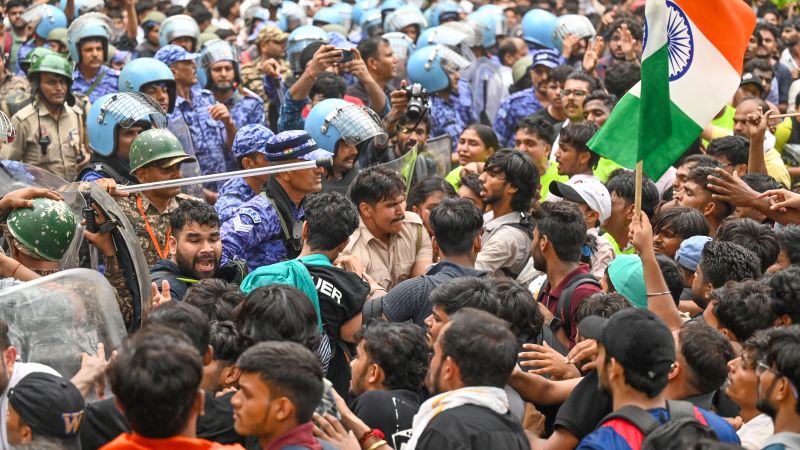
Earlier this week, protesters, mostly Gen Z, tried to make their demands known at Parliament, the world’s largest center of democracy, but were met with tear gas and police brutality with clubs and batons.
The protesters are refusing to back down and preparing for a continued confrontation with the Hindu nationalist government of Narendra Modi, which critics say has overseen a crushing of opposition during its more than a decade in power.
About 150 protesters were taken to hospital with injuries following Monday’s violence, according to leaders of the political parties leading the protests. Video of the police crackdown was widely shared hours after the incident thanks to a government-ordered internet shutdown, sparking outrage. Delhi Police said 118 police officers were injured in the “violent protests”.

Delhi Police had issued a prohibitory order ahead of the march, declaring it illegal.
And on Tuesday, protesters, many showing scars at the hands of police, returned to Jantar Mantar, a 300-year-old observatory surrounded by a vast park, and rebuilt a makeshift camp that serves as their headquarters. Police had demolished it the day before.
A spirit of rebellion arose in the camp.
“We stand here with pride,” said Sudhir Kumar, who attended Monday’s rally and said he saw protesters being beaten by police.
“The main theme here is education,” Kumar said. He said he spent a year preparing for entrance exams to prestigious medical schools, but later learned that his papers had been leaked.


“We’ve spent a year preparing for this, and it’s what we’re going to face when we hear that there was fraud on D-Day,” he told CNN.
Mohammad Taj, who traveled to Delhi from neighboring Haryana state and suffered severe bruises on his face in Monday’s crackdown, said the march to Parliament was peaceful.
“But in a split second, I don’t know what happened, the police started beating us with batons. They hit everyone, children, women, old people.”
By evening, the crowd had spilled outside the venue and onto the streets and driveways.
“Every time Prime Minister Modi is scared, he dispatches the police,” they said in unison, calling for “freedom.”
Monday’s parliamentary march was one of the largest demonstrations against the Modi government in years.
It was organized by the Cockroach Janta Party (CJP), a youth-led movement that started as a joke but has since grown into a political force expressing the grievances of millions of India’s youth.
CJP, founded by Boston University graduate Abhijeet Dipke, was launched in May after India’s chief justice made comments that many interpreted as calling the country’s unemployed youth “cockroaches.” These comments were seen by many as insensitive, especially in a country where youth unemployment remains high.

CJP has been at the forefront of recent protests over allegations that entrance exam questions for prestigious and competitive medical schools were leaked and sold. Millions of people had to retake the exam.
India’s education system has long been mired in controversies, including leaked exam questions and technical glitches, placing an overwhelming burden on students and a financial burden on families who invest everything in their children.
Anger grew over the weekend after prominent Indian activist Sonam Wangchuck, who had been on hunger strike in support of the movement, was removed from a protest and taken to hospital. Protesters tried to intervene, but some were seen holding sheets to block the view of police as they lifted Mr Wangchuk.
Prime Minister Modi, who rarely responds to criticism, has not publicly responded to the protesters’ demands. On Tuesday, he sent a message through the Parliamentary Affairs Minister, telling reporters that India’s leaders are working to ensure there are no further leaks.
Education Minister Dharmendra Pradhan has also yet to publicly comment on Monday’s protests. Last month on Indian news channel NDTV, he called the CJP the “B-team of a terrorist group”.

Rahul Gandhi, India’s main opposition leader, was briefly detained on Tuesday after staging a sit-in in front of Modi’s residence demanding his resignation.
There appears to be growing resolve among the protesters to continue the sit-in until their demands are met.
Some believe that replacing the education minister and overhauling the exam system is not enough. They are also demanding that Mr. Modi, who has overseen the Bharatiya Janata Party’s dominance in Indian politics for more than a decade, resign.
“A police officer in plain clothes hit me with a baton… while I was just standing there,” said protester Talwar. “This country will not change until Mr. Modi leaves.”
Fix:
This article has been updated to clarify that rally participant Sudhir Kumar witnessed protesters being beaten by police, but was not beaten himself.
