

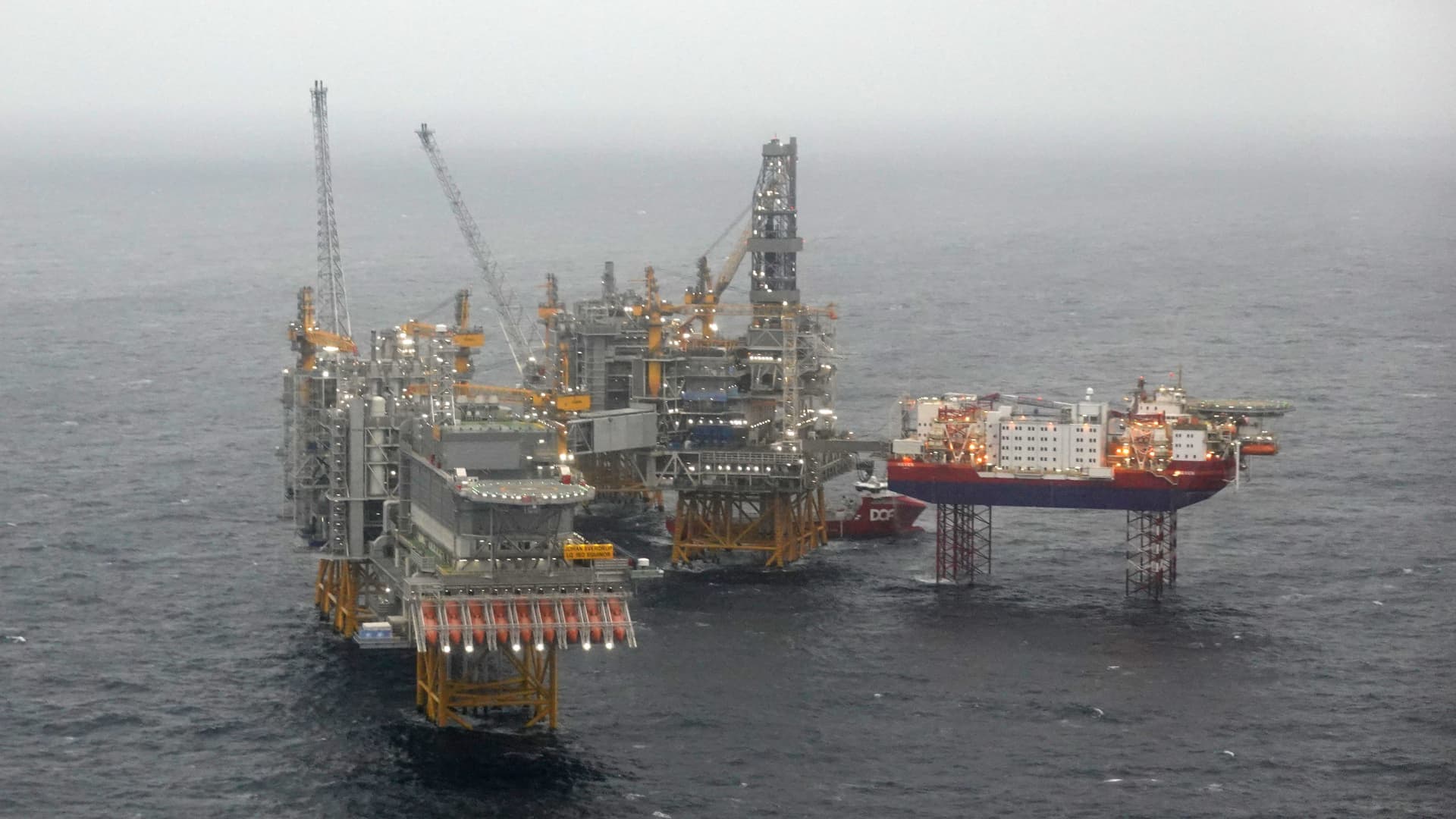
Five platforms are seen over the Johan Sverdrup oil field in the North Sea, about 140 kilometers west of the Norwegian town of Stavanger, on December 3, 2019, in an aerial photo taken from a helicopter during a media visit. (Photo by Tom LITTLE/AFP) (Photo by TOM LITTLE/AFP, Getty Images)
Tom Little | AFP | Getty Images
Oil prices rose on Monday as the U.S.-Iran conflict raised concerns about disruption to energy shipments through the Strait of Hormuz following renewed U.S. attacks and U.S. military casualties.
international benchmark brent crude oil Oil for September delivery rose 3.2% to trade at $90.91 per barrel. US West Texas Intermediate Crude August delivery rose about 2.8% to $84.79.
The escalation comes as the U.S. military confirmed that a third American service member was killed in recent operations, while investigators recovered an unidentified body near the site of an Iranian attack in Jordan that previously left two U.S. service members dead and one missing.
American forces have completed nine consecutive nights of strikes against Iranian targets. “This attack will continue to degrade Iran’s military ability to attack commercial vessels and civilian sailors transiting the Strait of Hormuz,” U.S. Central Command said in a statement carried by X News.
The new hostilities have reignited concerns about the safety of one of the world’s most important oil shipping routes. The Strait of Hormuz normally handles about 20% of the world’s oil shipments, but volumes have dropped significantly during the recent attack cycle.
US Centcom targets Iran’s coastal surveillance and air defense systems, maritime assets, and storage facilities for missiles and drones. The U.S. military also attacked Islamic Revolutionary Guard Corps units linked to the July 17 attack on U.S. soldiers in Jordan.
Iran’s semi-official Tasnim news agency said Iran’s Revolutionary Guards maintained full control of the Strait of Hormuz and renewed its pledge not to let “a single drop of oil, gas or chemical fertilizer” pass through the waterway.

Amrita Sen, founder and head of research at Energy Aspects, said a significant slowdown in shipping through the Strait of Hormuz and depletion of global inventories could push oil prices above $100 per barrel.
“Do you think the price should be in the triple digits or could be? You’re right. Remember, the market is also short, right? As soon as Hormuz starts to reopen,” Sen said on CNBC’s “Access Middle East” on Monday. It was a heavily shorted market. That’s why we got into the 70s. So that short is still covered as we speak, and I think that’s another momentum that you’re starting to get.”
“Despite the price increases we’ve seen so far, the market is still pretty complacent. Macro funds are saying to me, ‘Look, we’ve had this before, and we never really got much above $100, but what’s different this time? We need to worry about AI,'” Sen said.
“So for most people in the market, this is still not central.”
