

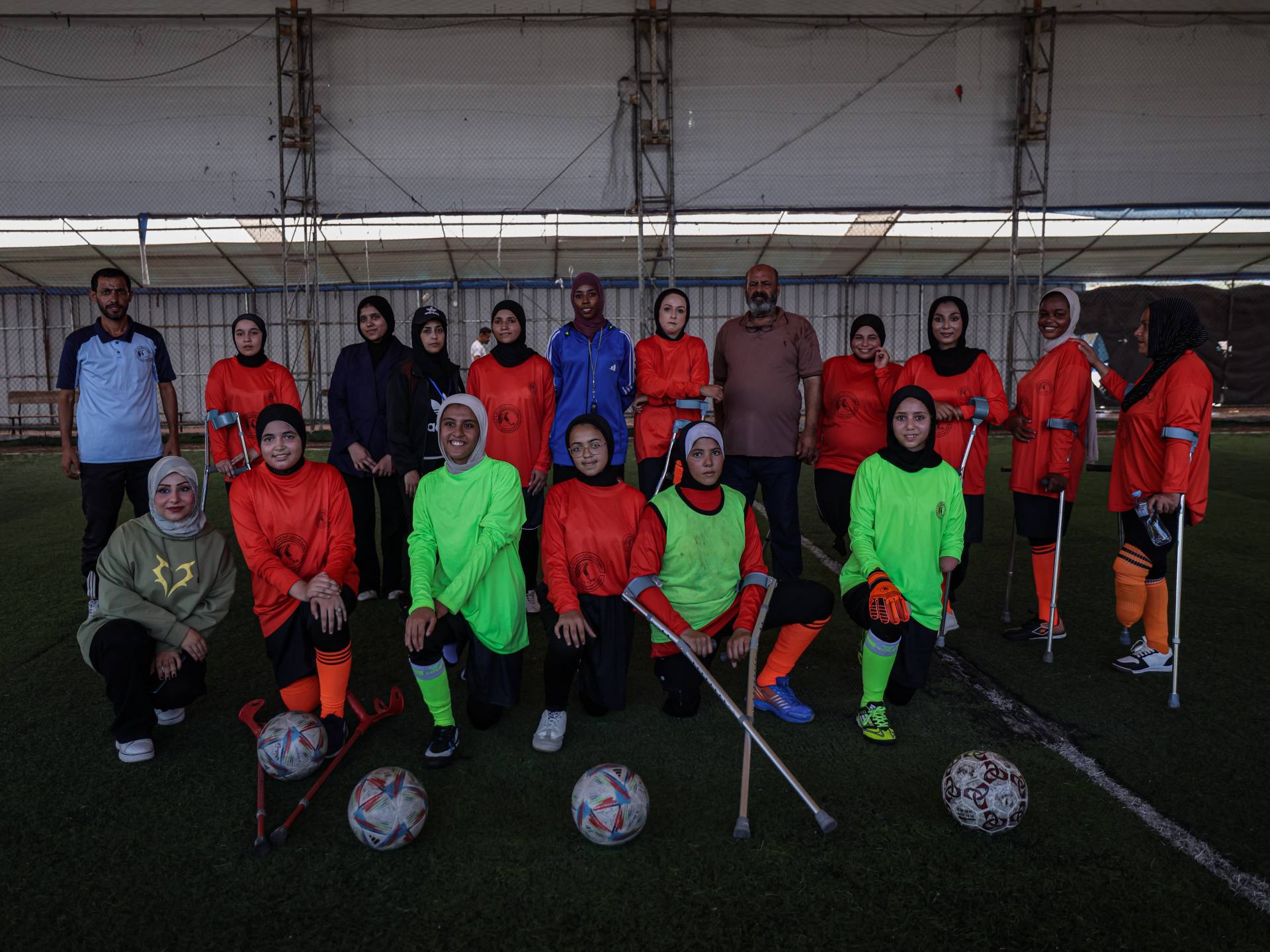
At a small soccer field in Deir El Bala, central Gaza, cheers and laughter erupt over the eerie silence of Israel’s ongoing genocide. On the pitch, one of the few to have survived the war so far, a group of young women with prosthetic limbs pass the ball onto an artificial turf playing surface.
They are part of a team of young Palestinian women who lost limbs and suffered life-threatening injuries and body parts amputated in Israeli bombings.
The story here begins with the pain each player endured in the moment of the airstrike and the long journey that brought them back to their feet.
Central to this is the role of the Palestine Association Women’s Amputee Soccer Team, helping them recover physically and mentally from life-changing ordeals.
Since Israel’s war against the enclave began on October 7, 2023, Gaza has experienced the highest number of amputations in modern history.
The World Health Organization (WHO) and the Palestinian Health Authority estimate that more than 5,000 people have had limbs amputated in the Gaza Strip as a result of Israeli bombing.
road to recovery
Among them is 23-year-old Farah Abu Kinas. On the night of June 28, 2024, the 23-year-old was sitting in her grandmother’s house when a nearby place was bombed.
Mr Farah suffered serious injuries to his left leg and severe burns to his right leg. Initially, she hoped that treatment would allow her to return to a normal life, but she was given the heartbreaking diagnosis that the wound to her left leg was so severe that it would need to be amputated.

Losing a leg was just part of the ordeal. What followed was loneliness and the realization that every aspect of her daily life had changed forever.
After being discharged from the hospital, even simple movements became difficult, and rehabilitation became a daily routine. As time passed, her recovery was much slower than she had hoped, and she felt her world shrinking within the walls of her home.
Everything changed when, during a physical therapy session, she met Fouad Abu Ghariyon, president of the Palestinian Amputee Football Association.
He helped establish Gaza’s women’s amputee team, which currently has 11 players, including nine lower limb amputees and two upper limb amputees who play as goalkeepers.
Farah immediately received an invitation to attend a training session and decided to give it a try. At first, it was difficult for her to adjust to soccer, but she was supported by other women who had gone through similar experiences.
She now carries herself more confidently on and off the pitch. With the help of a prosthetic leg, she chases the ball along with teammates Rozan Khaira and Aisha Al Abadllah.
Although their stories are different, Farah, Roseann, and Aisha all have missing limbs or live with physical disabilities.
Their quest for a space to regain a sense of purpose, confidence, and belonging came through this football team.
multiple stories
On November 19, 2023, at the height of the war, an airstrike destroyed the house directly across from Rosan Kayla’s home, seriously injuring her.
Rosan tried to get out of bed, but couldn’t. Doctors at a nearby clinic said her leg was attached to her body by just a small piece of skin and they had no choice but to amputate it.
Now, balancing on crutches, she passes the ball across the pitch to teammates with remarkable patience and defiance.
“The[Israeli]occupation mutilated our bodies, but it could not mutilate our dreams or our will to live,” she told Al Jazeera.

Aisha Al Abadllah was born with an incomplete arm. Doctors believe that Aisha’s disability may have been caused by her mother’s exposure to white phosphorous bombs used by Israel during the first war in Gaza in 2008, when she was pregnant with Aisha.
Currently, Aisha’s dream is to become a goalkeeper for the Palestinian women’s amputee national soccer team.
Fuad said the women’s team was not just about soccer, but also about creating a space where women like Aisha could reconnect with themselves and others.
After all, soccer has become an important way for them to physically and mentally recover from trauma.
The team continues to face major challenges, including limited resources and insufficient support, but has managed to survive thus far through community efforts and partnerships.
This comes after 1,009 members of the Palestinian sports community were killed and sports infrastructure was almost completely destroyed in Israel’s genocidal war in Gaza.
Dr. Kader Abu Shumara, a sports psychologist and coach of the Gaza Hope team, says the benefits of playing soccer for amputees go far beyond physical rehabilitation.

Many of these survivors initially experience isolation and withdrawal. By joining a team of people with similar experiences, you can regain your confidence and reconnect with society.
Today, Farah and her teammates stand on the football field not just as survivors of war, but as athletes with ambitions and goals.
They may have lost a body part, but they cling to what matters most: their determination to move forward with their lives.
In Gaza, where war has left thousands of people with life-altering wounds and deep emotional scars, these young women are writing a different story. It doesn’t start with loss, but the moment you choose to live again.
