

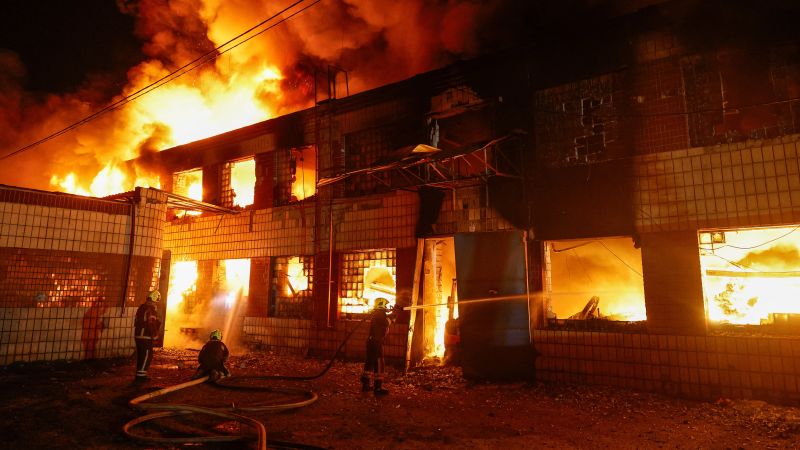
Russian missiles struck Kiev early Thursday and loud explosions were heard in the Ukrainian capital, hours before British Prime Minister Keir Starmer arrived for talks with President Volodymyr Zelenskiy.
The attack hit two districts of Kiev, killing two people, including a teenager, according to Ukraine’s State Emergency Service. The strike reportedly caused a fire in the warehouse and nearby vehicles.
The attack came ahead of a visit to Kiev on Thursday, one of Starmer’s last international engagements before he takes office as the new prime minister.
Mr Starmer and Mr Zelensky will discuss developments in the war against Russia, including Britain’s efforts to support Ukraine both militarily and diplomatically.
Mr Starmer said in a statement: “I am extremely proud of the UK’s contribution.” “That work will continue and our iron support for Ukraine will remain forever, not just for their safety and the safety of Europe, but also for the families of Britain who have felt the cost of this war through rising prices.”

Thursday’s attack also came after President Zelenskiy fired Ukrainian Defense Minister Mykhailo Fedorov in a government reshuffle. Days earlier, President Zelenskiy had also fired Prime Minister Yulia Sviridenko, who had been in office for just a year.
The appointment is controversial, with some critics warning it could cause instability at a critical time in the war, according to Reuters. Fedorov led Ukraine’s war effort, including the advances in technology that made Kiev such a formidable opponent.
Fedorov said in a statement late Wednesday that it was a “huge honor” to play the role. He praised his team’s accomplishments during his tenure, including strengthening Ukraine’s drone program and air defenses and significantly improving the country’s military’s ability to intercept Russian drones and cruise missiles.
Ukraine also conducted a successful ballistic missile test, which he said was carried out “symbolically on the day of the establishment of the government.”

It has been almost five years since the conflict began, and the cost to both sides is high. Ukraine’s advanced drone campaign has achieved extraordinary scale and impact, particularly over the past month. Kiev sometimes fires hundreds of drones a night, targeting oil refineries, naval vessels and weapons, demonstrating its growing ability to strike deep into Russian territory.
Some of those attacks prompted Moscow this week to suspend traffic through the gateway to the Black Sea, a key waterway that had been out of Kiev’s reach for years, limiting the Kremlin’s ability to trade with the rest of the world.
But Ukraine is also feeling the pain. The United Nations said this week that June was the deadliest month for Ukrainian civilians since April 2022, driven by long-range Russian missiles fired at residential buildings in urban areas.
President Zelenskiy has repeatedly implored allies to provide more aid to shore up Ukraine’s deteriorating air defenses, including provisionally authorizing the United States to build Patriot interceptors, the only weapons capable of shooting down some of Russia’s most advanced ballistic missiles.
In a surprise announcement on the sidelines of a NATO summit in Turkey last week, US President Donald Trump publicly gave Ukraine the green light to form the Patriots, but his wording was vague and he admitted he had not yet discussed the issue with US system manufacturers.
