

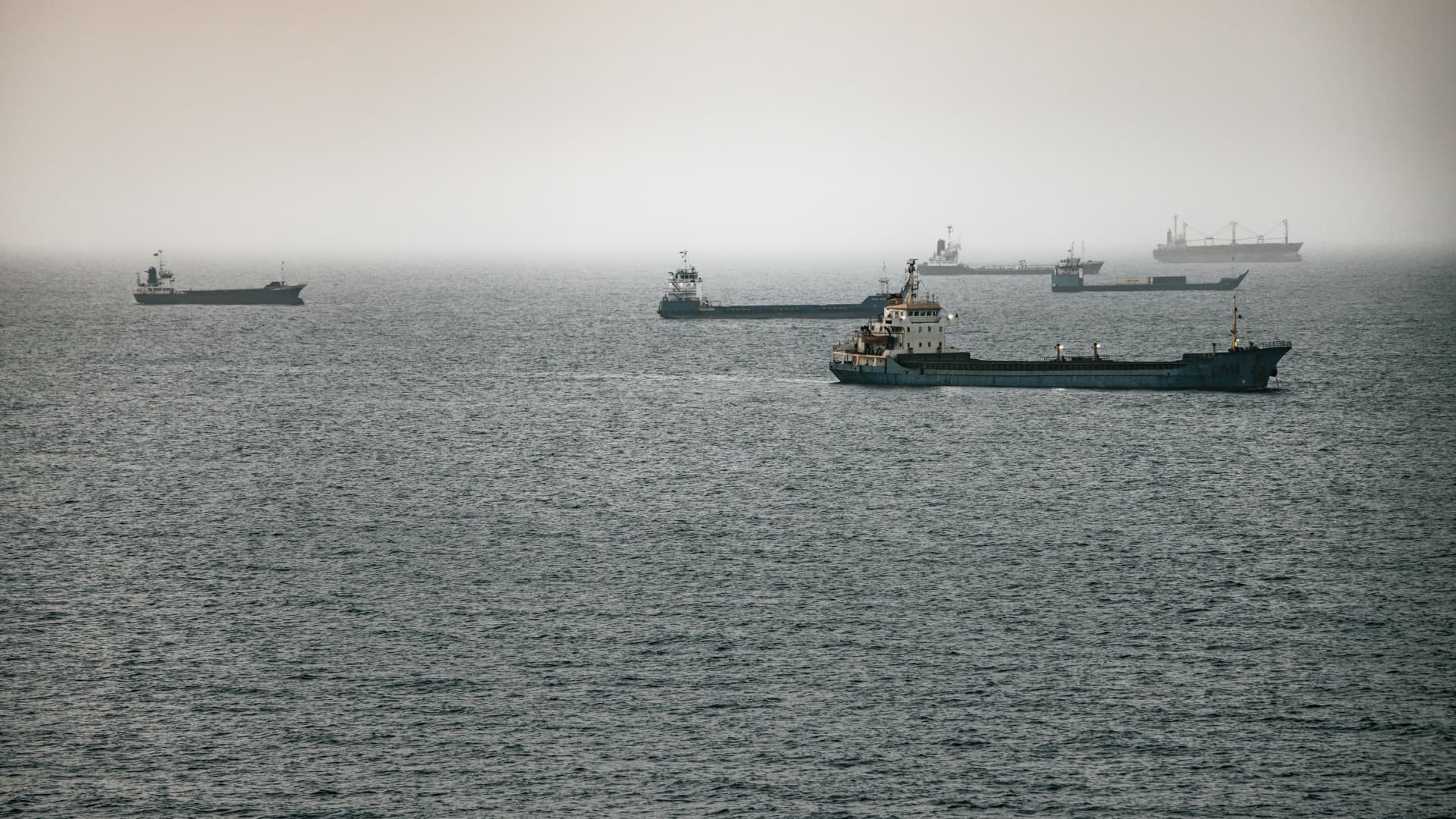
Oil tankers, bulk carriers and ships anchor around Qaboos Port in Muscat, Oman, June 22, 2026.
Elke Scoliers | Getty Images
Oil prices rose on Sunday evening after the United States and Iran traded strikes over control of the Strait of Hormuz, one of the most important trade routes for global energy supplies.
usa crude oil Futures were up 3.4% at $73.87 a barrel by 6:03 p.m. ET. brent Futures, the international benchmark, rose 3.5% to trade at $78.67.
The US military launched a new offensive against Iran on Sunday after hitting 140 targets on Saturday, according to US Central Command. The airstrike was carried out in response to an attack by the Islamic Revolutionary Guards Corps on a container ship sailing through Hormuz.
Iran responded Sunday with attacks on U.S. military facilities in Jordan, Kuwait, Bahrain and Oman, state news agency Tasnim said.
Iranian state media reported that the Revolutionary Guards had sealed off Hormuz until further notice, but the US military disputed this claim. Centcom said the strait is open to “all vessels seeking lawful passage.”
“U.S. forces are positioned and ready to ensure freedom of navigation despite Iran’s unwarranted aggression, harassment, threats, and arbitrary declarations,” Centcom said in a social media post Sunday. “Iran does not control the strait. Traffic is flowing.”
President Donald Trump said Holmes was open to it in an interview on NBC News’ “Meet the Press” that aired Sunday. Marine intelligence company Windward tracked nine ships that passed through the strait on Saturday.
The Joint Maritime Information Center, a U.S.-led naval coalition in Bahrain that provides up-to-date safety information for civilian vessels transiting Middle East waters, said the southern shipping lane through Omani waters remained open to traffic.
However, the security situation in Hormuz remains dire, the center said in a notification on Sunday. Sailors should exercise “extreme caution”.
The weekend airstrike was the fourth time the United States has bombed Iran in the past week, in retaliation for an attack on a commercial ship passing through Hormuz in the southern corridor protected by U.S. forces.
Iran claims control of the strait and requires ships to use the northern passage through its territorial waters.
The latest outbreak of fighting stems from conflicting interpretations between the United States and Iran, under which Hormuz Island was supposed to be reopened under the interim peace agreement signed on June 17.
Until the United States and Israel attacked Iran on February 28, about 20% of the world’s oil supplies passed through Hormuz. Traffic has plummeted since Iran began attacking ships in the strait in early March, but transits have resumed after the United States and Iran signed an interim agreement.
