

Beijing —
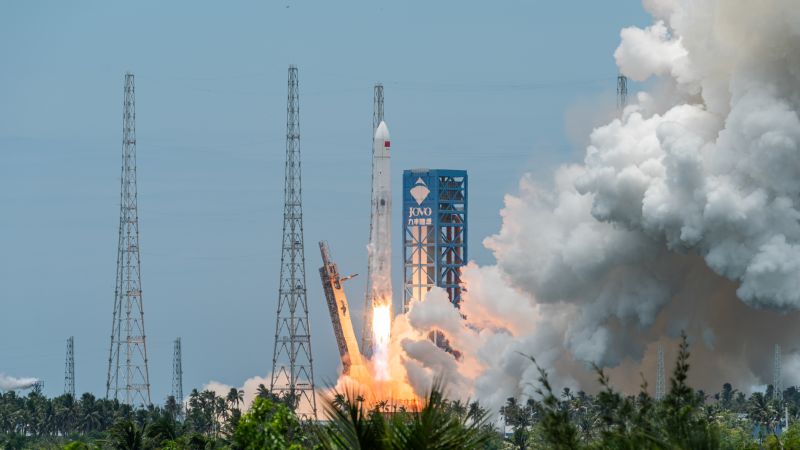
China successfully recovered the first stage of a carrier rocket during an orbital launch test, state media reported on Friday. This is a milestone for the country, which is trying to catch up with its U.S. rival in reusable rocket technology.
The Long March 10B rocket lifted off from southern China’s Hainan Island on Friday. About six minutes after the first and upper stages separated, the first stage booster returned to the floating platform, state broadcaster CCTV said.
In a video posted by a CCTV-related social media account, the booster can be seen billowing smoke at the top as it descends vertically onto the platform.
The success of this experiment brings China closer to matching the reusable rocket capabilities of U.S. companies. The technology is seen as key to both space exploration and travel, as well as the construction of critical satellite infrastructure.
“This mission…represents historic progress in China’s reusable rocket technology and a solid foundation for accelerating the improvement of China’s space access capabilities,” rocket maker China Aerospace Science and Technology Corp. said in a social media post.
According to state media, the mission also successfully deployed a satellite into orbit.
The successful landing follows other failed rocket tests in recent months as companies in China’s crowded space sector race to reach milestones in developing reusable launch technology.

The Chinese government aims to position itself as a “powerful aerospace nation,” leveraging not only its national space assets but also its commercial space sector to compete with global rivals.
Developing reusable technology can significantly reduce the cost and time required for rocket launches. It also has the potential to provide strategic advantages to nations as space becomes a relevant domain for military and defense capabilities on Earth.
Reusable rockets are at the heart of the success of Elon Musk’s company SpaceX, which devised a way to land and reuse rocket boosters about a decade ago and now dominates the global launch market.
U.S. SpaceX competitor Blue Origin successfully landed the first stage of its New Glenn rocket for the first time last November.
The Long March 10 series, designed and manufactured by a subsidiary of the state-owned China Aerospace Technology Corporation, is also critical to China’s ambitions to send a manned mission to the moon.
