

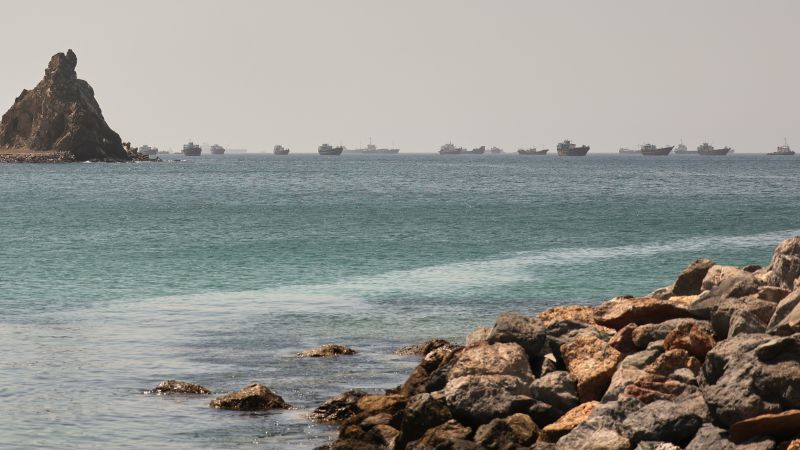
The tanker was reportedly struck by an unknown projectile while sailing near the Strait of Hormuz on Monday, the UK Maritime Trade Operations (UKMTO) said.
The Wall Street Journal, citing unnamed US officials, reported that Iran’s Islamic Revolutionary Guards Corps (IRGC) opened fire on two commercial ships near the strait. Axios, citing unnamed US officials, reported that Iran fired a missile at a commercial ship passing through the strait.
The reported attack occurred hours before US President Donald Trump was due to depart for a high-stakes NATO summit in Ankara, Turkey. The summit is scheduled to discuss security across the strait and comes as Iran oversees the multi-day funeral of its slain former supreme leader Ayatollah Khamenei.
Iran’s semi-official Fars news agency, citing unnamed sources, reported that the Qatari oil tanker was attacked as it attempted to transit the Strait of Hormuz “after ignoring repeated warnings.”
“Authorities have not yet confirmed or denied these reports,” it added.
According to UKMTO, the ship reportedly collided with its port side eight nautical miles east of Lima, Oman, causing a fire. It added that no casualties or environmental impacts were reported.
CNN has reached out to U.S. Central Command, which directs military operations in the Middle East, Central and South Asia, for comment.
Iran’s government suspended fragile negotiations with the United States aimed at reaching a lasting deal to end the conflict during days of funerals for Ayatollah Khamenei, who was killed in a U.S. and Israeli attack on the first day of the war in February.
On Monday, President Trump told reporters that the United States must reach a deal with Iran or “finish the job,” according to Reuters.
Iran’s Foreign Minister Abbas Aragushi warned in a post on Tuesday alongside a photo of a crowd mourning Khamenei that negotiations for a final deal “will not start if the threats continue.”
He cited Section 13 of the U.S.-Iran memorandum, which states that the two countries must meet several conditions before beginning negotiations on a final agreement.
Among the conditions is an end to all fighting, including in Lebanon, where Israeli forces carried out several attacks on Monday, Lebanese state media reported.
Another condition is that Iran make every effort to ensure safe and free passage of commercial ships through the strait.
Iranian authorities have repeatedly used the Strait of Hormuz, through which about a fifth of the world’s oil flowed before the war, as a bargaining chip.
Since the Memorandum of Understanding was signed, the number of ships passing through the Strait of Hormuz has increased, with many taking routes that pass close to Oman, with which they share the waterway.
Meanwhile, the Iranian government is seeking to strengthen its influence, insisting that crew members must receive permission to transit the strait along routes approved by government officials.
On Sunday, the Revolutionary Guards warned that the navy had sent patrol vessels to cut off the “Oman sea route,” according to Iranian media and the Revolutionary Guards-affiliated Telegram channel. In a report on Monday’s alleged attack, Iran’s Fars news agency, citing sources, claimed the tanker was attempting to transit via the “Oman route.”
UKMTO said in a post on Sunday that traffic through the Channel had stabilized in recent days but had not increased, warning that there remained a risk to ships transiting the vital waterway.
Referring to the US-Iran Memorandum, the UKMTO post said: “Although the risk remains lower than in the pre-Memorandum period, Iran’s intent and ability to carry out deliberate hostilities remains and despite the lack of recent escalation, the environment continues to warrant heightened vigilance.”
According to Monday’s update from maritime tracking agency Marine Traffic, 108 boats crossed the Channel between Friday and Sunday. Before the war, an average of more than 100 ships passed through the strait each day.
