

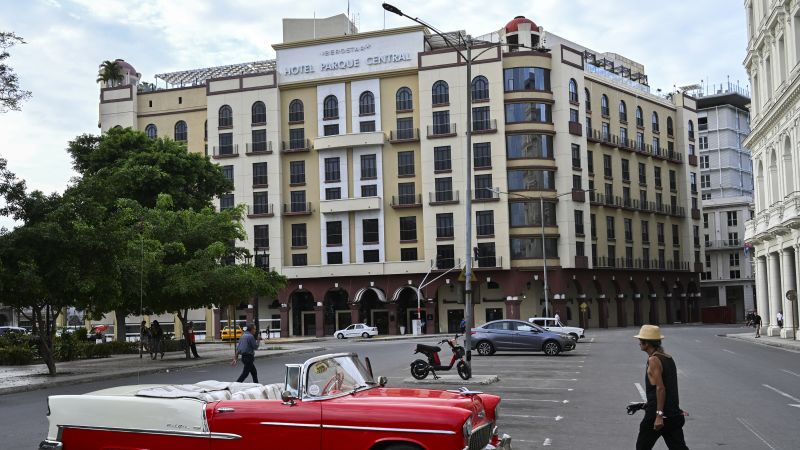
Havana, Cuba —
Cuba’s tourism sector seems to have it all, from white sand beaches to Spanish colonial forts.
All except tourists.
The island’s economy is in a death spiral following intensive sanctions imposed by the Trump administration against the communist-run government.
As services collapsed and supplies worsened, foreign tourists and the income they brought in disappeared faster than the ice on a mojito on a summer’s day.
Former tourist attractions are now ghost towns, including Old Havana, the original home of Cuba’s capital, founded in the 16th century and considered one of the best-preserved examples of Spanish colonial architecture in the Americas.
“There are no tourists,” said Elio, one half of a guitar duo that has been playing traditional Cuban music for nearly 30 years near the historic square in Old Havana. He did not want to give his last name because he was concerned about the repercussions of speaking with foreign media.

“Maybe they’re at home. Only one person comes every 30 minutes or an hour.”
According to Cuban government statistics, only 360,000 tourists visited the island in the first five months of 2026, a 58% decrease compared to the same period last year.
By comparison, Cuba’s neighboring Dominican Republic reported a more than 10-fold increase in tourist numbers during the same period.
The Trump administration’s military attack on Cuba’s former ally Venezuela in January cut off vital oil supplies to the island.
A U.S.-ordered oil blockade on the island followed soon after, further disrupting the fragile economy and causing many airlines to cancel all flights because they were unable to refuel their planes in Cuba.
New U.S. sanctions target foreign companies doing business with Cuba’s military, which controls much of the tourism industry, and have led to many international hotel chains abandoning the island.
The Trump administration says the economic stranglehold is aimed at forcing the Cuban government to pry open the island’s hermetic political system and allow foreign direct investment, including in the tourism sector.
In an interview with Axios in June, President Trump likened Cuba’s tourism potential to Venezuelan oil as he considered further steps to force the Cuban government into concessions, including military action.

“Venezuela has oil, Cuba doesn’t. Cuba has great land, great coastline,” Trump told the outlet.
The island’s tourism sector was hit by the pandemic and has not recovered since.
Increasingly punitive US economic sanctions have worsened the situation, preventing many tourists from coming or scaring away those who can.
Travel companies such as UK-based Cubania Travel have been forced to cancel all travel for the time being.
“Who would want to travel to a country that is in such dire straits? People are prepared for some discomfort on vacation, but at the moment going to a place like Cuba becomes a kind of dark tourism,” said Cubania Director Lucy Davis.
In the meantime, Davis said she is working with past customers and others concerned with the welfare of Cubans to raise funds to donate food island-wide for those affected by the crisis. This initiative also provides work to local staff who no longer have tourists to guide.
“I kept hearing stories of people struggling to find food,” Davis said. “We can’t help all of us. We may be a drop in the ocean, but this is what we can do.”
Trump’s pressure campaign could not have come at a worse time for Cubans, as the Cuban government appears to have bet the island’s future on tourism and has spent much of the past decade building new hotels, which are now vacant.
In June, Cuban President Miguel Díaz-Canel said for the first time that Cubans, whether they live on the island or abroad, could take over the management of government hotels as part of new reforms aimed at saving the Tank economy.
“We are open to Cubans who want to invest in and manage hotels,” Diaz-Canel said. “We have also provided these business opportunities to Cubans living abroad.”
Under current law, the Cuban government would retain full ownership of the hotel.
Pedro Monreal, a Spanish-based Cuban economist, told CNN he doubted whether Cuba’s emerging private sector would be able to take over management of government hotels.
“It’s unrealistic to expect Cubans, whether in exile or on the island, to replace hotel chains,” Monreal said. “Such a move would require capital scale, established supply chain links, and a level of know-how not possessed by Cuba’s private sector, either inside or outside Cuba.”
Monreal said the state is overinvesting in hotels and spending far more on tourism infrastructure than on health, education and agriculture. The combination of huge bets on tourism and President Trump’s overwhelming sanctions are now bankrupting the government, he said.
Despite the crisis, the Cuban government continues to build more hotels that the country no longer needs. Empty hotels are now painful symbols of the collapse of an industry once seen as key to Cuba’s economic future.
