

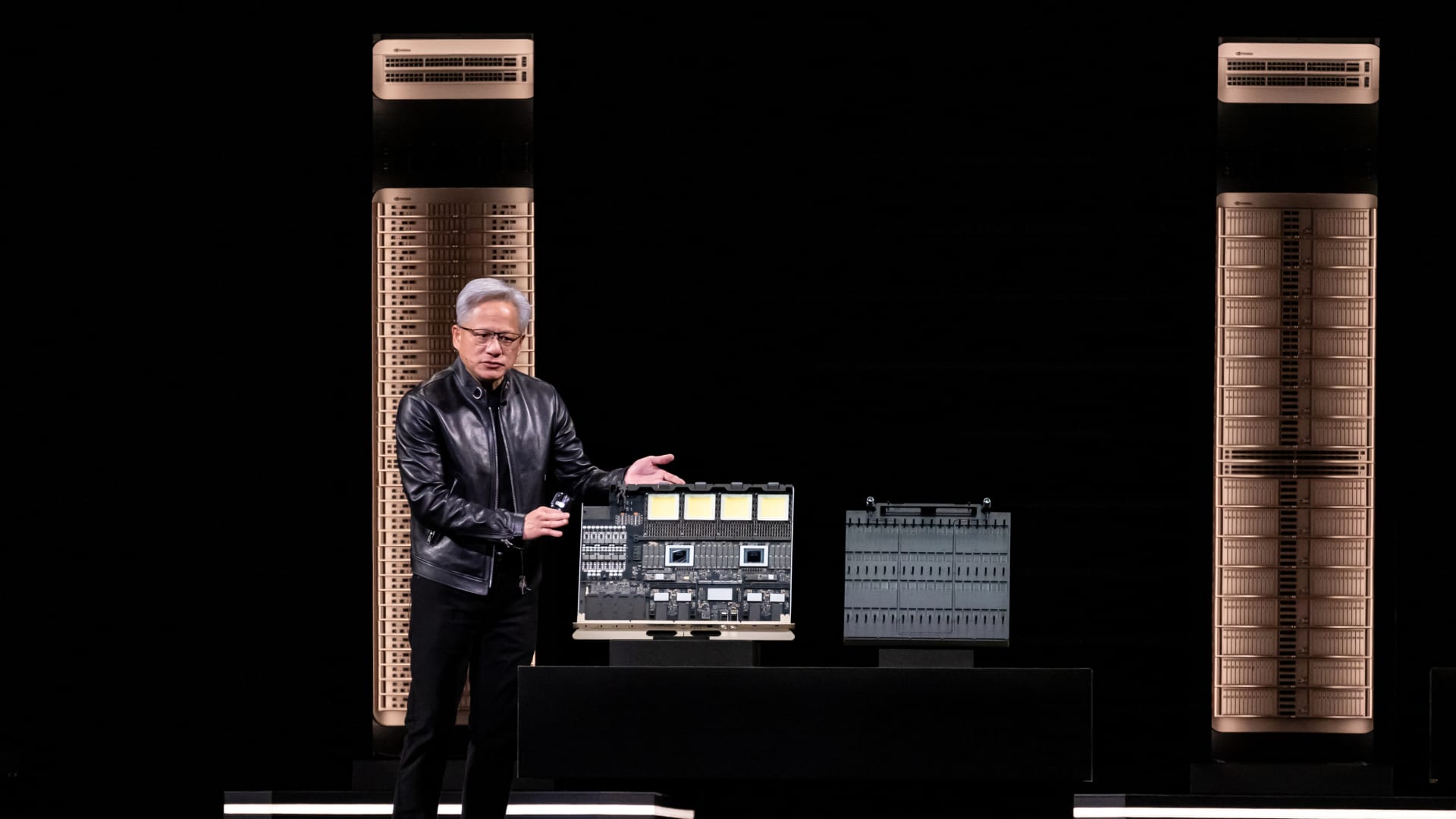
Nvidia Corp. Chief Executive Officer Jensen Huang speaks alongside the Vera Rubin Ultra Kyber Compute Tray and Vera Rubin Ultra Kyber NVLink MidPlane during the keynote address at the Nvidia GTC conference on Monday, March 16, 2026 in San Jose, California, USA.
Bloomberg | Bloomberg | Getty Images
NVIDIA’s next big product, the Kyber rack-scale architecture designed to include the 2027 Rubin Ultra chip, will be delayed by more than 12 months until 2028, according to research firm Semianalysis. This is the latest in a series of setbacks that cast doubt on the AI giant’s product roadmap.
Kyber is a server cabinet that packs 144 of Nvidia’s most powerful chips into a single unit that work together as one giant computer to provide AI companies with the horsepower they need to train and run cutting-edge models.
This design installs graphics processing units in compute trays that are arranged vertically instead of horizontally to increase density and reduce latency. It was also scheduled to debut in 2027 with Nvidia’s next-generation rack-scale system, the Vera Rubin Ultra.
Semianalysis said in a post Monday that the setback was due to difficulties manufacturing a critical circuit board at the heart of the system.
“The Kyber NVL144 rack architecture has been postponed to 2028 as the PCB midplane continues to be challenging from a manufacturability standpoint,” the company said, referring to the specialized multilayer printed circuit boards that connect the electronic modules in the system.
NVL576, a large system linking eight racks via optical connections, is also likely to be delayed or limited to small quantities, the research firm said.
Nvidia did not respond to CNBC’s request for comment.
The reported delays are adding to the strain on Nvidia’s entire product line and highlight concerns that Nvidia’s breakneck annual release pace is hitting manufacturing limits.
A backup plan to bolt two of Nvidia’s current-generation racks together to provide similar power was also scrapped after cloud customers rejected the design as difficult to use and expensive to operate. “It was subsequently discontinued following intense backlash from CSPs (cloud service providers) and hyperscalers due to its strange design and heavy operational burden,” Semi-Analysis said.
As such, NVIDIA “doesn’t have a proven solution to scale up Rubin Ultra’s global size,” the semi-analysis said, predicting it could impact rivals. advanced micro device and googleThe company’s in-house chips are already winning business from top AI labs, making them a rare technological advance in the high-end market.
Nvidia’s current generation Rubin systems are in full production and will begin shipping this fall to eight cloud partners, including Amazon Web Services, Microsoft Azure, and Google Cloud. The semi-analysis also predicts that Nvidia’s data center computing revenue will exceed Wall Street consensus by 20% in the second half of fiscal 2027.
Nvidia’s stock price fluctuated in pre-market trading, ending down less than 0.1% at $194.79.
