

Minutes after England overcame a World Cup scare against the Democratic Republic of Congo to reach the last 16, focus turned to the Three Lions’ next encounter.
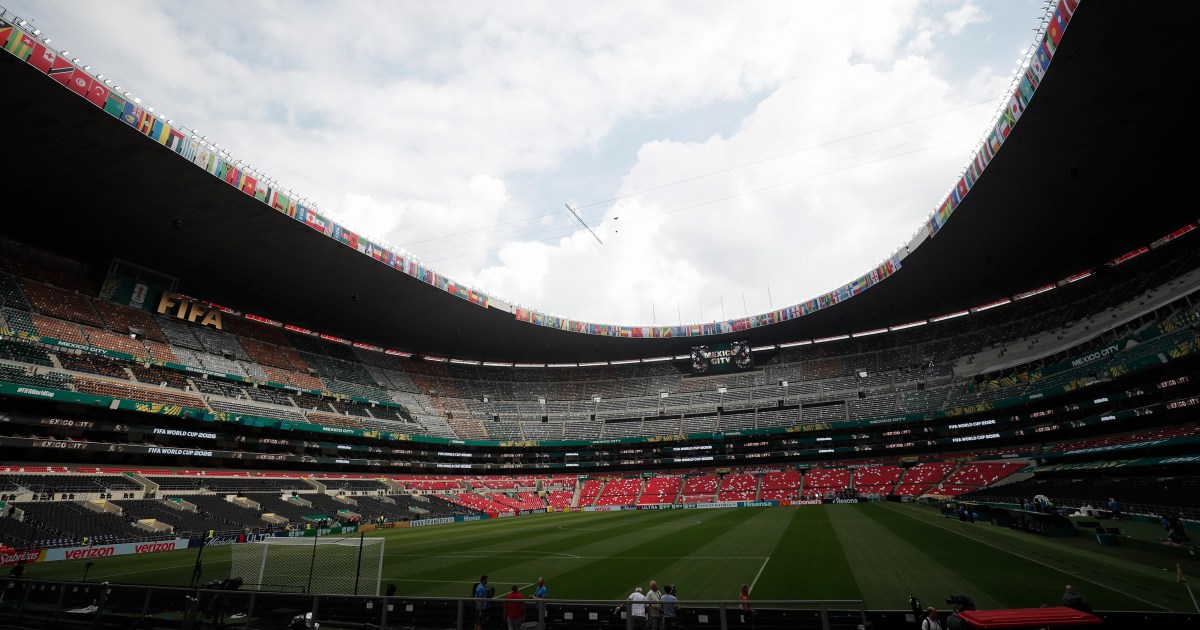
But it wasn’t the threat of an in-form Mexican team that made the most noise, but the challenge of playing at Azteca Stadium, an iconic soccer venue that literally takes your breath away.
Recommended stories
list of 3 itemsend of list
Sunday night’s match between Mexico and England in Mexico City is the most talked about match of the tournament, with discussions ranging from changing the kick-off time to hosting the tournament at high altitude and the risk of bad weather.
Al Jazeera analyzes the potential impact these could have on England’s chances of reaching the quarter-finals.
What time is England vs Mexico?
The match will kick off at 6pm on Sunday in Mexico City, while it will kick off at 1am (midnight GMT) on Monday in London.
Why did FIFA consider changing the kick-off time for England vs. Mexico?
On Friday, British and Mexican media reports said governing body FIFA planned to move kick-off at Azteca Stadium from 6pm to noon local time due to heavy rain and flooding expected in Mexico City on Sunday.
However, FIFA decided to stick to the scheduled time because moving the Mexico-England match forward would also mean postponing the Brazil-Norway match, to be held on the same day in New York/New Jersey.
Why is Mexico City one of the toughest venues at the World Cup?
The Azteca Stadium, Latin America’s largest with a capacity of just over 80,000, is the fortress-like home of co-hosts Mexico, who have lost only two of their 89 official games there.
Mexico is undefeated in its last 22 competitive games in Mexico (16 wins, 6 losses), but the average FIFA ranking of these opponents is only 57th, according to statistics provider Opta.
The Azteca Stadium, the venue of the 1970 and 1986 World Cup finals, has particular historical significance for England, who will be playing there for the first time since their controversial 2-1 loss to Argentina in the quarter-finals of the 1986 World Cup, famous for Diego Maradona’s “Hand of God” goal.

Is Mexico City located at a high altitude?
Mexico City’s pitch is located at 2,240 meters (7,350 feet) above sea level. At that altitude, the air is thinner, delivering less oxygen to your body with each breath, and the ball travels faster and farther.
By contrast, Atlanta Stadium, where England beat the Democratic Republic of Congo 2-1 on Wednesday, is just over 300 meters above sea level.
What does manager Thomas Tuchel say about Mexico City’s altitude?
England manager Tuchel was asked about the challenge of playing for the Aztecs immediately after the win over the Democratic Republic of Congo.
“Playing the Aztecs against Mexico is probably one of the most beautiful games and one of the most exciting games,” Tuchel said.
“And many obstacles will await us. Needless to say, the altitude will be a big disadvantage, since we cannot physically adapt to it in four days. It is impossible.”
The 2026 World Cup will be held in the United States, Canada, and Mexico, so it will be difficult for teams to make changes between games. The England squad traveled to Mexico City on Friday, arriving a day earlier than usual, but this was not enough to allow them to acclimate to Mexico City’s unique environment.
“I would recommend either going 10 days in advance, which is too long for us, or going last minute. That is not allowed,” Tuchel added.

Mexico City’s altitude impairs aerobic capacity because less oxygen is physically dissolved in the blood, making it harder for the body to pump oxygen to cells.
For soccer players, that means increased heart rate, shortness of breath, dehydration, faster and stronger fatigue, and slower recovery.
There is also the issue of soccer itself. Thinner air provides less resistance, which changes the speed and flight of your passes and shots.
Coach Tuchel explained the movement of the ball: “It will go another five yards (meters). It’s just difficult.”
Will England be at a disadvantage against Mexico?
yes.
England will not have had enough time to physiologically adapt before the final, but co-hosts Mexico are used to living and training at high altitude and will play three of their four World Cup matches at the Aztecs. They won all three games, defeating South Africa and the Czech Republic in the group stage and Ecuador in the last 32.
This venue will be physically demanding for all players, but it will be especially demanding for goalkeepers. He can struggle to deal with ball rotation and flight, such as shots on goal or crosses inside the box.
But England striker Marcus Rashford dismissed suggestions that altitude and atmosphere could be decisive.
“This is a football game. We’ve all been playing football since we were kids, we’ve all played in different environments, different atmospheres… It’s up to us to try to find a way to get to the top and that’s the focus,” he said.
“We have to work together and try to be as close to the best as we can, and that’s okay.”

Is there a short-term solution?
Tuchel could change his tactics to adapt to the testing conditions.
England may choose to loosen up their style of play against Mexico and give their players time to recover between high-intensity plays.
They will likely want to hold onto the ball, conserve energy, and move forward when the right opportunity comes.
