

Kyiv —
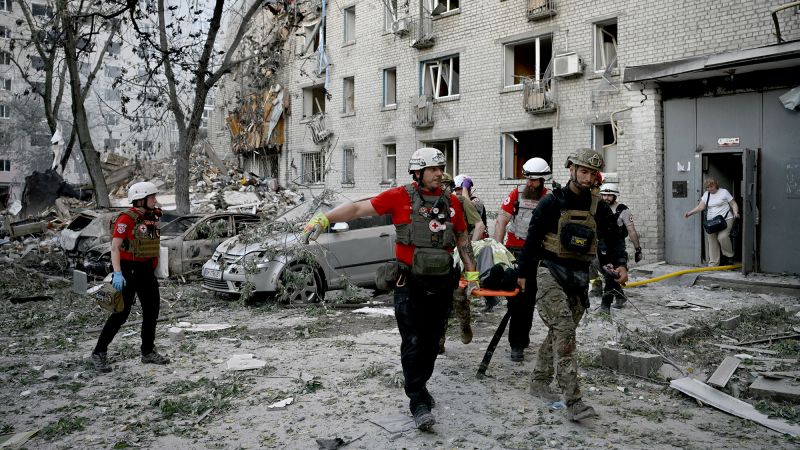
At least 30 people were killed in a ferocious Russian attack on Kiev on Thursday, making it the third deadliest attack on the Ukrainian capital since the start of the war.
Ukraine has withstood hundreds of major air attacks in the past, but this week’s strikes were extremely deadly. One reason for this is Russia’s choice of targets (houses) and its use of weapons such as ballistic missiles, loitering weapons, and jet-powered drones.
Jet-powered drones like the Geran-4 UAV are a relatively new addition to Russia’s arsenal, first spotted around the beginning of this year.
They can fly at speeds of up to 500 kilometers per hour (310 miles per hour) and evade Ukrainian defenses. They are also too fast for Kiev’s mobile fire groups and can only be shot down by surface-to-air missiles or fighter jets.
“The enemy is using jet aircraft more and more often, and the proportion of jet-powered Shaheds in the arsenal is increasing. That is depleting (our) resources,” Ukrainian Air Force spokesman Yuriy Ifnat said on Friday. Having to use missiles against drones would put further strain on Ukraine’s already stretched supplies.
Analysts at the Institute for the Study of War (ISW), a US-based conflict watchdog, said Russia’s use of jet-powered drones is another example of Russia exploiting tactical and technological innovations in unmanned aircraft systems to “maximize civilian casualties during attacks on Ukraine.”
“Fast-moving drones that are difficult for Ukraine to intercept will likely result in increased civilian casualties, similar to other attack package adaptations in the past,” ISW said in a memo released Thursday.
Ifnat said Thursday’s Russian attack was also unique because 28 of the 77 missiles Russia deployed were ballistic missiles, which he called “a very, very high number.”


Ukraine’s Ministry of Defense announced on Friday that more than 90% of cruise missiles and 90% of Shahed-class attack drones were intercepted during the attack.
Ifnat said the missiles Russia launched on Thursday included the Zircon anti-ship and ground attack hypersonic cruise missile. “The Patriot system is the only system that can travel at very high speeds, like ballistic missiles, and intercept missiles like this,” he said.
Although Ukraine has several Patriot squadrons, intercepting ballistic missiles remains a major challenge, and it still lacks missiles to do so. The strain has been exacerbated by the Iran conflict, which has led to some shipments originally destined for Ukraine being diverted to the Middle East.
The Defense Ministry said Friday that it has contracts to supply hundreds of new missiles in the future, but is currently facing an urgent shortage.
The department said it has sent letters to nearly 40 countries asking them to provide Patriot missiles from existing stockpiles as soon as possible. This will be “in exchange for future deliveries already contracted for Ukraine,” the company said.
ISW said Russia had been preparing for Thursday’s attack for some time and was likely stockpiling drones and missiles in June. After conducting an average of one major attack and several smaller attacks against Ukraine from January to May, the Russian government launched only two major attacks against Ukraine in June.
Russia has successfully ramped up production of unmanned aircraft, allowing them to produce thousands of drones every month and launch large-scale attacks every few days.
“Russian military may be stockpiling drones to carry out more frequent large-scale attacks at later times of the Kremlin’s choosing, especially if Russia believes it can further exhaust Ukraine’s air defenses,” ISW said in a memo.
Kiev authorities said about 25 locations were attacked across the capital, most of them in residential areas. That may have led to an unusually high death toll. A single Russian missile destroyed 64 apartment blocks, killing several people and leaving dozens of families homeless.
The Russian Ministry of Defense said in a statement on Thursday that the attack on Kiev was retaliatory and targeted “military industrial facilities and fuel and energy complex facilities” in Kiev, a statement contradicted by the fact that civilian goods were extensively damaged.
Ukrainian President Volodymyr Zelenskiy said more than 130 homes were damaged in the attack and accused Russia of attacking civilian infrastructure “every day and every night.”

“The only argument they have left for not stopping the war is terrorism,” he said.
Search and rescue operations continued into Friday, with several people still missing, including the parents of a 10-year-old boy rescued on Thursday.
But the death toll could have been much worse had it not been for a warning issued by Kiev authorities late Wednesday. Tens of thousands of people were evacuated as Ukrainian intelligence warned of an impending attack and President Zelenskiy implored residents to be “extremely careful” and not ignore air raid warnings.
According to Kyiv Metro, about 52,500 people, including 4,500 children, took shelter in the capital’s metro stations overnight.
