

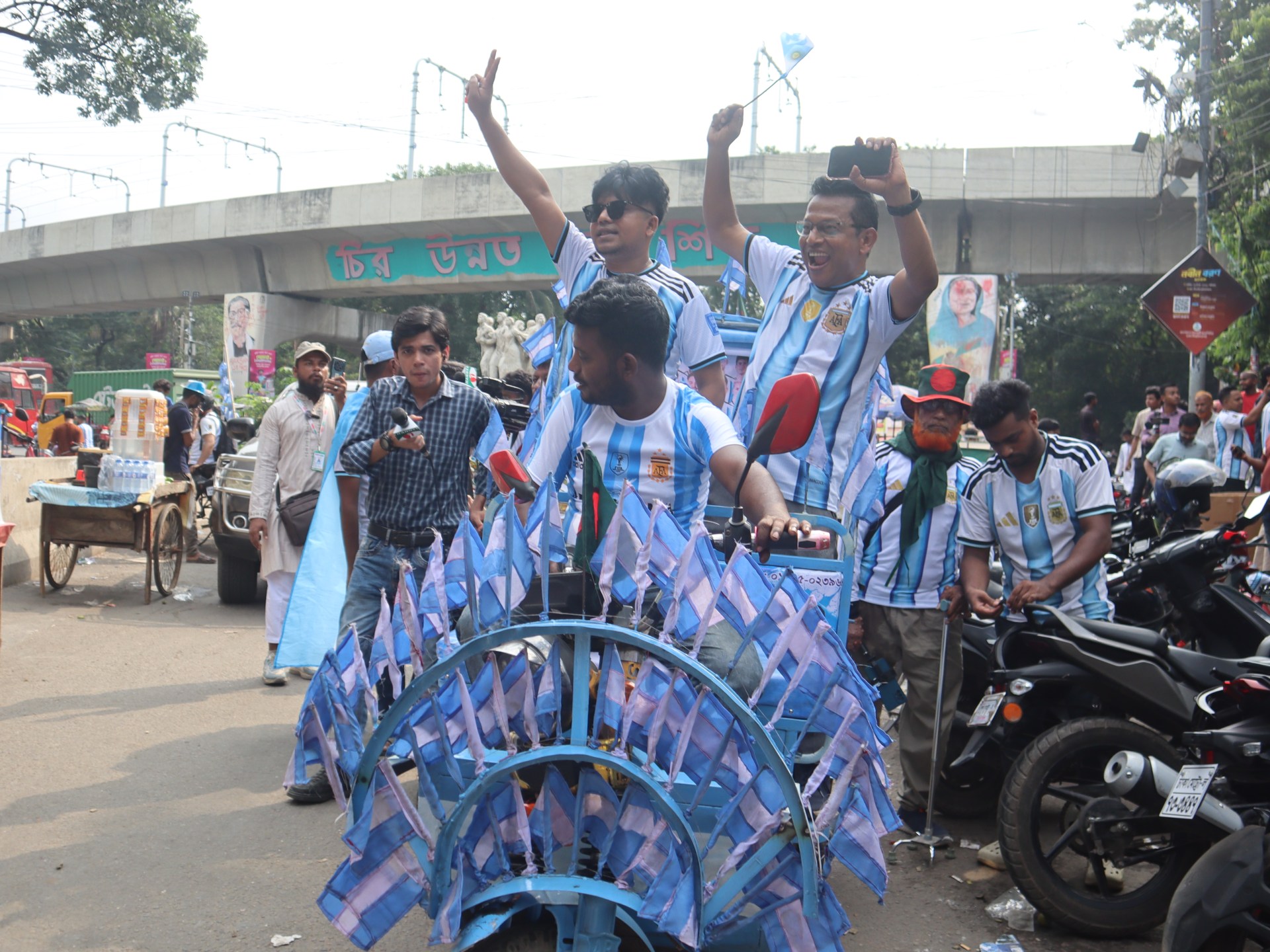
DHAKA, Bangladesh — The giant screen went dark, but thousands of fans were still chanting “Argentina! Argentina! Messi! Messi!” Vuvuzelas blare through the crowd. It was a sea of blue and white.
Moments earlier, Argentina’s talisman Lionel Messi had scored a hat-trick in Argentina’s first World Cup match against Algeria. Young people watching the game on screens wore Argentine flags, climbed on each other’s shoulders, sang and celebrated long after the final whistle.
This could be the scenery of Buenos Aires. This was the reality in Dhaka, the capital of Bangladesh, 17,000 kilometers from the capital of Argentina.
Bangladesh has never qualified for the FIFA World Cup. But every four years, when the Argentine games are played, neighborhoods across the country erupt in celebration. Giant screens will pop up on college campuses and neighborhoods. All-night watch parties are held in apartment complexes, and the streets are filled with the colors of Argentina.
For Abdul Hai, 50, a resident of Dhaka, the journey began long before Messi.
His lifelong dedication to Argentina goes back to the 1986 World Cup, when Diego Maradona led Argentina to the title. “I fell in love with Maradona in 1986,” High said. “Even though I was very young, I saw how people were crazy about him. Everything about his style, his passion, his skills, even his ‘hand of God’ captivated us like no other. He became a legend and a sensation for us.”
Argentina’s next World Cup victory will be less than 36 years later, after Messi took charge in Qatar during the 2022 tournament. “But it was worth the wait,” High said. “After watching Messi host the World Cup, I no longer have any regrets about football. I look at this World Cup with deep joy, instead of the anxiety I felt at previous tournaments.”

Maradona’s magic
Former Bangladesh national football team coach and player Shafiqul Islam Manik said Hai’s story reflects how Argentina’s support first took root across Bangladesh. “From what I’ve seen, it actually started in 1986,” Manik said. “After the Falklands war, Argentina won against England. Then Maradona won the World Cup and everything changed. Watching Maradona’s personal brilliance, Bangladeshi football supporters gradually became Argentina supporters.”
He said Brazil already has a huge fan following thanks to its World Cup victory and iconic soccer players. But “Argentina became a counter to Brazil,” Manic said. “Before that, most people in Bangladesh supported Brazil. After 1986, Argentina started building its own fan base.”
He believes Argentina’s defeat four years later in 1990 only strengthened that bond. “When Maradona couldn’t lift the trophy in 1990 and cried after the final, it touched the hearts of the public here,” he said. “Since then, Argentina’s support has been firmly established.”
This also helps explain why other soccer giants such as Germany and Italy have failed to garner a similar following. “Because Argentina and Brazil already occupied that emotional space,” he said.

Bangladeshi love for Argentina is also attracting attention in foreign policy. Argentina’s ambassador to Bangladesh, Marcelo Carlos Sesa, attended the public screening in Dhaka with fans and celebrated Argentina’s match with the fans.
After Bangladesh’s World Cup celebrations in support of Argentina in 2022 captured the world’s attention, the Buenos Aires government reopened its embassy in Dhaka in 2023, ending a 45-year absence. The mission was closed in 1978 by Argentina’s military dictatorship at the time amid budget cuts.
The move to reopen embassies reflects broader diplomatic and commercial interests, but officials from both countries also point to soccer as a catalyst for closer people-to-people ties.
But the younger generation of Bangladeshi fans are more obsessed with Messi’s tricks than with the memory of Maradona. “I’ve loved Argentina since I was a child, especially because of Messi,” said Dwin Islam, a private sector employee, as hundreds of Argentine supporters gathered in Dhaka for a “welcome rally” hours before the team’s opening game.
Unlike High’s generation, Muslims had never seen Maradona play. Around him, supporters beat drums, waved oversized Argentine flags and sang songs as they marched through the rain-soaked streets before kick-off.
Some inherited their loyalty from their homeland. Mohammad Jahir said his support for Argentina continues through his family. “My father was an Argentina fan and I inherited that support,” he said. “After that, I started to understand soccer myself and fell in love with how they played.”
While the World Cup is being held in the United States, many matches in Bangladesh are being played late at night. Argentina, who topped their group in the 2026 World Cup qualifiers, will play Cape Verde in the round of 32 on June 4th at 4:00 am Bangladesh time.
But times like these did little to deter supporters. “You don’t even need an alarm,” Jahil laughed. “I automatically wake up when Argentina is playing.”

The division between Argentina and Brazil
Sports journalist and commentator Shahanoor Rabbani said Bangladesh’s fascination with Argentina and Brazil also reflected its fascination with sports heroes.
“If you look back at the history of soccer, there are two South American teams that did well during Bangladesh’s independence (1971) and after,” Rabbani said. “Argentina have won the World Cup many times[sincethelate1970s]and so has Brazil. There have always been stars that have drawn people to those teams, from Maradona to Ronaldo to Rivaldo and now Messi and Neymar.
“It’s not just the style of football that matters, but also the players you have. Bangladesh generally likes to have protagonists and heroes, even if it’s a team game.”
For many Bangladeshis, soccer loyalty divides families as much as neighborhoods. Ayman, a 6th grader, is a Brazil supporter. “My brother forced me to come,” he said, clearly reluctant to attend a “welcome rally” in Dhaka ahead of the Argentina-Algeria match. His older brother, Salman, an eighth-grader, laughed. “We sometimes argue at home,” he admitted. “Our father supports Argentina. And our mother supports Brazil.”
Hours later, those conflicts were visible again in front of a giant screen near Dhaka University. As thousands of people celebrated Messi’s hat-trick, a teenage Brazilian supporter stood silently surrounded by a sea of Argentina jerseys. Friends who supported Argentina were making fun of him. “He came to say the game would end in a draw,” one person laughed.
Among those attending the rally was Zubaida Islam Gerin, a young political activist who proudly introduced her cat wearing an Argentina jersey. The cat’s name is Messi.
Nearby, first-year college student Saikat Hasan was still trying to process what he had witnessed. “It feels great,” he said after watching Messi score a hat-trick. His friend Mahiru was already looking ahead. “This time, the World Cup is ours,” he said confidently.

Will Bangladesh qualify for the World Cup?
But what is “we”? It’s a question that troubles journalist Rabbani.
He wonders why Bangladesh’s passion has not translated into success in football. The country ranks 181st in the FIFA rankings for the men’s national team.
“I’m really happy to see their reactions,” he said of the Bangladeshi fans and their reactions to the Argentina and Brazil teams. “But at the same time, it’s disappointing that our football team and our sport in general are so far from where they should be, even though we’re so passionate about it.”
He argued that Bangladesh lacks the necessary systems to turn that passion into success. “There is a lack of stadiums, facilities, academies, and suitable pathways for young people who want to become athletes,” he says. “People have a passion. They want to play. But many simply don’t know how to pursue it.”
Manik, a former national team coach, said Bangladesh once had the foundations of a thriving football culture but was unable to build on that foundation. “We had a lot of quality players, but no one was thinking about developing the next generation or building a proper system,” he said. “Young people are not looking for Bangladesh to qualify for tomorrow’s World Cup. They just want a roadmap and want football to move in the right direction.”
Rabbani cited Bangladesh’s own sports history as evidence that investment can change the national mood. “When Bangladesh qualified for the Cricket World Cup in 1997, the whole country celebrated. When Bangladesh defeated Pakistan in the 1999 (Cricket) World Cup, the whole country celebrated again. It wasn’t just about sports. It felt like Bangladesh had won,” he said.
“If sports can bring such happiness to a country, why shouldn’t we invest more in sports?” he asked.
