

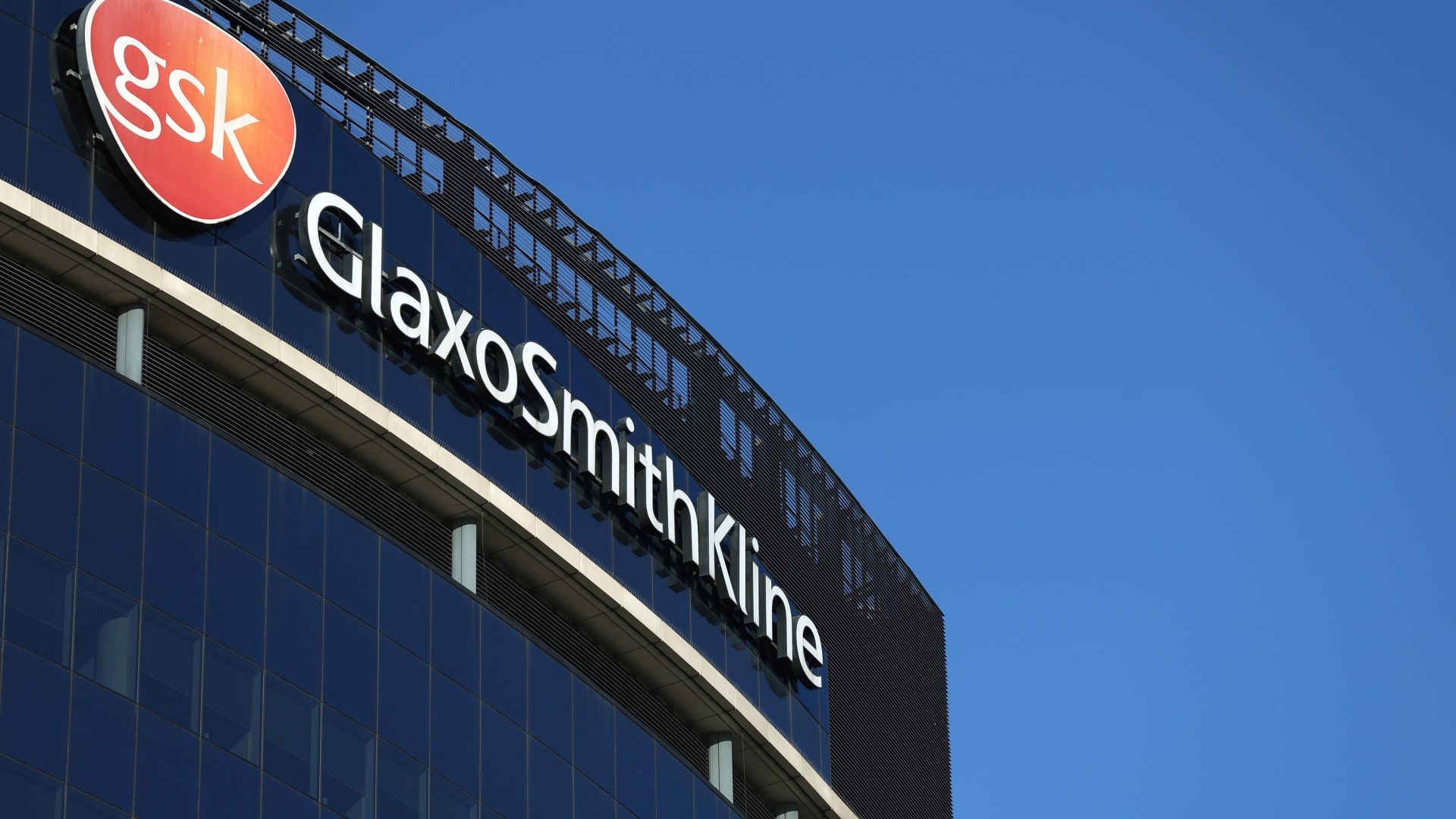
January 17, 2022, GlaxoSmithKline headquarters in London.
Hannah McKay | Reuters
UK’s second largest pharmaceutical company GSK Signed an agreement to acquire a U.S.-based pharmaceutical company valence Acquired for $10.6 billion to strengthen its oncology pipeline, it is the company’s largest acquisition in more than a decade.
The all-cash deal values Nuvalent at about $124 per share, representing a 40% premium over its previous closing price, according to GSK’s Tuesday filing. Nuvalent shares were last trading up 39% in U.S. premarket trading. GSK shares fell 2.6% on the London market.
The Financial Times reported on the deal early Tuesday. Nuvalent did not respond to requests for comment.
Nuvalent is a late-stage oncology biotechnology company focused on a subset of lung cancers with specific genetic mutations. The acquisition is expected to help GSK offset expected revenue declines as its best-selling HIV drug loses exclusivity from 2028.
The deal gives GSK access to Nuvalent’s two late-stage lung cancer treatments, which GSK said has the potential to be a blockbuster. The acquisition also includes early-stage medicines and Nuvalent’s preclinical portfolio of multiple programs.
“This acquisition provides GSK with immediate new revenue growth opportunities,” GSK CEO Luke Miels said in a statement. “These two lead products have the potential to be best-in-class assets and, if approved by the FDA, could be launched this year and could provide important new treatment options for patients with two forms of non-small cell lung cancer.”
Barclays analysts said the deal made conceptual sense as it would add clinically risk-free late-stage assets to GSK’s existing oncology business. However, they questioned the blockbuster status of two late-stage assets, didesamtinib and neradalquib, and said upside was “limited.”
“This acquisition will accelerate GSK’s entry into the lung cancer space,” Barclays said. “More importantly, this contract expansion could help offset the HIV (loss of exclusivity) headwinds starting in mid-2028.
The company said its full-year 2026 outlook for GSK’s core operating profit and core earnings per share growth remains unchanged and it expects the acquisition to contribute to revenue growth from 2027.

GSK
The deal is the second-biggest acquisition in GSK’s history, second only to its 2014 asset swap with Novartis in which it took control of the Swiss drugmaker’s vaccines division in a deal worth $20 billion.
It would also mark a notable departure from the smaller deals the company has focused on in recent years.
Miels, who took over from long-time boss Emma Walmsley earlier this year, told investors in February that he would focus on “low-profile” deals in the 2 billion pound ($2.67 billion) to 4 billion pound range.
Mr. Miels is tasked with overhauling a company that has struggled to overcome investor concerns about its drug pipeline. Since Miels’ appointment was announced in September, GSK’s share price has risen about 29%.
Nuvalent’s main asset, neradalquib, a treatment that targets certain types of lung cancer, is currently undergoing FDA review with a November 27 deadline.
The company also has a new drug application under FDA review for didesamtinib for patients with a type of cancer known as ROS1-positive non-small cell lung cancer.
In a January note to investors, CGS International analysts estimated that if approved, neradalquib and didesamtinib could generate combined annual revenue of $823 million in fiscal 2029.
The deal also comes amid a frenzy in biotech deals, driven by a looming patent cliff, a newly booming public market and big pharmaceutical companies racing to shore up their pipelines. Global biotech deals will reach $106 billion across 201 deals by 2026, according to PitchBook data, putting the sector on track for its strongest year since its pre-pandemic peak.
