

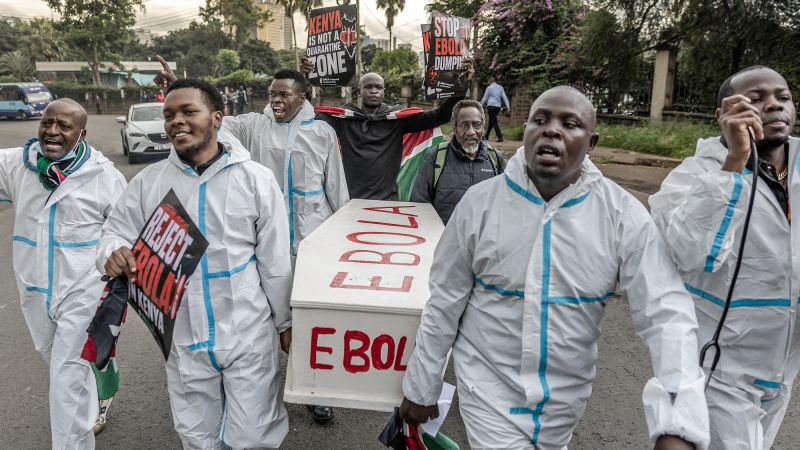
“Kenya is not an American colony!”
That was the chorus echoing in Nairobi and other Kenyan cities last week as angry protesters vented their anger over a U.S.-funded isolation ward program for Americans exposed to Ebola abroad.
The controversial proposal raised concerns that Ebola could enter the country, which has never recorded a case of the deadly disease. The closest outbreaks are more than 2,500 miles away in eastern Democratic Republic of the Congo (DRC), where Ebola was first detected, and neighboring Uganda.
Critics argue that the facility would expose Kenya to risks that the United States would not accept on its territory. Despite a court order halting construction of the hospital pending a legal challenge, the Kenyan government, which recently signed a $1.6 billion health deal with the United States, continues to support the plan, fueling a public backlash.
President William Ruto defended the decision, saying it would be “extremely inhumane” for Kenya, which has long received US aid, to deny US-funded facilities.
But Ruto’s former deputy Ligasi Gachagua, who was impeached in 2024, told CNN that the plan reveals double standards on the US side and should be resisted.

“If Americans are reluctant to take care of their own patients in their own country because it’s dangerous to the rest of the population, then Americans will decide they can do it in Kenya,” Gachagua said. “We think it’s unfair, it’s a double standard, and we’re completely against it.”
He added that the deal was “totally insensitive” and prioritized US interests over Kenyan concerns.
The dispute reflects a broader trend across Africa, with countries increasingly pushing back against what critics describe as Washington’s deal-making approach under President Donald Trump and deals seen as favoring U.S. interests.
Much of that backlash stems from changes in Washington’s approach to Africa.
When Trump returned to office last year, he cut off nearly all foreign aid and canceled thousands of aid contracts. The move marked the beginning of the dismantling of the United States Agency for International Development (USAID), with critical health and humanitarian funding cut around the world, including in Africa, one of the largest recipients of U.S. aid.

For decades, U.S. funding has supported the fight against HIV/AIDS, malaria, and tuberculosis across the continent. These plans are now being replaced by President Trump’s America First Global Health Strategy, which prioritizes direct trade with countries. The U.S. government says the goal is to reduce aid dependence while promoting U.S. interests.
But as aid is replaced by deals, questions are growing about what African countries are expected to offer in return.
The United States has signed new health deals with at least 16 African countries, but disagreements over the terms have stalled some.
Last month, Zambia’s Foreign Minister Mlambo Heimbe said his country was reluctant to accept a proposed $2 billion health package because it required “preferential treatment of American companies over Zambia’s critical minerals” and “sharing of data that would violate citizens’ privacy rights.”
Zambia is a major producer of copper, a key material used in renewable energy, electric vehicles and the power grid.

Heimbe’s comments followed criticism from outgoing U.S. Ambassador Michael Gonzalez, who accused Zambia’s leaders of relying on U.S.-funded health care and not investing enough in themselves.
Gonzalez denied that Washington was linking medical aid to access to critical minerals. But he also said: “Going forward, our relationship must be mutually beneficial.”
Zambia is not alone. Similar concerns are occurring elsewhere on the continent.
Zimbabwe and Ghana also oppose the proposed multi-million dollar deal, which includes requirements for sharing health data.
“We need an open-ended partnership,” Ghana’s Health Minister Kwabena Minta Akandoh told reporters last month.
Zimbabwe government spokesperson Nick Mangwana said Zimbabwe was being asked to “share biological resources and data on a long-term basis, without access to any resulting vaccines or treatments or guarantees of reciprocity from Washington.”
“Development aid should empower nations, not create dependencies or serve as a vehicle for strategic exploitation,” Mangwana wrote in a blog post in February.
Peace agreements and mineral interests

These concerns extend beyond health partnerships to the mining and critical mineral sectors.
In the Democratic Republic of the Congo (DRC), critics are questioning whether Washington’s diplomatic efforts to end decades of conflict in the mineral-rich east are driven by genuine security concerns. The region is home to some of the world’s largest deposits of coltan, which is used in smartphones and other electronic devices.
Victor Tesongo, a social rights activist and leader of the AFC rebel coalition fighting the Congolese army, told CNN that the United States cannot be considered neutral while seeking access to the Democratic Republic of Congo’s strategic resources.
Those concerns were heightened after President Trump invited Democratic Republic of Congo President Felix Shisekedi and Rwandan President Paul Kagame to Washington in December to sign a peace deal aimed at ending the conflict.
Tesongo dismissed the agreement as a resource grab.
“The Trump plan has nothing to do with security or restoring peace. Rather, it is about plundering Congo’s resources,” he claimed. “The proof is that the situation has not changed since the signing in the United States and the fighting continues.”
The United States insists its involvement is aimed at promoting regional security.
Taken together, the conflicts in Kenya, Zambia, Ghana, Zimbabwe, and the Democratic Republic of the Congo suggest far-reaching changes in the way African countries engage with external partners.
According to Solomon Delso, founding director of Pan-African policy think tank Amani Africa, there is nothing new for the United States to pursue its own strategic interests. The difference, he said, is that it’s happening “more blatantly and openly.”
For Oxfam’s Zambia representative in Southern Africa, Chitimbwa Chifunda, this shift highlights the need for African countries to reduce their dependence on foreign aid.
“The days of waiting for aid are rapidly passing away,” she said, adding that in recent negotiations African governments have increasingly shown a willingness to push back and protect their interests.
Simon Mhlongo, former African Union special envoy for Somalia and the Sahel, sees a similar trend, arguing that the debate is no longer about whether Africa should partner with world powers, but on what terms.
“African countries are no longer willing to quietly transfer strategic assets under the rubric of aid, partnership and emergency assistance,” he told CNN, adding that “health cooperation must not become a backdoor to the extraction of national data” and security partnerships “must not become a path to mineral extraction.”
“This is not isolationism. This is a demand for a fair exchange.”
